

42 Origin and Morphology of Ocean Margins
well layered or strongly defonned, depending on the tectonic forces active at the
margin.
The ocean margins, that is, the regions of transition between continent and deep
ocean, differ greatly in their characteristics, depending on whether they occur in
mid-plate areas (on the continent's trailing edge), or on the collision edge of a continent, or along a shear zone. The one thing most of the ocean margins have in
common is the occurrence of large masses of sediment. Ocean margins are generally
referred to as continental margins - a reflection of our landlubber point of view.
The importance of the continental margins in the overall geography of the ocean floor
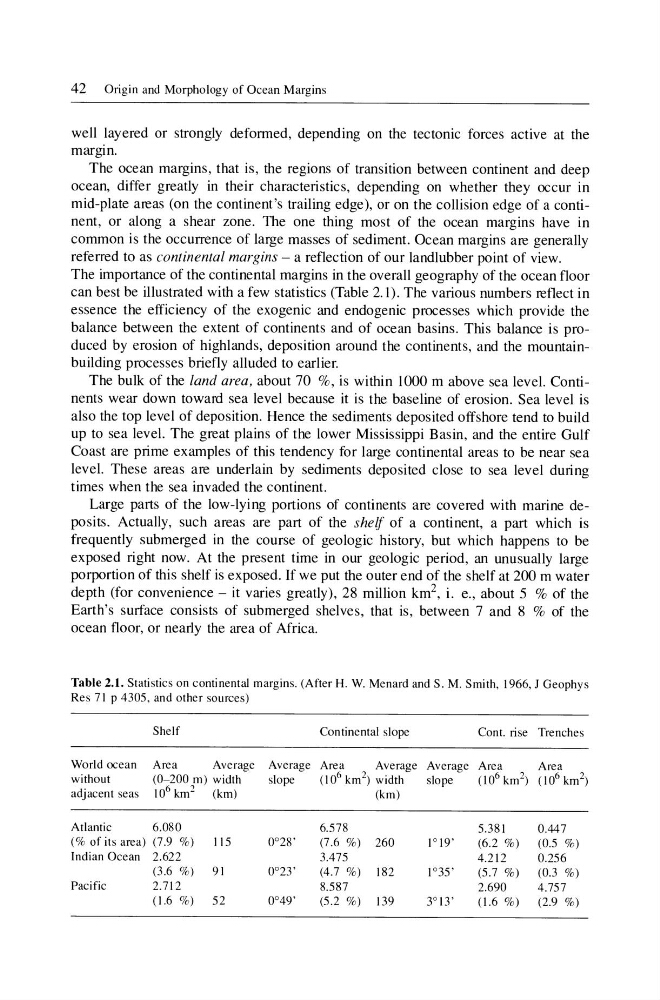
can best be illustrated with a few statistics (Table 2.1). The various numbers reflect in
essence the efficiency of the exogenic and endogenic processes which provide the
balance between the extent of continents and of ocean basins. This balance is produced by erosion of highlands, deposition around the continents, and the mountainbuilding processes briefly alluded to earlier.
The bulk of the land area, about 70 %, is within 1000 m above sea level. Continents wear down toward sea level because it is the baseline of erosion. Sea level is
also the top level of deposition. Hence the sediments deposited offshore tend to build
up to sea level. The great plains of the lower Mississippi Basin, and the entire Gulf
Coast are prime examples of this tendency for large continental areas to be near sea
level. These areas are underlain by sediments deposited close to sea level during
times when the sea invaded the continent.
Large parts of the low-lying portions of continents are covered with marine deposits. Actually, such areas are part of the shelf of a continent, a part which is
frequently submerged in the course of geologic history, but which happens to be
exposed right now. At the present time in our geologic period, an unusually large
porportion of this shelf is exposed. If we put the outer end of the shelf at 200 m water
depth (for convenience - it varies greatly), 28 million km 2 , i. e., about 5 % of the
Earth's surface consists of submerged shelves, that is, between 7 and 8 % of the
ocean floor, or nearly the area of Africa.
Table 2.1. Statistics on continental margins. (After H. W. Menard and S. M. Smith, 1966, J Geophys
Res 71 p 4305. and other sources)
Shelf
Continental slope
Cont. rise Trenches
World ocean Area
Average Average Area
Average Average Area
Area
without
(0~200 m) width
slope
(10 6 km 2 ) width
slope
(10 6 km 2 ) (10 6 km 2 )
adjacent seas 10 6 km 2 (km)
(km)
Atlantic
6.080
6.578
5.381
0.447
(% of its area) (7.9 %)
115
0°28'
(7.6 %) 260
1° 19'
(6.2 %)
(0.5 %)
Indian Ocean 2.622
3.475
4.212
0.256
(3.6 %)
91
0°23'
(4.7 %) 182
1°35'
(5.7 %)
(0.3 %)
Pacific
2.712
8.587
2.690
4.757
(1.6 %)
52
0°49'
(5.2 %) 139
3° 13'
(1.6 %)
(2.9 %)
well layered or strongly defonned, depending on the tectonic forces active at the
margin.
The ocean margins, that is, the regions of transition between continent and deep
ocean, differ greatly in their characteristics, depending on whether they occur in
mid-plate areas (on the continent's trailing edge), or on the collision edge of a continent, or along a shear zone. The one thing most of the ocean margins have in
common is the occurrence of large masses of sediment. Ocean margins are generally
referred to as continental margins - a reflection of our landlubber point of view.
The importance of the continental margins in the overall geography of the ocean floor
can best be illustrated with a few statistics (Table 2.1). The various numbers reflect in
essence the efficiency of the exogenic and endogenic processes which provide the
balance between the extent of continents and of ocean basins. This balance is produced by erosion of highlands, deposition around the continents, and the mountainbuilding processes briefly alluded to earlier.
The bulk of the land area, about 70 %, is within 1000 m above sea level. Continents wear down toward sea level because it is the baseline of erosion. Sea level is
also the top level of deposition. Hence the sediments deposited offshore tend to build
up to sea level. The great plains of the lower Mississippi Basin, and the entire Gulf
Coast are prime examples of this tendency for large continental areas to be near sea
level. These areas are underlain by sediments deposited close to sea level during
times when the sea invaded the continent.
Large parts of the low-lying portions of continents are covered with marine deposits. Actually, such areas are part of the shelf of a continent, a part which is
frequently submerged in the course of geologic history, but which happens to be
exposed right now. At the present time in our geologic period, an unusually large
porportion of this shelf is exposed. If we put the outer end of the shelf at 200 m water
depth (for convenience - it varies greatly), 28 million km 2 , i. e., about 5 % of the
Earth's surface consists of submerged shelves, that is, between 7 and 8 % of the
ocean floor, or nearly the area of Africa.
Table 2.1. Statistics on continental margins. (After H. W. Menard and S. M. Smith, 1966, J Geophys
Res 71 p 4305. and other sources)
Shelf
Continental slope
Cont. rise Trenches
World ocean Area
Average Average Area
Average Average Area
Area
without
(0~200 m) width
slope
(10 6 km 2 ) width
slope
(10 6 km 2 ) (10 6 km 2 )
adjacent seas 10 6 km 2 (km)
(km)
Atlantic
6.080
6.578
5.381
0.447
(% of its area) (7.9 %)
115
0°28'
(7.6 %) 260
1° 19'
(6.2 %)
(0.5 %)
Indian Ocean 2.622
3.475
4.212
0.256
(3.6 %)
91
0°23'
(4.7 %) 182
1°35'
(5.7 %)
(0.3 %)
Pacific
2.712
8.587
2.690
4.757
(1.6 %)
52
0°49'
(5.2 %) 139
3° 13'
(1.6 %)
(2.9 %)