

Seamounts, Island Chains, and Hot Spots
31
_
a)
- c )
--- d)
_
e)
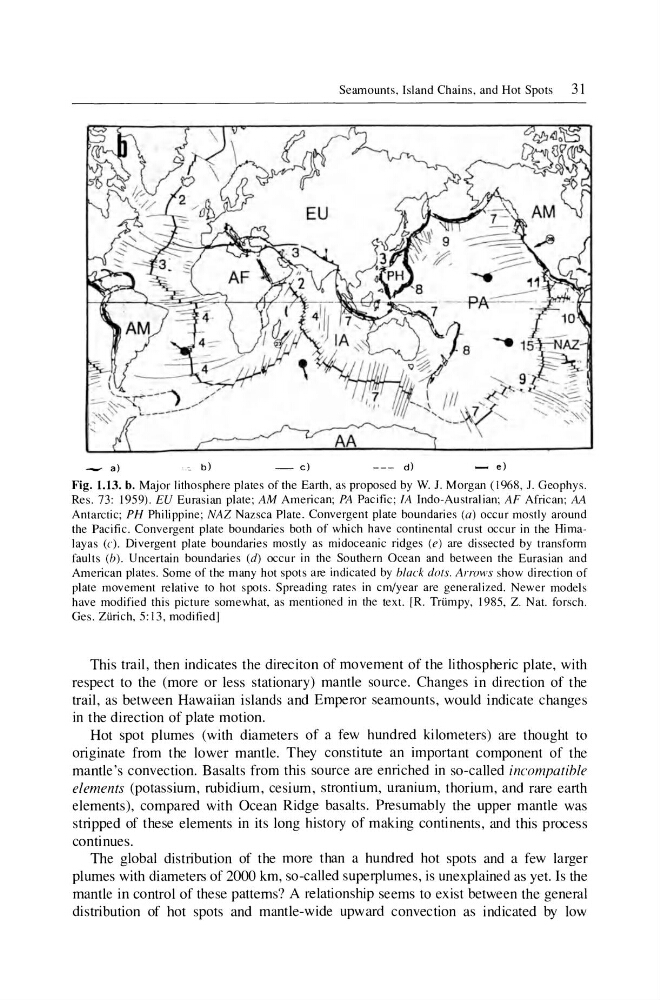
Fig, Ll3. b. Major lithosphere plates of the Earth, as proposed by W. J. Morgan (1968, J. Geophys.
Res. 73: 1959). EU Eurasian plate; AM American; PA Pacific; fA Indo-Australian; AF African; AA
Antarctic; PH Philippine; NAZ Nazsca Plate. Convergent plate boundaries (a) occur mostly around
the Pacific. Convergent plate boundaries both of which have continental crust occur in the Himalayas (c). Divergent plate boundaries mostly as midoceanic ridges (e) are dissected by transfonm
faults (b). Uncertain boundaries (d) occur in the Southern Ocean and between the Eurasian and
American plates. Some of the many hot spots are indicated by black dols. Arrows show direction of
plate movement relative to hot spots. Spreading rates in em/year are generalized. Newer models
have modified this picture somewhat, as mentioned in the text. [R. TrUmpy, 1985, Z. Nat. forsch.
Ges. ZUrich, 5: 13 , modified]
This trail, then indicates the direciton of movement of the lithospheric plate, with
respect to the (more or less stationary) mantle source. Changes in direction of the
trail, as between Hawaiian islands and Emperor seamounts, would indicate changes
in the direction of plate motion,
Hot spot plumes (with diameters of a few hundred kilometers) are thought to
originate from the lower mantle. They constitute an important component of the
mantle's convection. Basalts from this source are enriched in so-called incompatible
elements (potassium, rubidium, cesium, strontium, uranium, thorium, and rare earth
elements), compared with Ocean Ridge basalts. Presumably the upper mantle was
stripped of these elements in its long history of making continents, and this process
continues.
The global distribution of the more than a hundred hot spots and a few larger
plumes with diameters of 2000 km, so-called superplumes, is unexplained as yet. Is the
mantle in control of these pattems? A relationship seems to exist between the general
distribution of hot spots and mantle-wide upward convection as indicated by low
31
_
a)
- c )
--- d)
_
e)
Fig, Ll3. b. Major lithosphere plates of the Earth, as proposed by W. J. Morgan (1968, J. Geophys.
Res. 73: 1959). EU Eurasian plate; AM American; PA Pacific; fA Indo-Australian; AF African; AA
Antarctic; PH Philippine; NAZ Nazsca Plate. Convergent plate boundaries (a) occur mostly around
the Pacific. Convergent plate boundaries both of which have continental crust occur in the Himalayas (c). Divergent plate boundaries mostly as midoceanic ridges (e) are dissected by transfonm
faults (b). Uncertain boundaries (d) occur in the Southern Ocean and between the Eurasian and
American plates. Some of the many hot spots are indicated by black dols. Arrows show direction of
plate movement relative to hot spots. Spreading rates in em/year are generalized. Newer models
have modified this picture somewhat, as mentioned in the text. [R. TrUmpy, 1985, Z. Nat. forsch.
Ges. ZUrich, 5: 13 , modified]
This trail, then indicates the direciton of movement of the lithospheric plate, with
respect to the (more or less stationary) mantle source. Changes in direction of the
trail, as between Hawaiian islands and Emperor seamounts, would indicate changes
in the direction of plate motion,
Hot spot plumes (with diameters of a few hundred kilometers) are thought to
originate from the lower mantle. They constitute an important component of the
mantle's convection. Basalts from this source are enriched in so-called incompatible
elements (potassium, rubidium, cesium, strontium, uranium, thorium, and rare earth
elements), compared with Ocean Ridge basalts. Presumably the upper mantle was
stripped of these elements in its long history of making continents, and this process
continues.
The global distribution of the more than a hundred hot spots and a few larger
plumes with diameters of 2000 km, so-called superplumes, is unexplained as yet. Is the
mantle in control of these pattems? A relationship seems to exist between the general
distribution of hot spots and mantle-wide upward convection as indicated by low