

30 Origin and Morphology of Ocean Basins
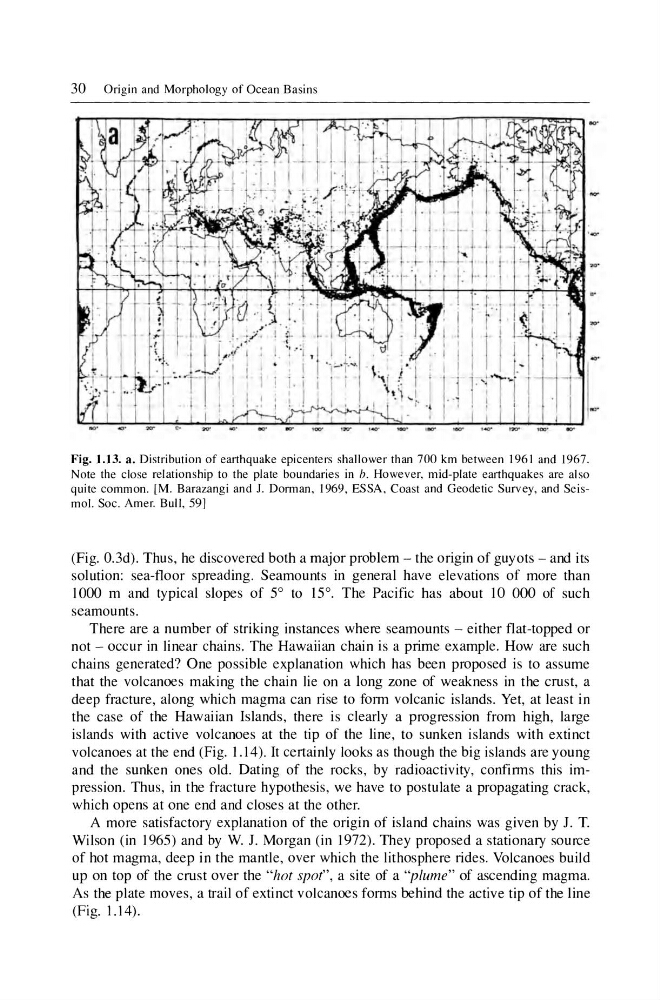
Fig. 1.13. a. Distribution of earthquake epicenters shallower than 700 km between 1961 and 1967.
Note the close relationship to the plate boundaries in b. However, mid-plate earthquakes are also
quite common. [M. Barazangi and J. Dorman, 1969, ESSA, Coast and Geodetic Survey, and Seismol. Soc. Amer. Bull, 59]
(Fig. 0.3d). Thus, he discovered both a major problem - the origin of guyots - and its
solution: sea-floor spreading. Seamounts in general have elevations of more than
1000 m and typical slopes of 5° to 15°. The Pacific has about 10 000 of such
seamounts.
There are a number of striking instances where seamounts - either flat-topped or
not - occur in linear chains. The Hawaiian chain is a prime example. How are such
chains generated? One possible explanation which has been proposed is to assume
that the volcanoes making the chain lie on a long zone of weakness in the crust, a
deep fracture, along which magma can rise to form volcanic islands. Yet, at least in
the case of the Hawaiian Islands, there is clearly a progression from high, large
islands with active volcanoes at the tip of the line , to sunken islands with extinct
volcanoes at the end (Fig. 1.14). It certainly looks as though the big islands are young
and the sunken ones old. Dating of the rocks, by radioactivity, confirms this impression. Thus, in the fracture hypothesis, we have to postulate a propagating crack,
which opens at one end and closes at the other.
A more satisfactory explanation of the origin of island chains was given by J. T.
Wilson (in 1965) and by W. J. Morgan (in 1972). They proposed a stationary source
of hot magma, deep in the mantle, over which the lithosphere rides. Volcanoes build
up on top of the crust over the "hot spot", a site of a "plume" of ascending magma.
As the plate moves, a trail of extinct volcanoes forms behind the active tip of the line
(Fig. 1.14).
Fig. 1.13. a. Distribution of earthquake epicenters shallower than 700 km between 1961 and 1967.
Note the close relationship to the plate boundaries in b. However, mid-plate earthquakes are also
quite common. [M. Barazangi and J. Dorman, 1969, ESSA, Coast and Geodetic Survey, and Seismol. Soc. Amer. Bull, 59]
(Fig. 0.3d). Thus, he discovered both a major problem - the origin of guyots - and its
solution: sea-floor spreading. Seamounts in general have elevations of more than
1000 m and typical slopes of 5° to 15°. The Pacific has about 10 000 of such
seamounts.
There are a number of striking instances where seamounts - either flat-topped or
not - occur in linear chains. The Hawaiian chain is a prime example. How are such
chains generated? One possible explanation which has been proposed is to assume
that the volcanoes making the chain lie on a long zone of weakness in the crust, a
deep fracture, along which magma can rise to form volcanic islands. Yet, at least in
the case of the Hawaiian Islands, there is clearly a progression from high, large
islands with active volcanoes at the tip of the line , to sunken islands with extinct
volcanoes at the end (Fig. 1.14). It certainly looks as though the big islands are young
and the sunken ones old. Dating of the rocks, by radioactivity, confirms this impression. Thus, in the fracture hypothesis, we have to postulate a propagating crack,
which opens at one end and closes at the other.
A more satisfactory explanation of the origin of island chains was given by J. T.
Wilson (in 1965) and by W. J. Morgan (in 1972). They proposed a stationary source
of hot magma, deep in the mantle, over which the lithosphere rides. Volcanoes build
up on top of the crust over the "hot spot", a site of a "plume" of ascending magma.
As the plate moves, a trail of extinct volcanoes forms behind the active tip of the line
(Fig. 1.14).