

32 Origin and Morphology of Ocean Basins
a
EXT INC T VOLCANOES
STATIONARY MANTLE
PLUME (HOT SPOT)
10;60~' :------;;!1 ..
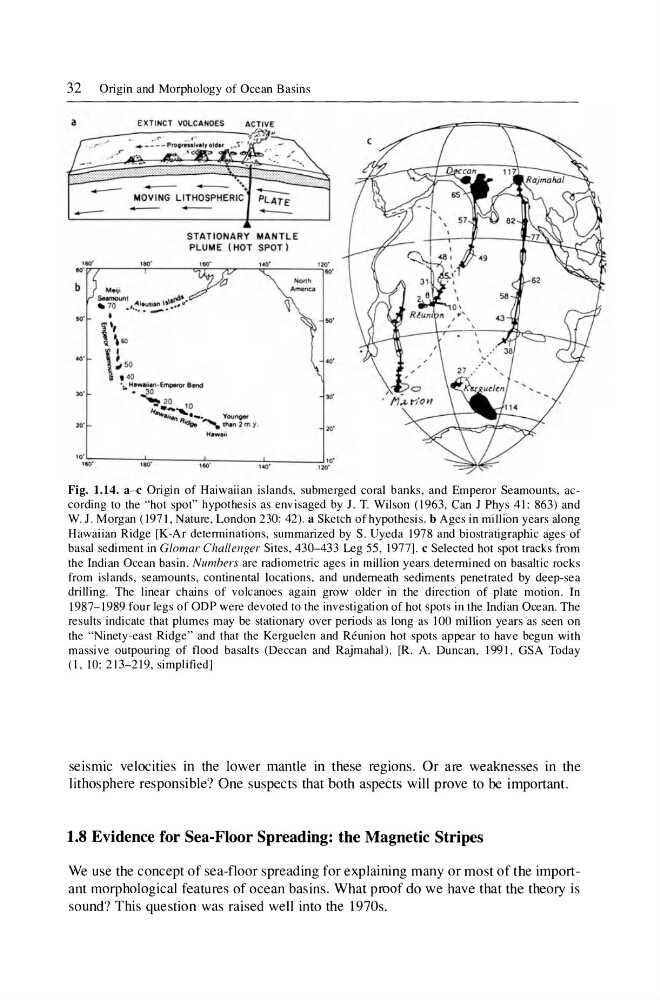
W. J. Morgan (1971, Nature, London 230: 42). a Sketch of hypothesis. b Ages in million years along
Hawaiian Ridge [K-Ar determinations, summarized by S. Uyeda 1978 and biostratigraphic ages of
basal sediment in Glomar Challellf!.er Sites, 430-433 Leg 55 , 1977]. c Selected hot spot tracks from
the Indian Ocean basin. Numbers are radiometric ages in million years determined on basaltic rocks
from islands, seamounts, continental locations, and underneath sediments penetrated by deep-sea
drilling. The linear chains of volcanoes again grow older in the direction of plate motion. In
1987-1989 four legs of ODP were devoted to the investigation of hot spots in the Indian Ocean. The
results indicate that plumes may be stationary over periods as long as 100 million years as seen on
the "Ninety-east Ridge" and that the Kerguelen and Reunion hot spots appear to have begun with
massive outpouring of flood basalts (Deccan and Rajmahal). [R. A. Duncan, 1991, GSA Today
(1,10: 213-219, simplified]
seismic velocities in the lower mantle in these regions. Or are weaknesses in the
lithosphere responsible? One suspects that both aspects will prove to be important.
1.8 Evidence for Sea-Floor Spreading: the Magnetic Stripes
We use the concept of sea-floor spreading for explaining many or most of the important morphological features of ocean basins. What proof do we have that the theory is
sound? This question was raised well into the 1970s.
a
EXT INC T VOLCANOES
STATIONARY MANTLE
PLUME (HOT SPOT)
10;60~' :------;;!1 ..
W. J. Morgan (1971, Nature, London 230: 42). a Sketch of hypothesis. b Ages in million years along
Hawaiian Ridge [K-Ar determinations, summarized by S. Uyeda 1978 and biostratigraphic ages of
basal sediment in Glomar Challellf!.er Sites, 430-433 Leg 55 , 1977]. c Selected hot spot tracks from
the Indian Ocean basin. Numbers are radiometric ages in million years determined on basaltic rocks
from islands, seamounts, continental locations, and underneath sediments penetrated by deep-sea
drilling. The linear chains of volcanoes again grow older in the direction of plate motion. In
1987-1989 four legs of ODP were devoted to the investigation of hot spots in the Indian Ocean. The
results indicate that plumes may be stationary over periods as long as 100 million years as seen on
the "Ninety-east Ridge" and that the Kerguelen and Reunion hot spots appear to have begun with
massive outpouring of flood basalts (Deccan and Rajmahal). [R. A. Duncan, 1991, GSA Today
(1,10: 213-219, simplified]
seismic velocities in the lower mantle in these regions. Or are weaknesses in the
lithosphere responsible? One suspects that both aspects will prove to be important.
1.8 Evidence for Sea-Floor Spreading: the Magnetic Stripes
We use the concept of sea-floor spreading for explaining many or most of the important morphological features of ocean basins. What proof do we have that the theory is
sound? This question was raised well into the 1970s.