

A9 Systematic Overvciew of Marine Organisms
331
Hemichordata (pterobranch and acorn worms; pterobranchia are common on the sea floor over a large
depth range, tube-building species colony-forming in
places; acom worms are common in soft sediment,
mainly on shelf).
Worms are important in reworking and processing
surface sediment, and in subsurface irrigation of the
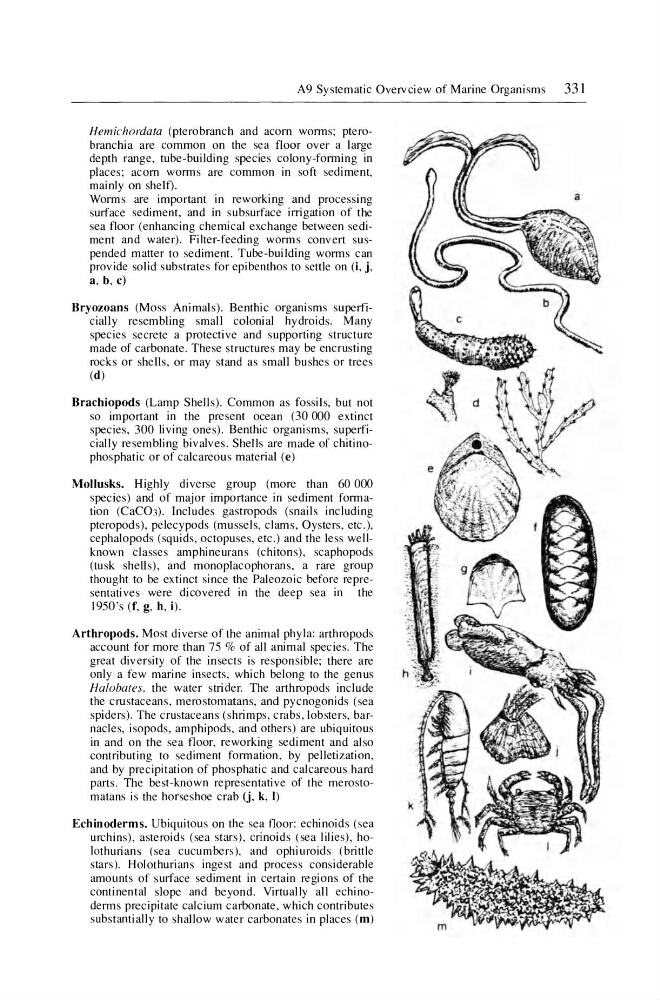
sea floor (enhancing chemical exchange between sediment and water). Filter-feeding worms convert suspended matter to sediment. Tube-building worms can
provide solid substrates for epi benthos to settle on (i , j,
a, b, c)
Bryozoans (Moss Animals). Benthic organisms superficially resembling small colonial hydroids. Many
species secrete a protective and supporting structure
made of carbonate. These structures may be encrusting
rocks or shells, or may stand as small bushes or trees
(d)
Brachiopods (Lamp Shells). Common as fossils, but not
so important in the present ocean (30 000 extinct
species, 300 living ones). Benthic organisms, superficially resembling bivalves . Shells are made of chitinophosphatic or of calcareous material (e)
Mollusks. Highly diverse group (more than 60000
species) and of major importance in sediment formation (CaC03). Includes gastropods (snails including
pteropods), pelecypods (mussels, clams, Oysters, etc .),
cephalopods (squids, octopuses, etc.) and the less wellknown classes amphineurans (chitons), scaphopods
(tusk shells), and monoplacophorans, a rare group
thought to be extinct since the Paleozoic before representatives were dicovered in the deep sea in the
1950's (r, g. h, i).
Arthropods. Most diverse of the animal phyla: arthropods
account for more than 75 % of all animal species. The
great diversity of the insects is responsible; there are
only a few marine insects, which belong to the genus
Halobales. the water strider. The arthropods include
the crustaceans, merostomatans, and pycnogonids (sea
spiders). The crustaceans (shrimps, crabs, lobsters, barnacles, isopods, amphipods, and others) are ubiquitous
in and on the sea /loor, reworking sediment and also
contributing to sediment fonnation. by pelletization.
and by precipitation of phosphatic and calcareous hard
parts. The best-known representative of the merostomatans is the horseshoe crab U, k, I)
Echinoderms. Ubiquitous on the sea floor: echinoids (sea
urchins), asteroids (sea stars), crinoids (sea lilies), holothurians (sea cucumbers). and ophiuroids (brittle
stars). Holothurians ingest and process considerable
amounts of surface sediment in certain regions of the
continental slope and beyond. Virtually all echinoderms precipitate calcium carbonate, which contributes
substantially to shallow water carbonates in places (m)
331
Hemichordata (pterobranch and acorn worms; pterobranchia are common on the sea floor over a large
depth range, tube-building species colony-forming in
places; acom worms are common in soft sediment,
mainly on shelf).
Worms are important in reworking and processing
surface sediment, and in subsurface irrigation of the
sea floor (enhancing chemical exchange between sediment and water). Filter-feeding worms convert suspended matter to sediment. Tube-building worms can
provide solid substrates for epi benthos to settle on (i , j,
a, b, c)
Bryozoans (Moss Animals). Benthic organisms superficially resembling small colonial hydroids. Many
species secrete a protective and supporting structure
made of carbonate. These structures may be encrusting
rocks or shells, or may stand as small bushes or trees
(d)
Brachiopods (Lamp Shells). Common as fossils, but not
so important in the present ocean (30 000 extinct
species, 300 living ones). Benthic organisms, superficially resembling bivalves . Shells are made of chitinophosphatic or of calcareous material (e)
Mollusks. Highly diverse group (more than 60000
species) and of major importance in sediment formation (CaC03). Includes gastropods (snails including
pteropods), pelecypods (mussels, clams, Oysters, etc .),
cephalopods (squids, octopuses, etc.) and the less wellknown classes amphineurans (chitons), scaphopods
(tusk shells), and monoplacophorans, a rare group
thought to be extinct since the Paleozoic before representatives were dicovered in the deep sea in the
1950's (r, g. h, i).
Arthropods. Most diverse of the animal phyla: arthropods
account for more than 75 % of all animal species. The
great diversity of the insects is responsible; there are
only a few marine insects, which belong to the genus
Halobales. the water strider. The arthropods include
the crustaceans, merostomatans, and pycnogonids (sea
spiders). The crustaceans (shrimps, crabs, lobsters, barnacles, isopods, amphipods, and others) are ubiquitous
in and on the sea /loor, reworking sediment and also
contributing to sediment fonnation. by pelletization.
and by precipitation of phosphatic and calcareous hard
parts. The best-known representative of the merostomatans is the horseshoe crab U, k, I)
Echinoderms. Ubiquitous on the sea floor: echinoids (sea
urchins), asteroids (sea stars), crinoids (sea lilies), holothurians (sea cucumbers). and ophiuroids (brittle
stars). Holothurians ingest and process considerable
amounts of surface sediment in certain regions of the
continental slope and beyond. Virtually all echinoderms precipitate calcium carbonate, which contributes
substantially to shallow water carbonates in places (m)