

330 Appendix
~
• •
j
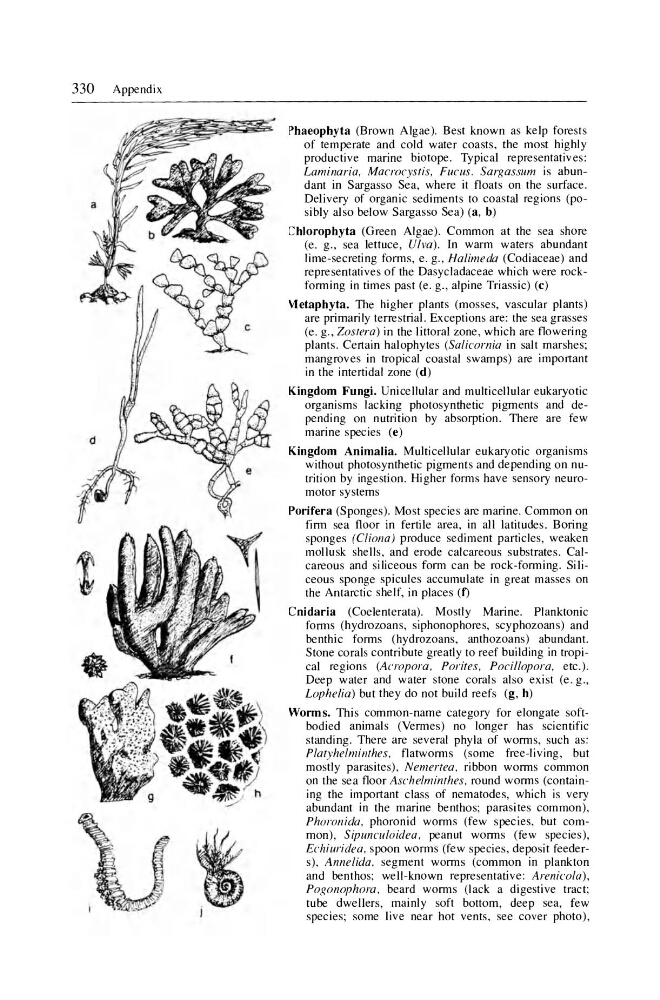
Phaeophyta (Brown Algae). Best known as kelp forests
of temperate and cold water coasts, the most highly
productive marine biotope. Typical representatives:
Laminaria, Macrocystis, Fucus. Sargassum is abundant in Sargasso Sea, where it floats on the surface.
Delivery of organic sediments to coastal regions (posibly also below Sargasso Sea) (a, b)
Chlorophyta (Green Algae). Common at the sea shore
(e. g. , sea lettuce, VIva). In warm waters abundant
lime-secreting forms, e. g., Halimeda (Codiaceae) and
representatives of the Dasycladaceae which were rockforming in times past (e . g., alpine Triassic) (e)
Vletaphyta. The higher plants (mosses, vascular plants)
are primari Iy terrestrial. Exceptions are: the sea grasses
(e. g., Zostera) in the littoral zone, which are flowering
plants. Certain halophytes (Salicornia in salt marshes;
mangroves in tropical coastal swamps) are important
in the intertidal zone (d)
Kingdom Fungi. Unicellular and multicellular eukaryotic
organisms lacking photosynthetic pigments and depending on nutrition by absorption. There are few
marine species (e)
Kingdom Animalia. Multicellular eukaryotic organisms
without photosynthetic pigments and depending on nutrition by ingestion. Higher forms have sensory neuromotor systems
Porifera (Sponges). Most species are marine. Common on
firm sea floor in fertile area, in all latitudes . Boring
sponges (Cliona) produce sediment particles, weaken
mollusk shells, and erode calcareous substrates. Calcareous and siliceous form can be rock-forming. Siliceous sponge spicules accumulate in great masses on
the Antarctic shelf, in places (f)
Cnidaria (Coelenterata). Mostly Marine. Planktonic
forms (hydrozoans, siphonophores, scyphozoans) and
benthic forms (hydrozoans, anthozoans) abundant.
Stone corals contribute greatly to reef building in tropical regions (Acropora, Porites, Pocil/opora, etc.).
Deep water and water stone corals also exist (e . g.,
Lophe/ia) but they do not build reefs (g, h)
Worms. This common-name category for elongate softbodied animals (Vermes) no longer has scientific
standing. There are several phyla of worms, such as:
Platyhelminthes. flatworms (some free-living, but
mostly parasites), Nemertea. ribbon worms common
on the sea floor Aschelminthes, round worms (containing the important class of nematodes, which is very
abundant in the marine benthos; parasites common),
Phoronida, phoronid worms (few species, but common), Sipunculoidea, peanut worms (few species),
Echiuridea, spoon worms (few species, deposit feeders), Annelida, segment worms (common in plankton
and benthos; well-known representative: Arenicola),
POfionophora , beard worms (lack a digestive tract;
tube dwellers, mainly soft bottom, deep sea, few
species; some live near hot vents, see cover photo),
~
• •
j
Phaeophyta (Brown Algae). Best known as kelp forests
of temperate and cold water coasts, the most highly
productive marine biotope. Typical representatives:
Laminaria, Macrocystis, Fucus. Sargassum is abundant in Sargasso Sea, where it floats on the surface.
Delivery of organic sediments to coastal regions (posibly also below Sargasso Sea) (a, b)
Chlorophyta (Green Algae). Common at the sea shore
(e. g. , sea lettuce, VIva). In warm waters abundant
lime-secreting forms, e. g., Halimeda (Codiaceae) and
representatives of the Dasycladaceae which were rockforming in times past (e . g., alpine Triassic) (e)
Vletaphyta. The higher plants (mosses, vascular plants)
are primari Iy terrestrial. Exceptions are: the sea grasses
(e. g., Zostera) in the littoral zone, which are flowering
plants. Certain halophytes (Salicornia in salt marshes;
mangroves in tropical coastal swamps) are important
in the intertidal zone (d)
Kingdom Fungi. Unicellular and multicellular eukaryotic
organisms lacking photosynthetic pigments and depending on nutrition by absorption. There are few
marine species (e)
Kingdom Animalia. Multicellular eukaryotic organisms
without photosynthetic pigments and depending on nutrition by ingestion. Higher forms have sensory neuromotor systems
Porifera (Sponges). Most species are marine. Common on
firm sea floor in fertile area, in all latitudes . Boring
sponges (Cliona) produce sediment particles, weaken
mollusk shells, and erode calcareous substrates. Calcareous and siliceous form can be rock-forming. Siliceous sponge spicules accumulate in great masses on
the Antarctic shelf, in places (f)
Cnidaria (Coelenterata). Mostly Marine. Planktonic
forms (hydrozoans, siphonophores, scyphozoans) and
benthic forms (hydrozoans, anthozoans) abundant.
Stone corals contribute greatly to reef building in tropical regions (Acropora, Porites, Pocil/opora, etc.).
Deep water and water stone corals also exist (e . g.,
Lophe/ia) but they do not build reefs (g, h)
Worms. This common-name category for elongate softbodied animals (Vermes) no longer has scientific
standing. There are several phyla of worms, such as:
Platyhelminthes. flatworms (some free-living, but
mostly parasites), Nemertea. ribbon worms common
on the sea floor Aschelminthes, round worms (containing the important class of nematodes, which is very
abundant in the marine benthos; parasites common),
Phoronida, phoronid worms (few species, but common), Sipunculoidea, peanut worms (few species),
Echiuridea, spoon worms (few species, deposit feeders), Annelida, segment worms (common in plankton
and benthos; well-known representative: Arenicola),
POfionophora , beard worms (lack a digestive tract;
tube dwellers, mainly soft bottom, deep sea, few
species; some live near hot vents, see cover photo),