

A9 Systematic OveIView of Marine Organisms
329
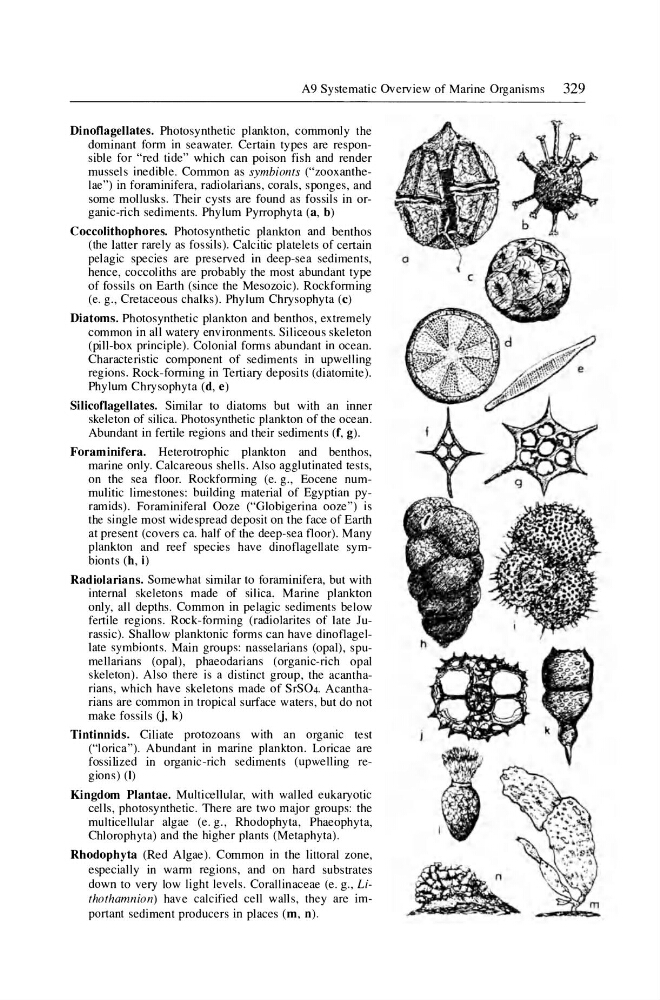
Dinoflagellates. Photosynthetic plankton, commonly the
dominant form in seawater. Certain types are responsible for "red tide" which can poison fish and render
mussels inedible. Common as symbionts ("zooxanthelae") in foraminifera, radiolarians, corals, sponges, and
some mollusks. Their cysts are found as fossils in organic-rich sediments. Phylum Pyrrophyta (a, b)
Coccolithophores. Photosynthetic plankton and benthos
(the latter rarely as fossils). Calcitic platelets of certain
pelagic species are preseIVed in deep-sea sediments,
hence, coccoliths are probably the most abundant type
of fossils on Earth (since the Mesozoic). Rockforming
(e. g., Cretaceous chalks). Phylum Chrysophyta (c)
Diatoms. Photosynthetic plankton and benthos, extremely
common in all watery environments. Siliceous skeleton
(pill-box principle). Colonial forms abundant in ocean.
Characteristic component of sediments in upwelling
regions. Rock-forming in Tertiary deposits (diatomite).
Phylum Chrysophyta (d, e)
Silicoflagellates. Similar to diatoms but with an inner
skeleton of silica. Photosynthetic plankton of the ocean .
Abundant in fertile regions and their sediments (r, g).
Foraminifera. Heterotrophic plankton and benthos,
marine only. Calcareous shells. Also agglutinated tests,
on the sea floor. Rockforming (e. g. , Eocene nummulitic limestones: building material of Egyptian pyramids). Foraminiferal Ooze ("Globigerina ooze") is
the single most widespread deposit on the face of Earth
at present (covers ca. half of the deep-sea floor) . Many
plankton and reef species have dinoflagellate symbionts (h, i)
Radiolarians. Somewhat similar to foraminifera, but with
internal skeletons made of silica. Marine plankton
only, all depths. Common in pelagic sediments below
fertile regions. Rock-forming (radiolarites of late Jurassic). Shallow planktonic forms can have dinoflagellate symbionts. Main groups: nasselarians (opal), spumellarians (opal), phaeodarians (organic-rich opal
skeleton) . Also there is a distinct group, the acantharians, which have skeletons made of SrS04. Acantharians are common in tropical surface waters, but do not
make fossils (j, k)
Tintinnids. Ciliate protozoans with an organic test
("Iorica"). Abundant in marine plankton . Loricae are
fossilized in organic-rich sediments (upwelling regions) (I)
Kingdom Plantae. Multicellular, with walled eukaryotic
cells, photosynthetic. There are two major groups: the
multicellular algae (e. g., Rhodophyta, Phaeophyta,
Chlorophyta) and the higher plants (Metaphyta).
Rhodophyta (Red Algae). Common in the littoral zone,
especially in warm regions, and on hard substrates
down to very low light levels. Corallinaceae (e. g., Lithothamnion) have calcified cell walls, they are important sediment producers in places (m, n).
329
Dinoflagellates. Photosynthetic plankton, commonly the
dominant form in seawater. Certain types are responsible for "red tide" which can poison fish and render
mussels inedible. Common as symbionts ("zooxanthelae") in foraminifera, radiolarians, corals, sponges, and
some mollusks. Their cysts are found as fossils in organic-rich sediments. Phylum Pyrrophyta (a, b)
Coccolithophores. Photosynthetic plankton and benthos
(the latter rarely as fossils). Calcitic platelets of certain
pelagic species are preseIVed in deep-sea sediments,
hence, coccoliths are probably the most abundant type
of fossils on Earth (since the Mesozoic). Rockforming
(e. g., Cretaceous chalks). Phylum Chrysophyta (c)
Diatoms. Photosynthetic plankton and benthos, extremely
common in all watery environments. Siliceous skeleton
(pill-box principle). Colonial forms abundant in ocean.
Characteristic component of sediments in upwelling
regions. Rock-forming in Tertiary deposits (diatomite).
Phylum Chrysophyta (d, e)
Silicoflagellates. Similar to diatoms but with an inner
skeleton of silica. Photosynthetic plankton of the ocean .
Abundant in fertile regions and their sediments (r, g).
Foraminifera. Heterotrophic plankton and benthos,
marine only. Calcareous shells. Also agglutinated tests,
on the sea floor. Rockforming (e. g. , Eocene nummulitic limestones: building material of Egyptian pyramids). Foraminiferal Ooze ("Globigerina ooze") is
the single most widespread deposit on the face of Earth
at present (covers ca. half of the deep-sea floor) . Many
plankton and reef species have dinoflagellate symbionts (h, i)
Radiolarians. Somewhat similar to foraminifera, but with
internal skeletons made of silica. Marine plankton
only, all depths. Common in pelagic sediments below
fertile regions. Rock-forming (radiolarites of late Jurassic). Shallow planktonic forms can have dinoflagellate symbionts. Main groups: nasselarians (opal), spumellarians (opal), phaeodarians (organic-rich opal
skeleton) . Also there is a distinct group, the acantharians, which have skeletons made of SrS04. Acantharians are common in tropical surface waters, but do not
make fossils (j, k)
Tintinnids. Ciliate protozoans with an organic test
("Iorica"). Abundant in marine plankton . Loricae are
fossilized in organic-rich sediments (upwelling regions) (I)
Kingdom Plantae. Multicellular, with walled eukaryotic
cells, photosynthetic. There are two major groups: the
multicellular algae (e. g., Rhodophyta, Phaeophyta,
Chlorophyta) and the higher plants (Metaphyta).
Rhodophyta (Red Algae). Common in the littoral zone,
especially in warm regions, and on hard substrates
down to very low light levels. Corallinaceae (e. g., Lithothamnion) have calcified cell walls, they are important sediment producers in places (m, n).