

328 Appendix
.,'/ Annelida
I
\ EchiUfida
" Phoronida
\ Brachiopoda
\ Ectoprocta
, , , ,
ANI MALIA
.
I
.. Animals " --1 - " Plants "
I
I
--_,
I
" ,
I
C hordata
" I
Hemichordai~:
Pagonophora ::
'I
Echinoder- ~I
mata :
I
' \ Aschelminth~e~ s~~'_~~
'- Platyhelmi nthes
I
I
I
I
/
"
Nemertina
"
Ctenophore
"
C nidaria
""
Porifera
" -
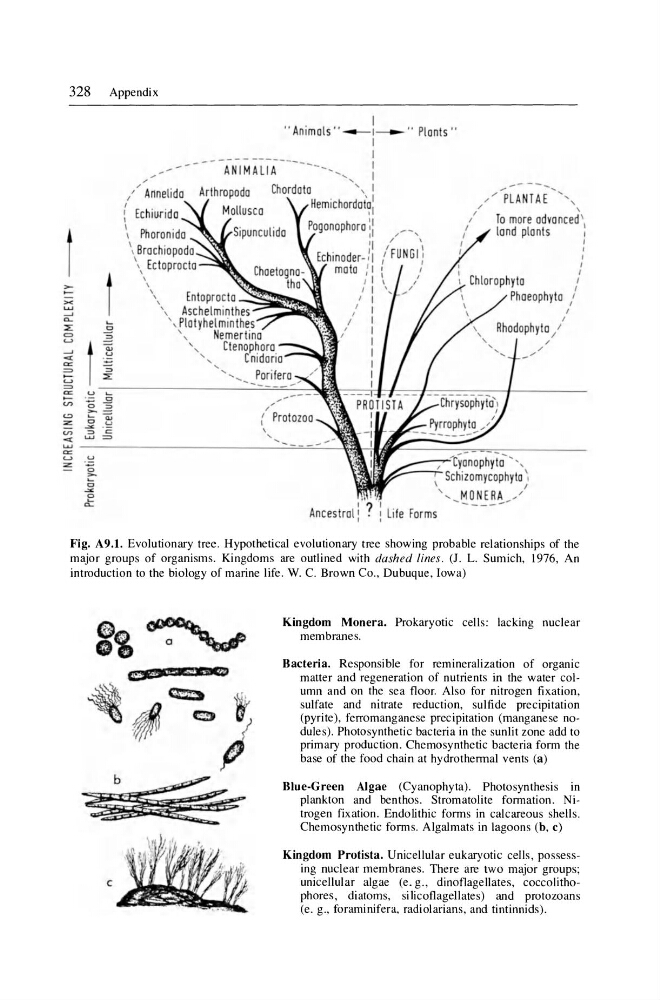
Fig. A9.1. Evolutionary tree. Hypothetical evolutionary tree showing probable relationships of the
major groups of organisms. Kingdom s are outlined with dashed lines. (J. L. Sumich, 1976, An
introduction to the biology of marine life . W. C. Brown Co., Dubuque, Iowa)
Kingdom Monera. Prokaryotic cells: lacking nuclear
membranes.
Bacteria. Responsible for remineralization of organic
matter and regeneration of nutrients in the water column and on the sea floor. Also for nitrogen fixation,
sulfate and nitrate reduction, sulfide precipitation
(pyrite), ferromanganese precipitation (manganese nodules). Photosynthetic bacteria in the sunlit zone add to
primary produc tion . Chemosynthetic bacteria form the
base of the food chain at hydrothermal vents (a)
Blue-Green Algae (Cyanophyta). Photosynthesis in
plankton and benthos. Stromatolite formation. Nitrogen fixation . Endolithic form s in calcareous shells.
Chemosynthetic forms. Algalmats in lagoons (b, c)
Kingdom Protista. Unicellular eukaryotic cells , possessing nuclear membranes. There are two major groups;
unicellular algae (e. g., dinoflagellates, coccolithophores, diatoms, si licoflagellates) and protozoans
(e. g. , foraminifera, radiolarians, and tintinnids).
.,'/ Annelida
I
\ EchiUfida
" Phoronida
\ Brachiopoda
\ Ectoprocta
, , , ,
ANI MALIA
.
I
.. Animals " --1 - " Plants "
I
I
--_,
I
" ,
I
C hordata
" I
Hemichordai~:
Pagonophora ::
'I
Echinoder- ~I
mata :
I
' \ Aschelminth~e~ s~~'_~~
'- Platyhelmi nthes
I
I
I
I
/
"
Nemertina
"
Ctenophore
"
C nidaria
""
Porifera
" -
Fig. A9.1. Evolutionary tree. Hypothetical evolutionary tree showing probable relationships of the
major groups of organisms. Kingdom s are outlined with dashed lines. (J. L. Sumich, 1976, An
introduction to the biology of marine life . W. C. Brown Co., Dubuque, Iowa)
Kingdom Monera. Prokaryotic cells: lacking nuclear
membranes.
Bacteria. Responsible for remineralization of organic
matter and regeneration of nutrients in the water column and on the sea floor. Also for nitrogen fixation,
sulfate and nitrate reduction, sulfide precipitation
(pyrite), ferromanganese precipitation (manganese nodules). Photosynthetic bacteria in the sunlit zone add to
primary produc tion . Chemosynthetic bacteria form the
base of the food chain at hydrothermal vents (a)
Blue-Green Algae (Cyanophyta). Photosynthesis in
plankton and benthos. Stromatolite formation. Nitrogen fixation . Endolithic form s in calcareous shells.
Chemosynthetic forms. Algalmats in lagoons (b, c)
Kingdom Protista. Unicellular eukaryotic cells , possessing nuclear membranes. There are two major groups;
unicellular algae (e. g., dinoflagellates, coccolithophores, diatoms, si licoflagellates) and protozoans
(e. g. , foraminifera, radiolarians, and tintinnids).