

A9 Systematic Overview of Marine Organisms
327
A9 Systematic Overview for Major
Groups of Common
Marine Organisms Important
in Sea-Floor Processes
The number of species of living organisms on Earth is not
known; estimates range from 3 to 10 million. As far as
animals (including protozoans, i. e., eukaryotic unicellular
organisms without chlorophyll) are concerned, there are
well over a million species, of which 16 % (160000) live
in the ocean. On land, some 75 % of the animal species are
insects. Hence, the number of noninsect species in the sea
is two thirds of the total noninsect species. Benthic species
outnumber pelagic ones by 50: I.
On the basis of similaritiy (and presumed common
origin, therefore) species are grouped into genera (sing.
genus), genera are grouped into families, these into orders,
these into classes, and classes finally into phyla (sing. phylum) (see Table A9.l).
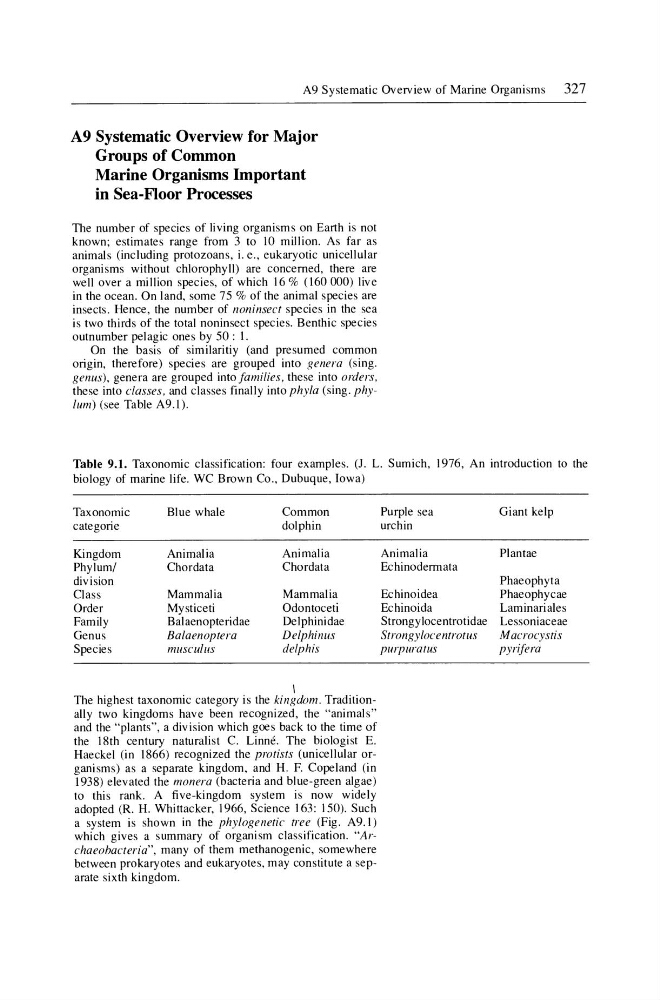
Table 9.1. Taxonomic classification: four examples. (1. L. Sumich, 1976, An introduction to the
biology of marine life. WC Brown Co., Dubuque, Iowa)
Taxonomic
Blue whale
Common
categorie
dolphin
Kingdom
Animalia
Animalia
Phylum/
Chordata
Chordata
division
Class
Mammalia
Mammalia
Order
Mysticeti
Odontoceti
Family
Balaenopteridae
Delphinidae
Genus
Balaenoptera
Delphinus
Species
musculus
delphis
\
The highest taxonomic category is the kingdom. Traditionally two kingdoms have been recognized, the "animals"
and the "plants", a division which goes back to the time of
the 18th century naturalist C. Linne. The biologist E.
Haeckel (in 1866) recognized the plVtists (unicellular organisms) as a separate kingdom, and H. F. Copeland (in
1938) elevated the monera (bacteria and blue-green algae)
to this rank. A five-kingdom system is now widely
adopted (R. H. Whittacker, 1966, Science 163: ISO). Such
a system is shown in the phylogenetic tree (Fig. A9.1)
which gives a summary of organism classification. "Archaeohacteria", many of them methanogenic, somewhere
between prokaryotes and eukaryotes, may constitute a separate sixth kingdom.
Purple sea
urchin
Animalia
Echinodermata
Echinoidea
Echinoida
Strongylocentrotidae
Strongylocentrotus
purpuratus
Giant kelp
Plantae
Phaeophyta
Phaeophycae
Laminariales
Lessoniaceae
Macrocystis
pynj'era
327
A9 Systematic Overview for Major
Groups of Common
Marine Organisms Important
in Sea-Floor Processes
The number of species of living organisms on Earth is not
known; estimates range from 3 to 10 million. As far as
animals (including protozoans, i. e., eukaryotic unicellular
organisms without chlorophyll) are concerned, there are
well over a million species, of which 16 % (160000) live
in the ocean. On land, some 75 % of the animal species are
insects. Hence, the number of noninsect species in the sea
is two thirds of the total noninsect species. Benthic species
outnumber pelagic ones by 50: I.
On the basis of similaritiy (and presumed common
origin, therefore) species are grouped into genera (sing.
genus), genera are grouped into families, these into orders,
these into classes, and classes finally into phyla (sing. phylum) (see Table A9.l).
Table 9.1. Taxonomic classification: four examples. (1. L. Sumich, 1976, An introduction to the
biology of marine life. WC Brown Co., Dubuque, Iowa)
Taxonomic
Blue whale
Common
categorie
dolphin
Kingdom
Animalia
Animalia
Phylum/
Chordata
Chordata
division
Class
Mammalia
Mammalia
Order
Mysticeti
Odontoceti
Family
Balaenopteridae
Delphinidae
Genus
Balaenoptera
Delphinus
Species
musculus
delphis
\
The highest taxonomic category is the kingdom. Traditionally two kingdoms have been recognized, the "animals"
and the "plants", a division which goes back to the time of
the 18th century naturalist C. Linne. The biologist E.
Haeckel (in 1866) recognized the plVtists (unicellular organisms) as a separate kingdom, and H. F. Copeland (in
1938) elevated the monera (bacteria and blue-green algae)
to this rank. A five-kingdom system is now widely
adopted (R. H. Whittacker, 1966, Science 163: ISO). Such
a system is shown in the phylogenetic tree (Fig. A9.1)
which gives a summary of organism classification. "Archaeohacteria", many of them methanogenic, somewhere
between prokaryotes and eukaryotes, may constitute a separate sixth kingdom.
Purple sea
urchin
Animalia
Echinodermata
Echinoidea
Echinoida
Strongylocentrotidae
Strongylocentrotus
purpuratus
Giant kelp
Plantae
Phaeophyta
Phaeophycae
Laminariales
Lessoniaceae
Macrocystis
pynj'era