

326 Appendix
o
100 000
Age of sed iments I yrs I
200 000
300 000
400 000
rll
~ 10 \
c
.~
'!\
~
\
. ~
\
1/ ' .
::
"\
20rlQlnol
f
"'\. ~ acllv lty
2
3
230Th_ Hall- lives
Hall-life of 230Th
! -t/2 -----1
!
'0 t').
lh oriQinol
!',
, activity
E
'1,
1/80riginot
co.
-c
I
..c
~
. . . . . . .
I activ ity
1116 orig inal
t 'l~.......
,
~ act IVI ty
1/32 original
.............
, activity
" . . . . . . . . . . . . . . L
E
co.
-c
2
-5
Oe pth in core I m I
---o-_L __ _ 17
B
9
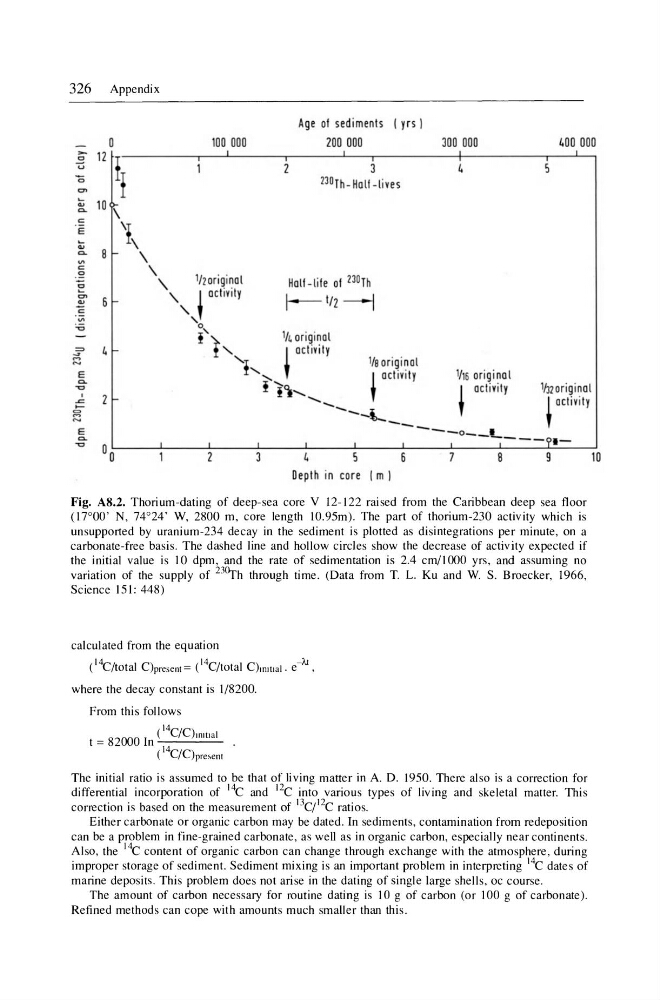
Fig. AS.2. Thorium·dating of deep-sea core V 12-122 raised from the Caribbean deep sea floor
(\7°00 ' N, 74°24' W, 2800 m, core length JO.95m). The part of thorium-230 activity which is
unsupported by uranium-234 decay in the sediment is plotted as disintegrations per minute, on a
carbonate-free basis. The dashed line and hollow circles show the decrease of activity expected if
the initial value is 10 dpm. and the rate of sedimentation is 2.4 cm/lOOO yrs, and assuming no
variation of the supply of 23~h through time. (Data from T. L. Ku and W. S. Broecker, 1966,
Science 15 I: 448)
calculated from the equation
(14C/total C)presenl= (14C/total C)m'I,al. e- N ,
where the decay constant is 1/8200.
From this follows
( 14C/C )
t = 82000 In
,ml,al
( 14C/C)presenl
The initial ratio is assumed to be that of living matter in A. D. 1950. There also is a correction for
differential incorporation of 14C and 12C into various types of living and skeletal matter. This
correction is based on the measurement of 13C/12C ratios.
Either carbonate or organic carbon may be dated. In sediments, contamination from redeposition
can be a problem in fine-grained carbonate, as well as in organic carbon, especially near continents.
Also, the 14C content of organic carbon can change through exchange with the atmosphere, during
improper storage of sediment. Sediment mixing is an important problem in interpreting 14C dates of
marine deposits. This problem does not arise in the dating of single large shells, oc course.
The amount of carbon necessary for routine dating is 10 g of carbon (or 100 g of carbonate).
Refined methods can cope with amounts much smaller than this.
10
o
100 000
Age of sed iments I yrs I
200 000
300 000
400 000
rll
~ 10 \
c
.~
'!\
~
\
. ~
\
1/ ' .
::
"\
20rlQlnol
f
"'\. ~ acllv lty
2
3
230Th_ Hall- lives
Hall-life of 230Th
! -t/2 -----1
!
'0 t').
lh oriQinol
!',
, activity
E
'1,
1/80riginot
co.
-c
I
..c
~
. . . . . . .
I activ ity
1116 orig inal
t 'l~.......
,
~ act IVI ty
1/32 original
.............
, activity
" . . . . . . . . . . . . . . L
E
co.
-c
2
-5
Oe pth in core I m I
---o-_L __ _ 17
B
9
Fig. AS.2. Thorium·dating of deep-sea core V 12-122 raised from the Caribbean deep sea floor
(\7°00 ' N, 74°24' W, 2800 m, core length JO.95m). The part of thorium-230 activity which is
unsupported by uranium-234 decay in the sediment is plotted as disintegrations per minute, on a
carbonate-free basis. The dashed line and hollow circles show the decrease of activity expected if
the initial value is 10 dpm. and the rate of sedimentation is 2.4 cm/lOOO yrs, and assuming no
variation of the supply of 23~h through time. (Data from T. L. Ku and W. S. Broecker, 1966,
Science 15 I: 448)
calculated from the equation
(14C/total C)presenl= (14C/total C)m'I,al. e- N ,
where the decay constant is 1/8200.
From this follows
( 14C/C )
t = 82000 In
,ml,al
( 14C/C)presenl
The initial ratio is assumed to be that of living matter in A. D. 1950. There also is a correction for
differential incorporation of 14C and 12C into various types of living and skeletal matter. This
correction is based on the measurement of 13C/12C ratios.
Either carbonate or organic carbon may be dated. In sediments, contamination from redeposition
can be a problem in fine-grained carbonate, as well as in organic carbon, especially near continents.
Also, the 14C content of organic carbon can change through exchange with the atmosphere, during
improper storage of sediment. Sediment mixing is an important problem in interpreting 14C dates of
marine deposits. This problem does not arise in the dating of single large shells, oc course.
The amount of carbon necessary for routine dating is 10 g of carbon (or 100 g of carbonate).
Refined methods can cope with amounts much smaller than this.
10