

AS Radioisotops and Dating
325
Atmosphere
Ocean
precip.
precip.
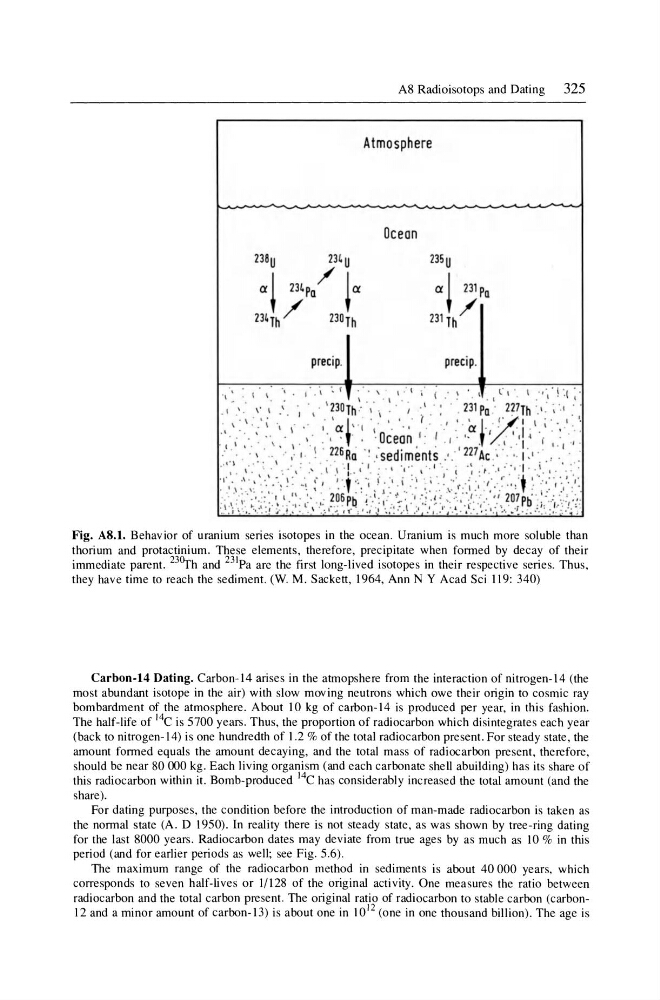
Fig. AS.I. Behavior of uranium series isotopes in the ocean. Uranium is much more soluble than
thorium and protactinium. These elements, therefore, precipitate when formed by decay of their
immediate parent. 23CTh and 231pa are the first long-lived isotopes in their respective series. Thus,
they have time to reach the sediment. (w. M. Sackett, 1964, Ann N Y Acad Sci 119: 340)
Carbon-14 Dating. Carbon-14 arises in the atmopshere from the interaction of nitrogen-14 (the
most abundant isotope in the air) with slow moving neutrons which owe their origin to cosmic ray
bombardment of the atmosphere. About 10 kg of carbon-14 is produced per year, in this fashion.
The half-life of 14C is 5700 years. Thus, the proportion of radiocarbon which disintegrates each year
(back to nitrogen-14) is one hundredth of 1.2 % of the total radiocarbon present. For steady state, the
amount formed equals the amount decaying, and the total mass of radiocarbon present, therefore,
should be near 80 000 kg . Each living organism (and each carbonate shell abuilding) has its share of
this radiocarbon within it. Bomb-produced 14C has considerably increased the total amount (and the
share).
For dating purposes, the condition before the introduction of man-made radiocarbon is taken as
the normal state (A. D 1950). In reality there is not steady state, as was shown by tree-ring dating
for the last 8000 years. Radiocarbon dates may deviate from true ages by as much as 10 % in this
period (and for earlier periods as well; see Fig. 5.6).
The maximum range of the radiocarbon method in sediments is about 40000 years, which
corresponds to seven half-lives or 1/128 of the original activity. One measures the ratio between
radiocarbon and the total carbon present. The original ratio of radiocarbon to stable carbon (carbon12 and a minor amount of carbon-l3) is about one in 10 12 (one in one thousand billion) . The age is
325
Atmosphere
Ocean
precip.
precip.
Fig. AS.I. Behavior of uranium series isotopes in the ocean. Uranium is much more soluble than
thorium and protactinium. These elements, therefore, precipitate when formed by decay of their
immediate parent. 23CTh and 231pa are the first long-lived isotopes in their respective series. Thus,
they have time to reach the sediment. (w. M. Sackett, 1964, Ann N Y Acad Sci 119: 340)
Carbon-14 Dating. Carbon-14 arises in the atmopshere from the interaction of nitrogen-14 (the
most abundant isotope in the air) with slow moving neutrons which owe their origin to cosmic ray
bombardment of the atmosphere. About 10 kg of carbon-14 is produced per year, in this fashion.
The half-life of 14C is 5700 years. Thus, the proportion of radiocarbon which disintegrates each year
(back to nitrogen-14) is one hundredth of 1.2 % of the total radiocarbon present. For steady state, the
amount formed equals the amount decaying, and the total mass of radiocarbon present, therefore,
should be near 80 000 kg . Each living organism (and each carbonate shell abuilding) has its share of
this radiocarbon within it. Bomb-produced 14C has considerably increased the total amount (and the
share).
For dating purposes, the condition before the introduction of man-made radiocarbon is taken as
the normal state (A. D 1950). In reality there is not steady state, as was shown by tree-ring dating
for the last 8000 years. Radiocarbon dates may deviate from true ages by as much as 10 % in this
period (and for earlier periods as well; see Fig. 5.6).
The maximum range of the radiocarbon method in sediments is about 40000 years, which
corresponds to seven half-lives or 1/128 of the original activity. One measures the ratio between
radiocarbon and the total carbon present. The original ratio of radiocarbon to stable carbon (carbon12 and a minor amount of carbon-l3) is about one in 10 12 (one in one thousand billion) . The age is