

324 Appendix
Another kind of radioactivity is called secondary; it consists in the alpha, beta, and gamma
emissions from the daughter elements along a decay series. The third kind of radioactivity is
cosmic-ray-induced. Certain radioisotopes are continually being produced by cosmic ray bombardment of the atmosphere and the ocean. Their abundance represents an equilibrium between new
production on Earth, and the decay by radioactivity. Examples are carbon-14, hydrogen-3 (= tritium), beryllium-7, beryllium-IO, and silicon-32.
A fourth kind of radioactivity - the man-made type - is useful for measuring the rate of rapid
geologic processes, such as water movements, dispersion of sediments, sediment mixing on the sea
floor, and growth rate of skeleton-producing organisms. The degree to which bomb-produced tritium
and carbon-14 are dispersed in the ocean, for example, contains clues about rates of deep water
formation and rates of carbon cycling. The depth to which plutonium penetrates sediment on the sea
floor tells something about the activity of benthic organisms. Some short-lived isotopes in the
natural uranium decay series also are used for the study of such processes.
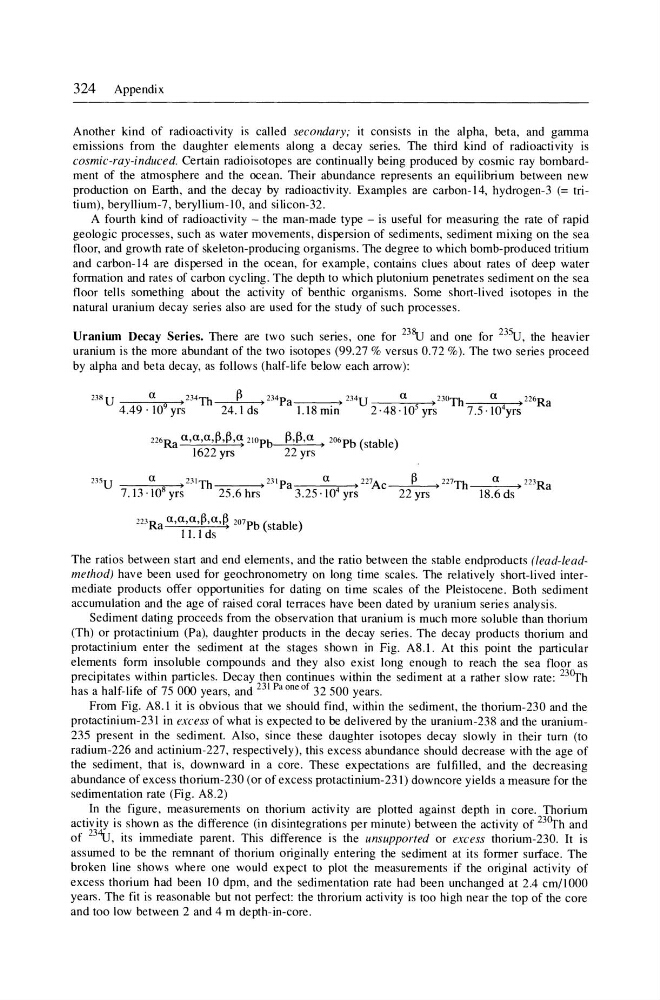
Uranium Decay Series. There are two such series, one for 238u and one for 23\;, the heavier
uranium is the more abundant of the two isotopes (99.27 % versus 0.72 %). The two series proceed
by alpha and beta decay, as follows (half-life below each arrow):
''"u
a
) 234Th
~ ) 234Pa
) 214U
a
) 230Th
a
) 226Ra
4.49·l0 9 yrs
24.lds
1.1Smin
2·4S·IO'yrs
7.5·10 4 yrs
226Ra a,a,a,~,~,~ 210Pb
1622 yrs
f3,f3,a ) 206Pb (stable)
22 yrs
223Ra a,a,a,~,a,~ 207Pb (stable)
II. I ds
~ ) 227Th
a
) 223Ra
22 yrs
IS.6 ds
The ratios between start and end elements, and the ratio between the stable end products (lead-leadmethod) have been used for geochronometry on long time scales. The relatively short-lived intermediate products offer opportunities for dating on time scales of the Pleistocene. Both sediment
accumulation and the age of raised coral terraces have been dated by uranium series analysis.
Sediment dating proceeds from the observation that uranium is much more soluble than thorium
(Th) or protactinium (Pa), daughter products in the decay series. The decay products thorium and
protactinium enter the sediment at the stages shown in Fig. AS.I. At this point the particular
elements form insoluble compounds and they also exist long enough to reach the sea floor as
precipitates within particles. Decay then continues within the sediment at a rather slow rate: 230rh
has a half-life of 75 000 years, and 231 Pa one of 32 500 years.
From Fig. AS.l it is obvious that we should find, within the sediment, the thorium-230 and the
protactinium-231 in excess of what is expected to be delivered by the uranium-23S and the uranium235 present in the sediment. Also, since these daughter isotopes decay slowly in their turn (to
radium-226 and actinium-227, respectively), this excess abundance should decrease with the age of
the sediment, that is, downward in a core. These expectations are fulfilled, and the decreasing
abundance of excess thorium-230 (or of excess protactinium-231) downcore yields a measure for the
sedimentation rate (Fig. AS.2)
In the figure, measurements on thorium activity are plotted against depth in core. Thorium
activity is shown as the difference (in disintegrations per minute) between the activity of 230rh and
of 23\;, its immediate parent. This difference is the unsupported or excess thorium-230. It is
assumed to be the remnant of thorium originally entering the sediment at its former surface. The
broken line shows where one would expect to plot the measurements if the original activity of
excess thorium had been 10 dpm, and the sedimentation rate had been unchanged at 2.4 cm/lOOO
years. The fit is reasonable but not perfect: the throrium activity is too high near the top of the core
and too low between 2 and 4 m depth-in-core.
Another kind of radioactivity is called secondary; it consists in the alpha, beta, and gamma
emissions from the daughter elements along a decay series. The third kind of radioactivity is
cosmic-ray-induced. Certain radioisotopes are continually being produced by cosmic ray bombardment of the atmosphere and the ocean. Their abundance represents an equilibrium between new
production on Earth, and the decay by radioactivity. Examples are carbon-14, hydrogen-3 (= tritium), beryllium-7, beryllium-IO, and silicon-32.
A fourth kind of radioactivity - the man-made type - is useful for measuring the rate of rapid
geologic processes, such as water movements, dispersion of sediments, sediment mixing on the sea
floor, and growth rate of skeleton-producing organisms. The degree to which bomb-produced tritium
and carbon-14 are dispersed in the ocean, for example, contains clues about rates of deep water
formation and rates of carbon cycling. The depth to which plutonium penetrates sediment on the sea
floor tells something about the activity of benthic organisms. Some short-lived isotopes in the
natural uranium decay series also are used for the study of such processes.
Uranium Decay Series. There are two such series, one for 238u and one for 23\;, the heavier
uranium is the more abundant of the two isotopes (99.27 % versus 0.72 %). The two series proceed
by alpha and beta decay, as follows (half-life below each arrow):
''"u
a
) 234Th
~ ) 234Pa
) 214U
a
) 230Th
a
) 226Ra
4.49·l0 9 yrs
24.lds
1.1Smin
2·4S·IO'yrs
7.5·10 4 yrs
226Ra a,a,a,~,~,~ 210Pb
1622 yrs
f3,f3,a ) 206Pb (stable)
22 yrs
223Ra a,a,a,~,a,~ 207Pb (stable)
II. I ds
~ ) 227Th
a
) 223Ra
22 yrs
IS.6 ds
The ratios between start and end elements, and the ratio between the stable end products (lead-leadmethod) have been used for geochronometry on long time scales. The relatively short-lived intermediate products offer opportunities for dating on time scales of the Pleistocene. Both sediment
accumulation and the age of raised coral terraces have been dated by uranium series analysis.
Sediment dating proceeds from the observation that uranium is much more soluble than thorium
(Th) or protactinium (Pa), daughter products in the decay series. The decay products thorium and
protactinium enter the sediment at the stages shown in Fig. AS.I. At this point the particular
elements form insoluble compounds and they also exist long enough to reach the sea floor as
precipitates within particles. Decay then continues within the sediment at a rather slow rate: 230rh
has a half-life of 75 000 years, and 231 Pa one of 32 500 years.
From Fig. AS.l it is obvious that we should find, within the sediment, the thorium-230 and the
protactinium-231 in excess of what is expected to be delivered by the uranium-23S and the uranium235 present in the sediment. Also, since these daughter isotopes decay slowly in their turn (to
radium-226 and actinium-227, respectively), this excess abundance should decrease with the age of
the sediment, that is, downward in a core. These expectations are fulfilled, and the decreasing
abundance of excess thorium-230 (or of excess protactinium-231) downcore yields a measure for the
sedimentation rate (Fig. AS.2)
In the figure, measurements on thorium activity are plotted against depth in core. Thorium
activity is shown as the difference (in disintegrations per minute) between the activity of 230rh and
of 23\;, its immediate parent. This difference is the unsupported or excess thorium-230. It is
assumed to be the remnant of thorium originally entering the sediment at its former surface. The
broken line shows where one would expect to plot the measurements if the original activity of
excess thorium had been 10 dpm, and the sedimentation rate had been unchanged at 2.4 cm/lOOO
years. The fit is reasonable but not perfect: the throrium activity is too high near the top of the core
and too low between 2 and 4 m depth-in-core.