

Petroleum Beneath the Sea Floor
283
Exploration in the North Sea started in the early 1960s. In 1969 the Ekofisk Field
was discovered. Offshore production began in 1967 for gas and in 1971 for oil. The
technical difficulties in recovering hydrocarbons in this "fiercest of all seas" are
enormous. Blinding fog, swift and drastic changes in weather, wind speeds of more
than 160 km per hour, and waves frequently 30 m high, are dangerous even for the
huge platforms. In March 1980 in the Ekofisk field, the Norwegian platform Alexander L. Kielland collapsed in stormy weather, a catastrophe leaving over a hundred
people dead. Subsidence of the sea floor due to extraction of oil from overpressured
chalks in this field made it necessary to elongate the legs of several platforms by
several meters - a major engineering endeavor in the midst of the North Sea.
In the south of the hydrocarbon-rich region, a broad belt of gas fields stretches
east-west from Germany to southern England (Fig. lOA). Gas migrated from Carboniferous coal measures to porous Lower Permian sandstones and is sealed by overlying Zechstein (upper Permian) evaporites. Oil fields, however, are concentrated
around the north-south rift in the northern North Sea mentioned above, which originated in the first stages of opening of the northern North Atlantic. The major faults
bordering the rift lie on either side of the political median line between ther United
Kingdom and Norway. In the south the oil occurs in Cretaceous chalk reservoirs, next
to salt domes. Some fields are developed on Jurassic sandstones on the crests of
horsts and tilted blocks. The Forties and other fields get oil from basal Tertiary sands.
10.2.4 Present Oil Exploration. As already mentioned, one of the prerequisites of
petroleum formation and migration is an elevated temperature. A cover of roughly I
to 2 km of sediment is required with some possible exceptions in areas with high heat
flow or in sediments where large time spans for conversion are available. Most of the
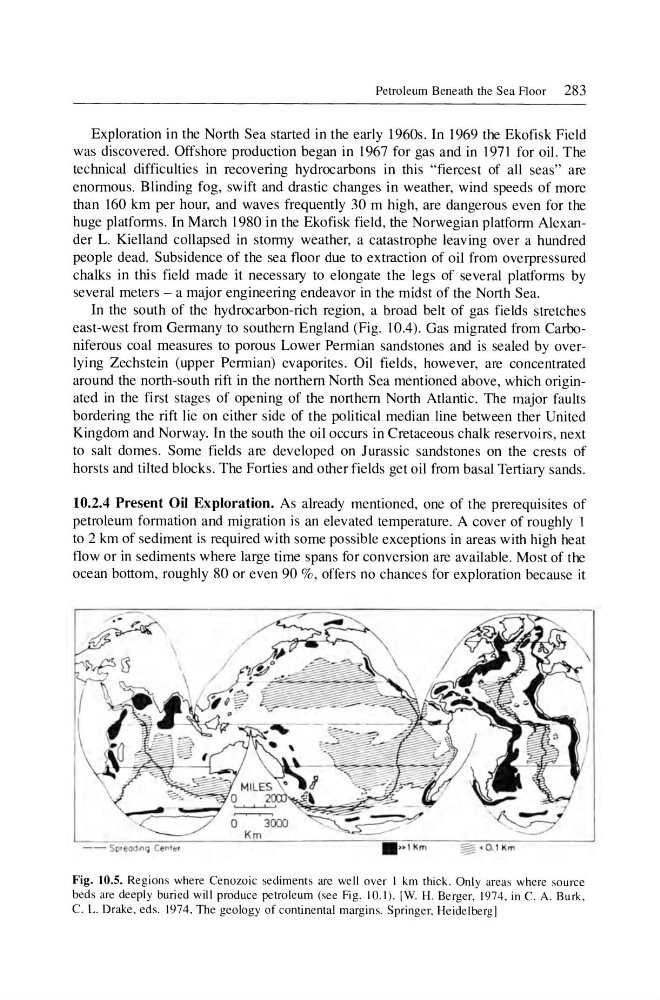
ocean bottom, roughly 80 or even 90 %, offers no chances for exploration because it
Fig. 10.5. Regions where Cenozoic sediments are well over I km thick. Only areas where source
beds are deeply buried will produce petroleum (see Fig. 10.1). IW. H. Berger, 1974, in e. A. Burk ,
e. L. Drake , eds. 1974, The geology of continental margins. Springer, Heidelberg]
283
Exploration in the North Sea started in the early 1960s. In 1969 the Ekofisk Field
was discovered. Offshore production began in 1967 for gas and in 1971 for oil. The
technical difficulties in recovering hydrocarbons in this "fiercest of all seas" are
enormous. Blinding fog, swift and drastic changes in weather, wind speeds of more
than 160 km per hour, and waves frequently 30 m high, are dangerous even for the
huge platforms. In March 1980 in the Ekofisk field, the Norwegian platform Alexander L. Kielland collapsed in stormy weather, a catastrophe leaving over a hundred
people dead. Subsidence of the sea floor due to extraction of oil from overpressured
chalks in this field made it necessary to elongate the legs of several platforms by
several meters - a major engineering endeavor in the midst of the North Sea.
In the south of the hydrocarbon-rich region, a broad belt of gas fields stretches
east-west from Germany to southern England (Fig. lOA). Gas migrated from Carboniferous coal measures to porous Lower Permian sandstones and is sealed by overlying Zechstein (upper Permian) evaporites. Oil fields, however, are concentrated
around the north-south rift in the northern North Sea mentioned above, which originated in the first stages of opening of the northern North Atlantic. The major faults
bordering the rift lie on either side of the political median line between ther United
Kingdom and Norway. In the south the oil occurs in Cretaceous chalk reservoirs, next
to salt domes. Some fields are developed on Jurassic sandstones on the crests of
horsts and tilted blocks. The Forties and other fields get oil from basal Tertiary sands.
10.2.4 Present Oil Exploration. As already mentioned, one of the prerequisites of
petroleum formation and migration is an elevated temperature. A cover of roughly I
to 2 km of sediment is required with some possible exceptions in areas with high heat
flow or in sediments where large time spans for conversion are available. Most of the
ocean bottom, roughly 80 or even 90 %, offers no chances for exploration because it
Fig. 10.5. Regions where Cenozoic sediments are well over I km thick. Only areas where source
beds are deeply buried will produce petroleum (see Fig. 10.1). IW. H. Berger, 1974, in e. A. Burk ,
e. L. Drake , eds. 1974, The geology of continental margins. Springer, Heidelberg]