

282 Resources from the Ocean Roor
A AUK FIELD
•
EKOfISl( FIELD
B
<>
•
.. . ... ..... ... . .
6 1
+ tAlD NORTH SEA' •••
• • .. .tt1~H + .. • .. .. .. ... .. ... .... ..
8· .. .. • • .. . . . .. • • . . . .. . . .
I w ......... ....................... . . " ................... .
o
4
c
FORTIES
•
o Eocene-PoItoclnl
o Poleocene
~ Up, Cl'lioceou.
o Low. CrllOClOlll
~ Jurouic (\oIoIconiQ)
o Triouic
_
Zleh"lln Soli (Permian)
_
RolIIlQlnd and Olvonia"
Q 8aMmen'
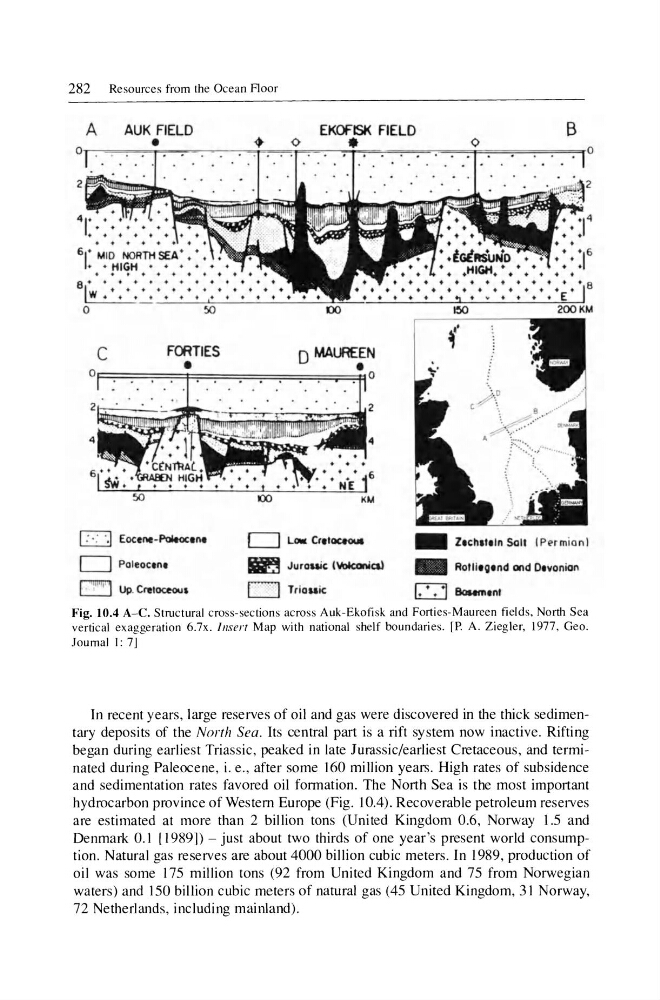
Fig. 10.4 A- C. SlruclUral cross-sections across Auk-Ekofisk and Forties-Maureen fields. North Sea
vertical exaggeration 6.7x. Insert Map with national shelf boundaries. [P A. Ziegler, 1977 , Geo.
Journal I: 7]
In recent years, large reserves of oil and gas were discovered in the thick sedimentary deposits of the North Sea. Its central part is a rift system now inactive. Rifting
began during earliest Triassic, peaked in late J urassic/earliest Cretaceous, and terminated during Paleocene, i. e., after some 160 million years. High rates of subsidence
and sedimentation rates favored oil formation. The North Sea is the most important
hydrocarbon province of Western Europe (Fig. 10.4). Recoverable petroleum reserves
are estimated at more than 2 billion tons (United Kingdom 0.6, Norway 1.5 and
Denmark 0.1 [1989]) - just about two thirds of one year 's present world consumption. Natural gas reserves are about 4000 billion cubic meters. In 1989, production of
oil was some 175 million tons (92 from United Kingdom and 75 from Norwegian
waters) and 150 billion cubic meters of natural gas (45 United Kingdom, 31 Norway,
72 Netherlands, including mainland).
A AUK FIELD
•
EKOfISl( FIELD
B
<>
•
.. . ... ..... ... . .
6 1
+ tAlD NORTH SEA' •••
• • .. .tt1~H + .. • .. .. .. ... .. ... .... ..
8· .. .. • • .. . . . .. • • . . . .. . . .
I w ......... ....................... . . " ................... .
o
4
c
FORTIES
•
o Eocene-PoItoclnl
o Poleocene
~ Up, Cl'lioceou.
o Low. CrllOClOlll
~ Jurouic (\oIoIconiQ)
o Triouic
_
Zleh"lln Soli (Permian)
_
RolIIlQlnd and Olvonia"
Q 8aMmen'
Fig. 10.4 A- C. SlruclUral cross-sections across Auk-Ekofisk and Forties-Maureen fields. North Sea
vertical exaggeration 6.7x. Insert Map with national shelf boundaries. [P A. Ziegler, 1977 , Geo.
Journal I: 7]
In recent years, large reserves of oil and gas were discovered in the thick sedimentary deposits of the North Sea. Its central part is a rift system now inactive. Rifting
began during earliest Triassic, peaked in late J urassic/earliest Cretaceous, and terminated during Paleocene, i. e., after some 160 million years. High rates of subsidence
and sedimentation rates favored oil formation. The North Sea is the most important
hydrocarbon province of Western Europe (Fig. 10.4). Recoverable petroleum reserves
are estimated at more than 2 billion tons (United Kingdom 0.6, Norway 1.5 and
Denmark 0.1 [1989]) - just about two thirds of one year 's present world consumption. Natural gas reserves are about 4000 billion cubic meters. In 1989, production of
oil was some 175 million tons (92 from United Kingdom and 75 from Norwegian
waters) and 150 billion cubic meters of natural gas (45 United Kingdom, 31 Norway,
72 Netherlands, including mainland).