

a
b
Petroleum Beneath the Sea Floor
281
N
S
- - - -- 5",11 - - - - -+O- - SIoPf
'I ' R,~ - -..... · ~I-·-Ab"Jal PIo;,, -
not to ,col,
D .. ·d D Sond • Sal
CHALLENGER
SE
NW
KNOt.l
2
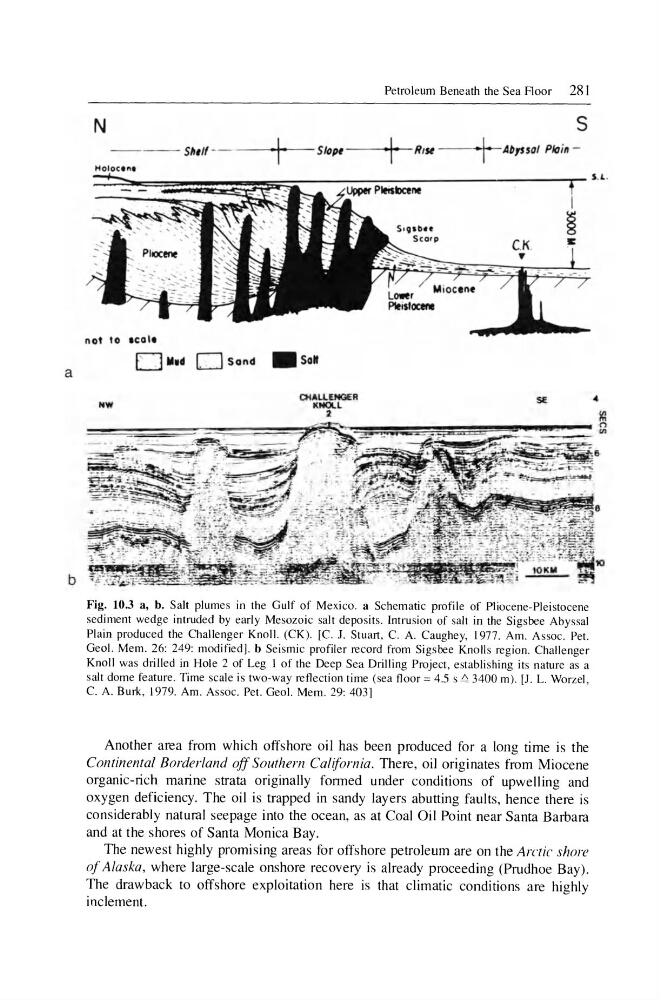
Fig. 10.3 a, b. Salt plumes in the Gulf of Mexico. a Schematic profile of Pliocene-Pleistocene
sediment wedge intruded by early Mesozoic salt deposits. Intrusion of salt in the Sigsbee Abyssal
Plain produced the Challenger Knoll. (CK). [CO 1. Stuart, C. A. Caughey, 1977. Am. Assoc. Pet.
Geol. Mem. 26: 249: modified]. b Seismic profiler record from Sigsbee Knolls region. Challenger
Knoll was drilled in Hole 2 of Leg I of the Deep Sea Drilling Project, establishing its nature as a
salt dome feature. Time scale is two-way refl ection time (sea floor = 4.5 s Q 3400 mi. [1. L. Worzel ,
C. A. Burk, 1979. Am. Assoc. Pet. Geol. Mem. 29: 403]
Another area from which offshore oil has been produced for a long time is the
Continental Borderland off Southern California. There, oil originates from Miocene
organic-rich marine strata originally formed under conditions of upwelling and
oxygen deficiency. The oil is trapped in sandy layers abutting faults, hence there is
considerably natural seepage into the ocean, as at Coal Oil Point near Santa Barbara
and at the shores of Santa Monica Bay.
The newest highly promising areas for offshore petroleum are on the Arctic shore
of Alaska, where large-scale onshore recovery is already proceeding (Prudhoe Bay) .
The drawback to offshore exploitation here is that climatic conditions are highly
inclement.
4
b
Petroleum Beneath the Sea Floor
281
N
S
- - - -- 5",11 - - - - -+O- - SIoPf
'I ' R,~ - -..... · ~I-·-Ab"Jal PIo;,, -
not to ,col,
D .. ·d D Sond • Sal
CHALLENGER
SE
NW
KNOt.l
2
Fig. 10.3 a, b. Salt plumes in the Gulf of Mexico. a Schematic profile of Pliocene-Pleistocene
sediment wedge intruded by early Mesozoic salt deposits. Intrusion of salt in the Sigsbee Abyssal
Plain produced the Challenger Knoll. (CK). [CO 1. Stuart, C. A. Caughey, 1977. Am. Assoc. Pet.
Geol. Mem. 26: 249: modified]. b Seismic profiler record from Sigsbee Knolls region. Challenger
Knoll was drilled in Hole 2 of Leg I of the Deep Sea Drilling Project, establishing its nature as a
salt dome feature. Time scale is two-way refl ection time (sea floor = 4.5 s Q 3400 mi. [1. L. Worzel ,
C. A. Burk, 1979. Am. Assoc. Pet. Geol. Mem. 29: 403]
Another area from which offshore oil has been produced for a long time is the
Continental Borderland off Southern California. There, oil originates from Miocene
organic-rich marine strata originally formed under conditions of upwelling and
oxygen deficiency. The oil is trapped in sandy layers abutting faults, hence there is
considerably natural seepage into the ocean, as at Coal Oil Point near Santa Barbara
and at the shores of Santa Monica Bay.
The newest highly promising areas for offshore petroleum are on the Arctic shore
of Alaska, where large-scale onshore recovery is already proceeding (Prudhoe Bay) .
The drawback to offshore exploitation here is that climatic conditions are highly
inclement.
4