

280 Resources from the Ocean Roor
of course, very schematic. Long reaction times may compensate for low temperatures. Also, high temperatures may convert organic matter into petroleum very
rapidly, even with only a modest sediment cover. This is demonstrated in the
Guayamas Basin in the southern Gulf of California, where hydrothermal activity
produced oil from sediments less than 5000 years old. If temperatures become too
high, oil is cracked to natural gas (Fig. 10.1). (2) Petroleum must migrate from
organic-rich source-rock sediments to porous and permeable reservoir rocks such as
sandstones or vuggy limestones in response to compaction pressure and gravity (oil
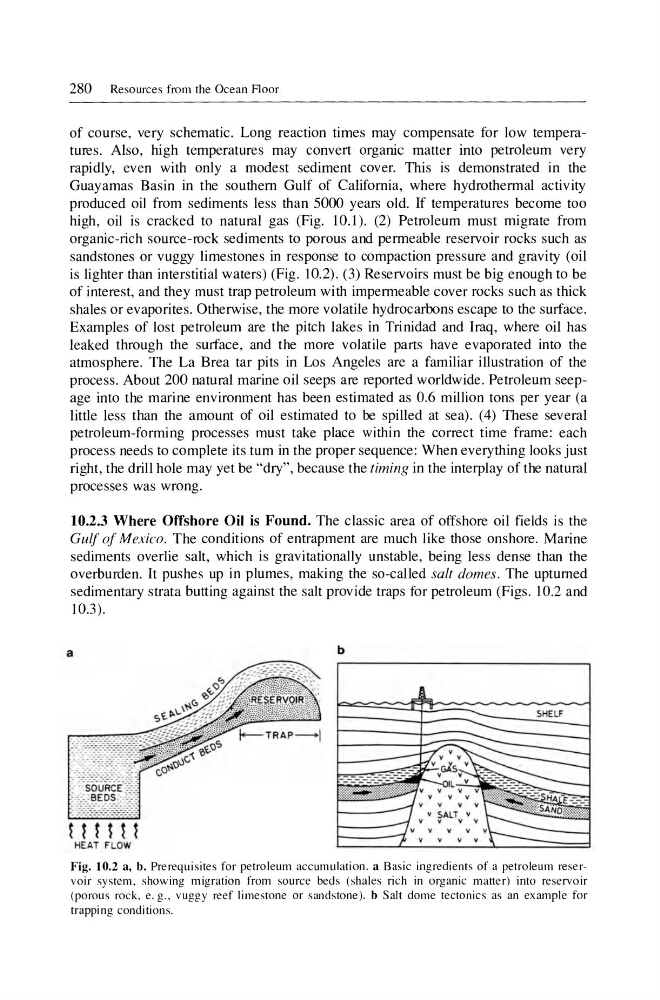
is lighter than interstitial waters) (Fig. 10.2). (3) Reservoirs must be big enough to be
of interest, and they must trap petroleum with impermeable cover rocks such as thick
shales or evaporites. Otherwise, the more volatile hydrocarbons escape to the surface.
Examples of lost petroleum are the pitch lakes in Trinidad and Iraq, where oil has
leaked through the surface, and the more volatile parts have evaporated into the
atmosphere. The La Brea tar pits in Los Angeles are a familiar illustration of the
process. About 200 natural marine oil seeps are reported worldwide. Petroleum seepage into the marine environment has been estimated as 0.6 million tons per year (a
little less than the amount of oil estimated to be spilled at sea). (4) These several
petroleum-forming processes must take place within the correct time frame: each
process needs to complete its tum in the proper sequence: When everything looks just
right, the drill hole may yet be "dry", because the timing in the interplay of the natural
processes was wrong.
10.2.3 Where Offshore Oil is Found. The classic area of offshore oil fields is the
Gulf of Mexico. The conditions of entrapment are much like those onshore. Marine
sediments overlie salt, which is gravitationally unstable, being less dense than the
overburden. It pushes up in plumes, making the so-called salt domes. The uptumed
sedimentary strata butting against the salt provide traps for petroleum (Figs. 10.2 and
10.3).
a
b
f t ttl t
HEAT FLOW
Fig. 10.2 a, b. Prerequisites for petroleum accumulation. a Basic ingredients of a petroleum reservoir system, showing migration from source beds (shales rich in organic matter) into reservoir
(porous rock. e. g .. vuggy reef limestone or sandstone). b Salt dome tectonics as an example for
trapping conditions.
of course, very schematic. Long reaction times may compensate for low temperatures. Also, high temperatures may convert organic matter into petroleum very
rapidly, even with only a modest sediment cover. This is demonstrated in the
Guayamas Basin in the southern Gulf of California, where hydrothermal activity
produced oil from sediments less than 5000 years old. If temperatures become too
high, oil is cracked to natural gas (Fig. 10.1). (2) Petroleum must migrate from
organic-rich source-rock sediments to porous and permeable reservoir rocks such as
sandstones or vuggy limestones in response to compaction pressure and gravity (oil
is lighter than interstitial waters) (Fig. 10.2). (3) Reservoirs must be big enough to be
of interest, and they must trap petroleum with impermeable cover rocks such as thick
shales or evaporites. Otherwise, the more volatile hydrocarbons escape to the surface.
Examples of lost petroleum are the pitch lakes in Trinidad and Iraq, where oil has
leaked through the surface, and the more volatile parts have evaporated into the
atmosphere. The La Brea tar pits in Los Angeles are a familiar illustration of the
process. About 200 natural marine oil seeps are reported worldwide. Petroleum seepage into the marine environment has been estimated as 0.6 million tons per year (a
little less than the amount of oil estimated to be spilled at sea). (4) These several
petroleum-forming processes must take place within the correct time frame: each
process needs to complete its tum in the proper sequence: When everything looks just
right, the drill hole may yet be "dry", because the timing in the interplay of the natural
processes was wrong.
10.2.3 Where Offshore Oil is Found. The classic area of offshore oil fields is the
Gulf of Mexico. The conditions of entrapment are much like those onshore. Marine
sediments overlie salt, which is gravitationally unstable, being less dense than the
overburden. It pushes up in plumes, making the so-called salt domes. The uptumed
sedimentary strata butting against the salt provide traps for petroleum (Figs. 10.2 and
10.3).
a
b
f t ttl t
HEAT FLOW
Fig. 10.2 a, b. Prerequisites for petroleum accumulation. a Basic ingredients of a petroleum reservoir system, showing migration from source beds (shales rich in organic matter) into reservoir
(porous rock. e. g .. vuggy reef limestone or sandstone). b Salt dome tectonics as an example for
trapping conditions.