

Petroleum Beneath the Sea Roor
279
if all US consumption were to be supplied from US reserves as defined in available
statistics.
So far new discoveries have kept up with increasing use . At some point, of course,
new discoveries will fall behind. Some experts think that this is happening right now.
10.2.2 Origin of Petroleum. Petroleum is a complex mixture of hydrocarbons and
other organic compounds originating from organic matter produced both on land and
in the sea, but largely from marine plankton. Therefore, essentially, petroleum is
stored fossil solar energy; but this storage system is extremely inefficient. At present,
only 0.23 % of solar radiation is used for photosynthesis (the basis of organic production). During Earth's history, less than 0.1 % of the organic production was preserved
in sediments as organic carbon compounds. Only about 0.01 % of this organic matter
in sediments became concentrated in oil and gas fields. Why so little?
The reasons are manifold. (1) The organic matter captured within the sediment
must be converted to fluid petroleum by thermochemical processes, requiring a blanket of sediments more than 1000 m thick and temperatures of 50 to 150 °C. This is ,
HYDROCARBONS GENERATED
UUAIES
o
'BIOCHEMICAL CH4
~ ~ ~
--~~~
E
~------~l ~J U ~
:.::
:r 2
~
a..
w
0
:3
C-ATOI WIIID
RII'IUIIlR
C-ATOI IUIBER
GAS
4
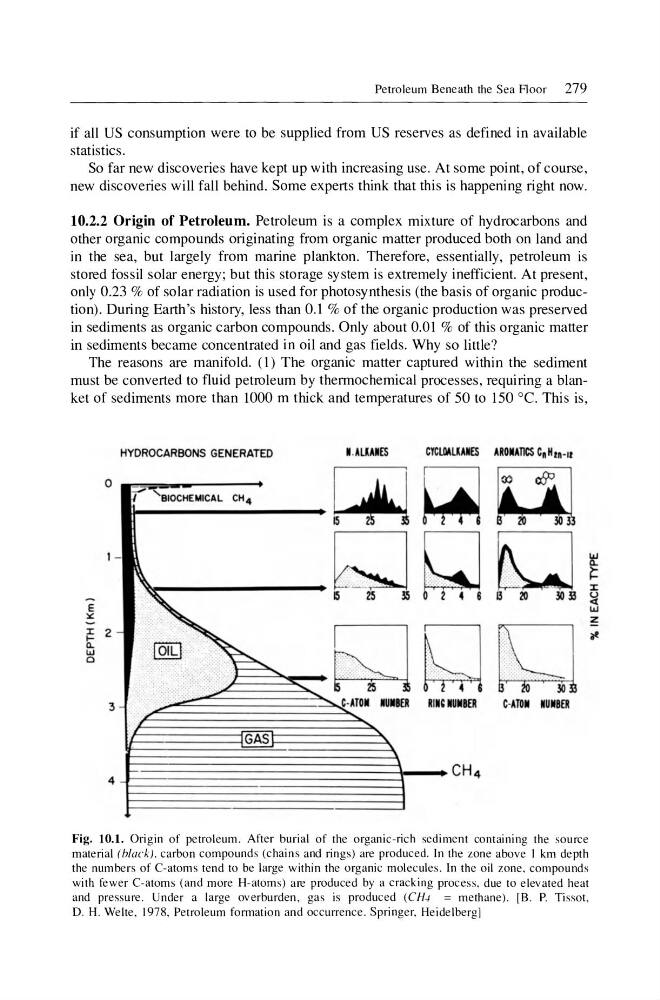
Fig. 10.1. Origin of petroleum. After burial of Ihe organic-rich sedimenl containing the source
material (black). carbon compounds (chains and rings) are produced. In the zone above I km depth
the numbers of C-atoms tend 10 be large within the organic mol ecules. In the oil zone. compounds
with fewer C-atoms (and more H-atoms) are produced by a cracking process. due to elevated heat
and press ure. Under a large overburden, gas is produced (CH.J = methane). [B. P. Tissot,
D. H. Welte, 1978, Petroleum formation and occurrence. Springer, He ide lberg]
ILl
~
279
if all US consumption were to be supplied from US reserves as defined in available
statistics.
So far new discoveries have kept up with increasing use . At some point, of course,
new discoveries will fall behind. Some experts think that this is happening right now.
10.2.2 Origin of Petroleum. Petroleum is a complex mixture of hydrocarbons and
other organic compounds originating from organic matter produced both on land and
in the sea, but largely from marine plankton. Therefore, essentially, petroleum is
stored fossil solar energy; but this storage system is extremely inefficient. At present,
only 0.23 % of solar radiation is used for photosynthesis (the basis of organic production). During Earth's history, less than 0.1 % of the organic production was preserved
in sediments as organic carbon compounds. Only about 0.01 % of this organic matter
in sediments became concentrated in oil and gas fields. Why so little?
The reasons are manifold. (1) The organic matter captured within the sediment
must be converted to fluid petroleum by thermochemical processes, requiring a blanket of sediments more than 1000 m thick and temperatures of 50 to 150 °C. This is ,
HYDROCARBONS GENERATED
UUAIES
o
'BIOCHEMICAL CH4
~ ~ ~
--~~~
E
~------~l ~J U ~
:.::
:r 2
~
a..
w
0
:3
C-ATOI WIIID
RII'IUIIlR
C-ATOI IUIBER
GAS
4
Fig. 10.1. Origin of petroleum. After burial of Ihe organic-rich sedimenl containing the source
material (black). carbon compounds (chains and rings) are produced. In the zone above I km depth
the numbers of C-atoms tend 10 be large within the organic mol ecules. In the oil zone. compounds
with fewer C-atoms (and more H-atoms) are produced by a cracking process. due to elevated heat
and press ure. Under a large overburden, gas is produced (CH.J = methane). [B. P. Tissot,
D. H. Welte, 1978, Petroleum formation and occurrence. Springer, He ide lberg]
ILl
~