

Cretaceous Oceans : a Question of Oxygenation
273
reduce the oxygen supply. This is a common factor today, along continental margins
(but is unimportant in the open ocean).
One scenario that also needs to be considered is the formation of heavy warm
saline water masses originating from high evaporation shelf seas. Pulsed input from
such sources to the deep ocean could conceivably produce stagnant bottom water
layers in somewhat restricted areas, as existed in the early Atlantic.
9.8.4 Milankovitch in the Cretaceous? Many pelagic sediments of Cretaceous age -
some now exposed in the mountains of Italy, others in the deep ocean - show distinct
cyclic deposition. Alternations of organic-rich and carbonate-rich facies are typical.
The detailed mathematical analysis of numerical sequences of such alternations (by
Fourier expansion) indicates that orbital cycles were important in producing them.
What might be the mechanism translating orbital information into sediment cycles,
during ice-free times? We do not know - presumably these mechanisms have to do
with fluctuations in productivity, perhaps linked to oxygen supply to the deep sea
(which releases nutrients) and to a changing rate of overturn, from fluctuations in
deep-water formation, and from a slight change in the latitude where deep waters
formed. It is unlikely that we shall know about these mechanisms soon - after all, we
do not yet understand the cycles of the Quaternary very well, even though they
govern the period we live in.
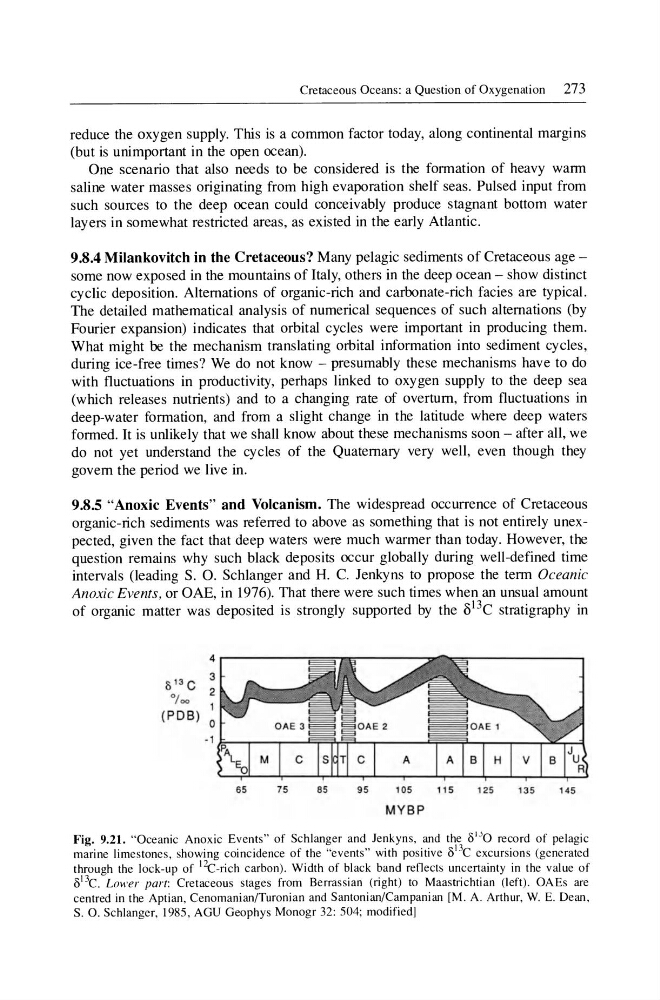
9.8.5 " Anoxic Events" and Volcanism. The widespread occurrence of Cretaceous
organic-rich sediments was referred to above as something that is not entirely unexpected, given the fact that deep waters were much warmer than today. However, the
question remains why such black deposits occur globally during well-defined time
intervals (leading S. O. Schlanger and H. C. Jenkyns to propose the term Oceanic
Anoxic Events . or OAE, in 1976). That there were such times when an unsual amount
of organic matter was deposited is strongly supported by the ol3C stratigraphy in
4
& 13 C
3
°/00
2
(POB) 0
· 1
65
75
85
95
1 0 5
11 5
125
135
145
MYBP
Fig. 9.21. " Oceanic Anoxic Events" of Schlanger and Jenkyns, and the 1)"0 record of pelagic
marine limestones, showing coincidence of the "events" with positive 1)1 3C excursions (generated
through the lock-up of 12c-rich carbon). Width of black band reflects uncertainty in the value of
ol3e. Lower part: Cretaceous stages from Berrassian (right) to Maastrichtian (left). OAEs are
centred in the Aptian, Cenomanian/Turonian and Santonian/Campanian [M. A. Arthur, W. E. Dean ,
S. O. Schlanger, 1985 , AGU Geophys Monogr 32: 504; modifi ed]
273
reduce the oxygen supply. This is a common factor today, along continental margins
(but is unimportant in the open ocean).
One scenario that also needs to be considered is the formation of heavy warm
saline water masses originating from high evaporation shelf seas. Pulsed input from
such sources to the deep ocean could conceivably produce stagnant bottom water
layers in somewhat restricted areas, as existed in the early Atlantic.
9.8.4 Milankovitch in the Cretaceous? Many pelagic sediments of Cretaceous age -
some now exposed in the mountains of Italy, others in the deep ocean - show distinct
cyclic deposition. Alternations of organic-rich and carbonate-rich facies are typical.
The detailed mathematical analysis of numerical sequences of such alternations (by
Fourier expansion) indicates that orbital cycles were important in producing them.
What might be the mechanism translating orbital information into sediment cycles,
during ice-free times? We do not know - presumably these mechanisms have to do
with fluctuations in productivity, perhaps linked to oxygen supply to the deep sea
(which releases nutrients) and to a changing rate of overturn, from fluctuations in
deep-water formation, and from a slight change in the latitude where deep waters
formed. It is unlikely that we shall know about these mechanisms soon - after all, we
do not yet understand the cycles of the Quaternary very well, even though they
govern the period we live in.
9.8.5 " Anoxic Events" and Volcanism. The widespread occurrence of Cretaceous
organic-rich sediments was referred to above as something that is not entirely unexpected, given the fact that deep waters were much warmer than today. However, the
question remains why such black deposits occur globally during well-defined time
intervals (leading S. O. Schlanger and H. C. Jenkyns to propose the term Oceanic
Anoxic Events . or OAE, in 1976). That there were such times when an unsual amount
of organic matter was deposited is strongly supported by the ol3C stratigraphy in
4
& 13 C
3
°/00
2
(POB) 0
· 1
65
75
85
95
1 0 5
11 5
125
135
145
MYBP
Fig. 9.21. " Oceanic Anoxic Events" of Schlanger and Jenkyns, and the 1)"0 record of pelagic
marine limestones, showing coincidence of the "events" with positive 1)1 3C excursions (generated
through the lock-up of 12c-rich carbon). Width of black band reflects uncertainty in the value of
ol3e. Lower part: Cretaceous stages from Berrassian (right) to Maastrichtian (left). OAEs are
centred in the Aptian, Cenomanian/Turonian and Santonian/Campanian [M. A. Arthur, W. E. Dean ,
S. O. Schlanger, 1985 , AGU Geophys Monogr 32: 504; modifi ed]