

272 Paleoceanography - the Deep-Sea Record
°2(mIjL)
Salinity ("' 00)
°2(mljL)
0 246 8
'\.
0,5
E
~
:r
...
~
...
0
a:
2
... ...
a
17
23
-,~
AEROBIC
/'
• ~
!ANAEROBIC
Rich looblntl'lOS abo.e I ~O -175m_
Laminat.d c lay'Y ond mar ly muds
In 'hi ono. it d.pth . no benthic lift.
BLACK SEA
024 6
b
Oatt! orow"
,.",d..
2
N . INDIAN
OCEAN
3
4
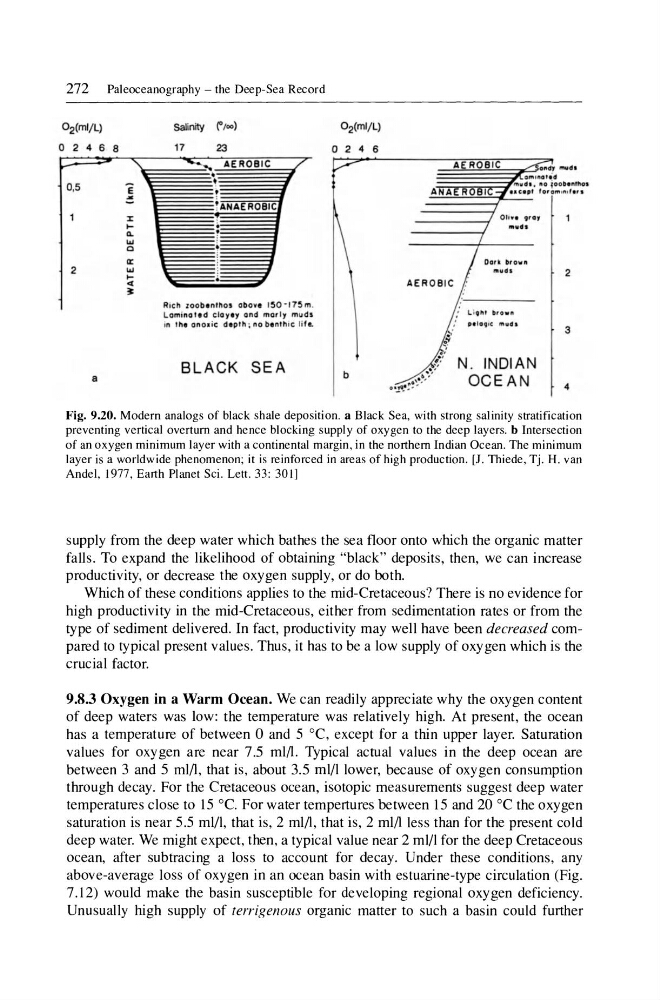
Fig. 9.20. Modern analogs of black shale deposition. a Black Sea, with strong salinity stratification
preventing vertical overturn and hence blocking supply of oxygen to the deep layers. b Intersection
of an oxygen minimum layer with a continental margin, in the northern Indian Ocean. The minimum
layer is a worldwide phenomenon; it is reinforced in areas of high production. [I. Thiede, Tj. H. van
Andel, 1977, Earth Planet Sci. Lett. 33: 301]
supply from the deep water which bathes the sea floor onto which the organic matter
falls. To expand the likelihood of obtaining "black" deposits, then, we can increase
productivity, or decrease the oxygen supply, or do both.
Which of these conditions applies to the mid-Cretaceous? There is no evidence for
high productivity in the mid-Cretaceous, either from sedimentation rates or from the
type of sediment delivered. In fact, productivity may well have been decreased compared to typical present values. Thus, it has to be a low supply of oxygen which is the
crucial factor.
9.8.3 Oxygen in a Warm Ocean. We can readily appreciate why the oxygen content
of deep waters was low: the temperature was relatively high. At present, the ocean
has a temperature of between 0 and 5 0c, except for a thin upper layer. Saturation
values for oxygen are near 7.5 mIll. Typical actual values in the deep ocean are
between 3 and 5 ml/l , that is, about 3.5 mill lower, because of oxygen consumption
through decay. For the Cretaceous ocean, isotopic measurements suggest deep water
temperatures close to 15 °C. For water tempertures between 15 and 20°C the oxygen
saturation is near 5.5 mIll, that is, 2 ml/l, that is, 2 ml/lless than for the present cold
deep water. We might expect, then, a typical value near 2 mill for the deep Cretaceous
ocean, after subtracing a loss to account for decay. Under these conditions, any
above-average loss of oxygen in an ocean basin with estuarine-type circulation (Fig.
7.12) would make the basin susceptible for developing regional oxygen deficiency.
Unusually high supply of terrigenous organic matter to such a basin could further
°2(mIjL)
Salinity ("' 00)
°2(mljL)
0 246 8
'\.
0,5
E
~
:r
...
~
...
0
a:
2
... ...
a
17
23
-,~
AEROBIC
/'
• ~
!ANAEROBIC
Rich looblntl'lOS abo.e I ~O -175m_
Laminat.d c lay'Y ond mar ly muds
In 'hi ono. it d.pth . no benthic lift.
BLACK SEA
024 6
b
Oatt! orow"
,.",d..
2
N . INDIAN
OCEAN
3
4
Fig. 9.20. Modern analogs of black shale deposition. a Black Sea, with strong salinity stratification
preventing vertical overturn and hence blocking supply of oxygen to the deep layers. b Intersection
of an oxygen minimum layer with a continental margin, in the northern Indian Ocean. The minimum
layer is a worldwide phenomenon; it is reinforced in areas of high production. [I. Thiede, Tj. H. van
Andel, 1977, Earth Planet Sci. Lett. 33: 301]
supply from the deep water which bathes the sea floor onto which the organic matter
falls. To expand the likelihood of obtaining "black" deposits, then, we can increase
productivity, or decrease the oxygen supply, or do both.
Which of these conditions applies to the mid-Cretaceous? There is no evidence for
high productivity in the mid-Cretaceous, either from sedimentation rates or from the
type of sediment delivered. In fact, productivity may well have been decreased compared to typical present values. Thus, it has to be a low supply of oxygen which is the
crucial factor.
9.8.3 Oxygen in a Warm Ocean. We can readily appreciate why the oxygen content
of deep waters was low: the temperature was relatively high. At present, the ocean
has a temperature of between 0 and 5 0c, except for a thin upper layer. Saturation
values for oxygen are near 7.5 mIll. Typical actual values in the deep ocean are
between 3 and 5 ml/l , that is, about 3.5 mill lower, because of oxygen consumption
through decay. For the Cretaceous ocean, isotopic measurements suggest deep water
temperatures close to 15 °C. For water tempertures between 15 and 20°C the oxygen
saturation is near 5.5 mIll, that is, 2 ml/l, that is, 2 ml/lless than for the present cold
deep water. We might expect, then, a typical value near 2 mill for the deep Cretaceous
ocean, after subtracing a loss to account for decay. Under these conditions, any
above-average loss of oxygen in an ocean basin with estuarine-type circulation (Fig.
7.12) would make the basin susceptible for developing regional oxygen deficiency.
Unusually high supply of terrigenous organic matter to such a basin could further