

Cretaceous Oceans: a Question of Oxygenation
271
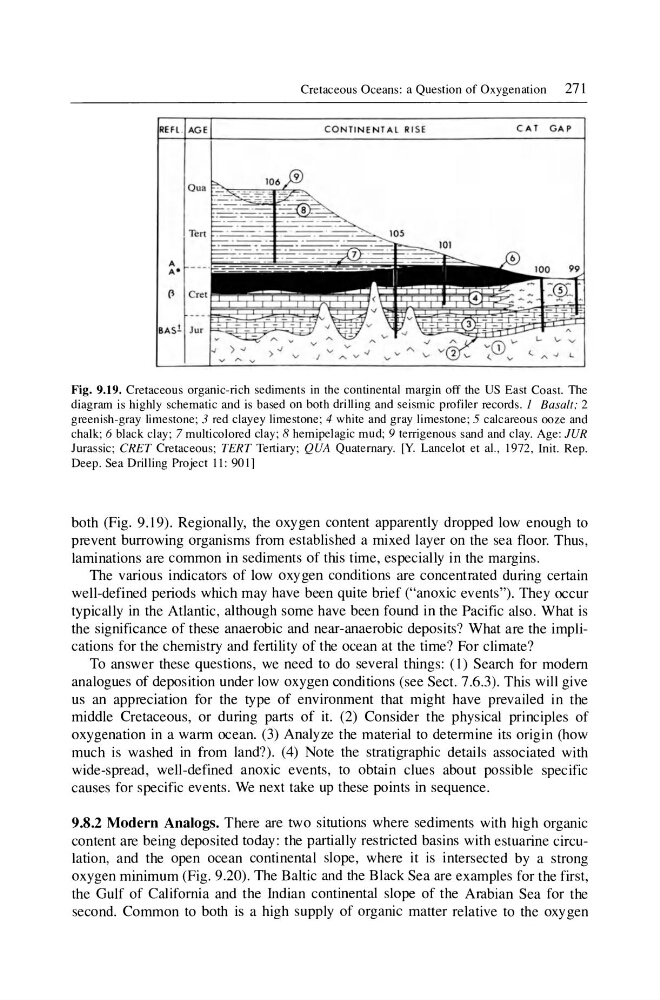
Fig. 9.19. Cretaceous organic-rich sediments in the continental margin off the US East Coast. The
diagram is highly schematic and is based on both drilling and seismic profiler records. 1 Basalt; 2
greenish-gray limestone; 3 red clayey limestone; 4 white and gray limestone; 5 calcareous ooze and
chalk; 6 black clay; 7 multicolored clay; 8 hemipelagic mud; 9 terrigenous sand and clay. Age: fUR
Jurassic; CRET Cretaceous; TERT Tertiary; QUA Quaternary. [Y. Lancelot et al.. 1972, Init. Rep.
Deep. Sea Drilling Project 11 : 901]
both (Fig. 9.19). Regionally, the oxygen content apparently dropped low enough to
prevent burrowing organisms from established a mixed layer on the sea floor. Thus,
laminations are common in sediments of this time, especially in the margins.
The various indicators of low oxygen conditions are concentrated during certain
well-defined periods which may have been quite brief ("anoxic events"). They occur
typically in the Atlantic, although some have been found in the Pacific also. What is
the significance of these anaerobic and near-anaerobic deposits? What are the implications for the chemistry and fertility of the ocean at the time? For climate?
To answer these questions, we need to do several things: (I) Search for modem
analogues of deposition under low oxygen conditions (see Sect. 7.6.3). This will give
us an appreciation for the type of environment that might have prevailed in the
middle Cretaceous, or during parts of it. (2) Consider the physical principles of
oxygenation in a warm ocean. (3) Analyze the material to determine its origin (how
much is washed in from land?). (4) Note the stratigraphic details associated with
wide-spread, well-defined anoxic events, to obtain clues about possible specific
causes for specific events. We next take up these points in sequence.
9.8.2 Modern Analogs. There are two situtions where sediments with high organic
content are being deposited today: the partially restricted basins with estuarine circulation, and the open ocean continental slope, where it is intersected by a strong
oxygen minimum (Fig. 9.20). The Baltic and the Black Sea are examples for the first,
the Gulf of California and the Indian continental slope of the Arabian Sea for the
second. Common to both is a high supply of organic matter relative to the oxygen
271
Fig. 9.19. Cretaceous organic-rich sediments in the continental margin off the US East Coast. The
diagram is highly schematic and is based on both drilling and seismic profiler records. 1 Basalt; 2
greenish-gray limestone; 3 red clayey limestone; 4 white and gray limestone; 5 calcareous ooze and
chalk; 6 black clay; 7 multicolored clay; 8 hemipelagic mud; 9 terrigenous sand and clay. Age: fUR
Jurassic; CRET Cretaceous; TERT Tertiary; QUA Quaternary. [Y. Lancelot et al.. 1972, Init. Rep.
Deep. Sea Drilling Project 11 : 901]
both (Fig. 9.19). Regionally, the oxygen content apparently dropped low enough to
prevent burrowing organisms from established a mixed layer on the sea floor. Thus,
laminations are common in sediments of this time, especially in the margins.
The various indicators of low oxygen conditions are concentrated during certain
well-defined periods which may have been quite brief ("anoxic events"). They occur
typically in the Atlantic, although some have been found in the Pacific also. What is
the significance of these anaerobic and near-anaerobic deposits? What are the implications for the chemistry and fertility of the ocean at the time? For climate?
To answer these questions, we need to do several things: (I) Search for modem
analogues of deposition under low oxygen conditions (see Sect. 7.6.3). This will give
us an appreciation for the type of environment that might have prevailed in the
middle Cretaceous, or during parts of it. (2) Consider the physical principles of
oxygenation in a warm ocean. (3) Analyze the material to determine its origin (how
much is washed in from land?). (4) Note the stratigraphic details associated with
wide-spread, well-defined anoxic events, to obtain clues about possible specific
causes for specific events. We next take up these points in sequence.
9.8.2 Modern Analogs. There are two situtions where sediments with high organic
content are being deposited today: the partially restricted basins with estuarine circulation, and the open ocean continental slope, where it is intersected by a strong
oxygen minimum (Fig. 9.20). The Baltic and the Black Sea are examples for the first,
the Gulf of California and the Indian continental slope of the Arabian Sea for the
second. Common to both is a high supply of organic matter relative to the oxygen