

274 Paleoceanography - the Deep-Sea Record
marine carbonates (as emphasized by P. A. Scholle and M. A. Arthur, in 1980).
During the crucial intervals, one observes distinct positive excursions in the (i l3 e
record, which result from the preferential extraction of 12e into organic matter, whose
rate of deposition was greatly increased at the time (see Fig. 9.21).
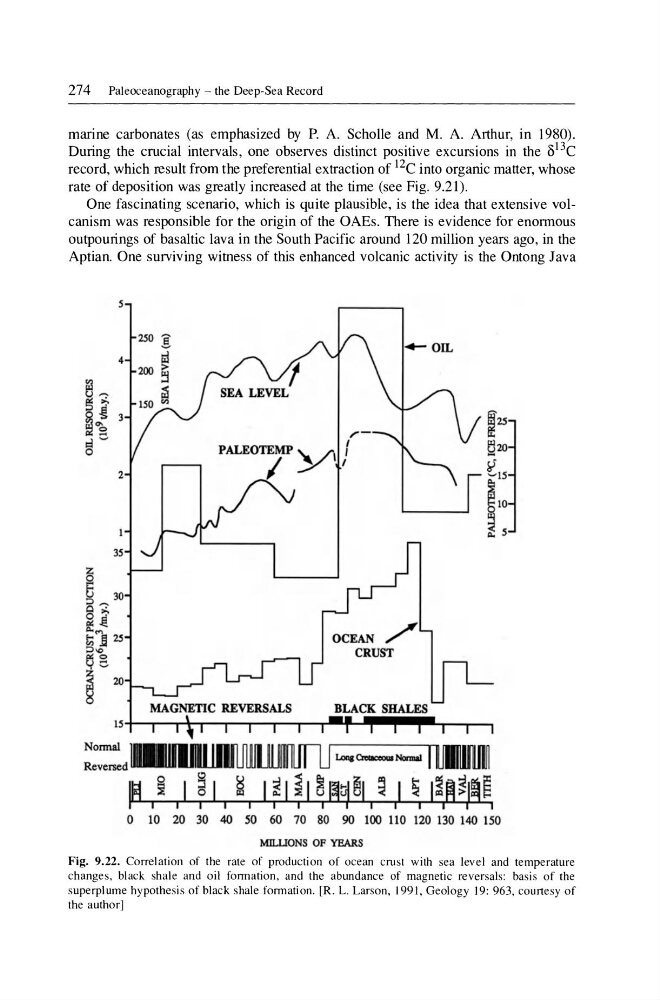
One fascinating scenario, which is quite plausible, is the idea that extensive volcanism was responsible for the origin of the OAEs. There is evidence for enormous
outpourings of basaltic lava in the South Pacific around 120 million years ago, in the
Aptian. One surviving witness of this enhanced volcanic activity is the Ontong Java
s
250
4
200
2
3S
r -
I
PALEOiMPyJ
"'-OIL
OCEAN . /
CRUST
MAGNETIC REVERSALS
BLACK SHALES
ls+-.,--Th--,--,r-,--.,-....,... .......... I111111~ .... -r--r-.....,
Nonnal
Reversed
1M ~ I I ~ I ~ I I ~ I ~ I ~ ~~ ~II ~ II ~I I~IA ~II~ S,
o 10 20 30 40 50 60 70 80 90 100 110 120 130 140 150
MILUONS Of YEARS
Fig. 9.22. Correlation of the rate of production of ocean crust with sea level and temperature
changes, black shale and oil formation, and the abundance of magnetic reversals: basis of the
superplume hypothesis of black shale formation. [R. L. Larson, 1991, Geology 19: 963, courtesy of
the author]
marine carbonates (as emphasized by P. A. Scholle and M. A. Arthur, in 1980).
During the crucial intervals, one observes distinct positive excursions in the (i l3 e
record, which result from the preferential extraction of 12e into organic matter, whose
rate of deposition was greatly increased at the time (see Fig. 9.21).
One fascinating scenario, which is quite plausible, is the idea that extensive volcanism was responsible for the origin of the OAEs. There is evidence for enormous
outpourings of basaltic lava in the South Pacific around 120 million years ago, in the
Aptian. One surviving witness of this enhanced volcanic activity is the Ontong Java
s
250
4
200
2
3S
r -
I
PALEOiMPyJ
"'-OIL
OCEAN . /
CRUST
MAGNETIC REVERSALS
BLACK SHALES
ls+-.,--Th--,--,r-,--.,-....,... .......... I111111~ .... -r--r-.....,
Nonnal
Reversed
1M ~ I I ~ I ~ I I ~ I ~ I ~ ~~ ~II ~ II ~I I~IA ~II~ S,
o 10 20 30 40 50 60 70 80 90 100 110 120 130 140 150
MILUONS Of YEARS
Fig. 9.22. Correlation of the rate of production of ocean crust with sea level and temperature
changes, black shale and oil formation, and the abundance of magnetic reversals: basis of the
superplume hypothesis of black shale formation. [R. L. Larson, 1991, Geology 19: 963, courtesy of
the author]