

Calcareous Ooze: CCD and Lysocline
227
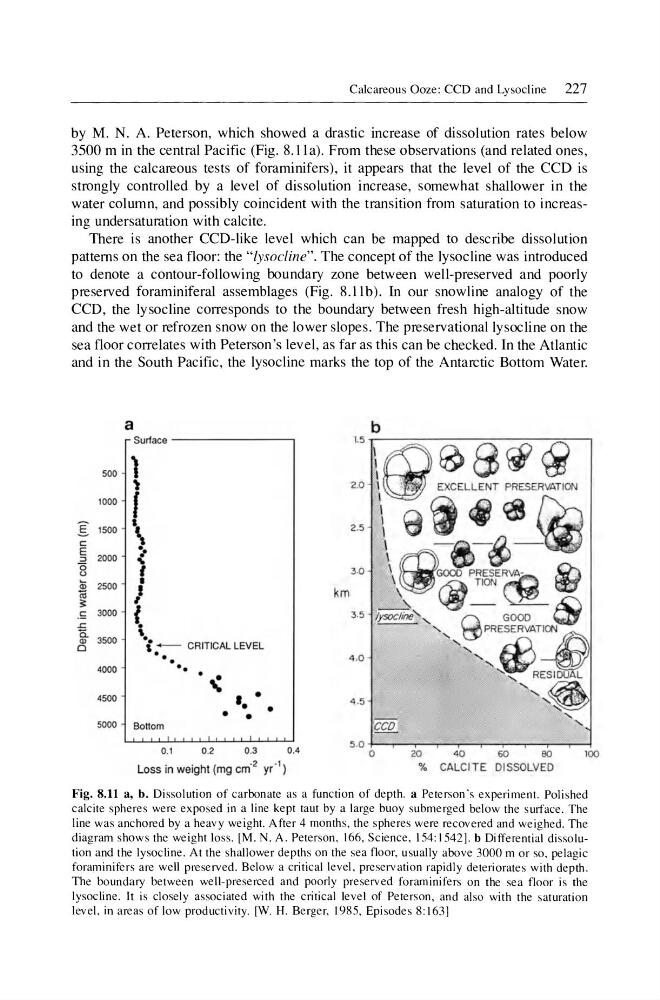
by M. N. A. Peterson, which showed a drastic increase of dissolution rates below
3500 m in the central Pacific (Fig. 8.11a). From these observations (and related ones,
using the calcareous tests of foraminifers), it appears that the level of the CCD is
strongly controlled by a level of dissolution increase, somewhat shallower in the
water column, and possibly coincident with the transition from saturation to increasing undersaturation with calcite.
There is another CCD-Iike level which can be mapped to describe dissolution
patterns on the sea floor: the "lysocline". The concept of the lysocline was introduced
to denote a contour-following boundary zone between well-preserved and poorly
preserved foraminiferal assemblages (Fig. 8.11b). In our snowline analogy of the
CCD, the lysocline corresponds to the boundary between fresh high-altitude snow
and the wet or refrozen snow on the lower slopes. The preservational lysocline on the
sea floor correlates with Peterson's level, as far as this can be checked. In the Atlantic
and in the South Pacific, the lysocline marks the top of the Antarctic Bottom Water.
a
Surface - - - - - - - - - ,
SOO 1 l
1000
I lS00
c
§ 2000
"8
Q; 2S00
~
.5 3000
.c
a.
Q)
3500
o
4000
4500
I
'\
~
'\0
I
•
,t
{
'. i ~ CRITICAL LEVEL
.. ..
o •
~
•
• •
• •
•
5000
Bottom
0,1
0.2
03
0,4
Loss in weight (mg cm· 2 yr · 1 )
b
1.5
~
\rn ~ e~ ~
2,0 \ ~ EXCELLENT PRESERVATION
,,\9i tla . .
\ -3-&- '
,, ~GOOD PRESER~VA - ii, '. riA TION
•
km
\
' \f!IJI
3,5 ~/~,
; ; - GOOD
~
- - - """ "
t'JlPRESERVATl}ION
4 .0
" ", ~
" ' ,
RES IDU L
' .
"4 ,5
"
5,0 +--'---r--r---'r--r---'-"T'""--r--r-~
o
20
40
60
eo
100
% CALC ITE DISSOLVED
Fig. 8.11 a, b. Dissolution of carbonate as a function of depth, a Peterson's experiment. Polished
calcite spheres were exposed in a line kept taut by a large buoy submerged below the surface. The
line was anchored by a heavy weight. After 4 months, the spheres were recovered and weighed. The
diagram shows the weight loss. [M, N, A. Peterson, 166, Science, 154: 1542]. b Differential dissolution and the lysocline , At the shallower depths on the sea floor, usually above 3000 m or so, pelagic
foraminifers are well preserved. Below a critical level, preservation rapidly deteriorates with depth,
The boundary between well-preserced and poorly preserved foraminifers on the sea floor is the
lysocline , It is closely associated with the critical level of Peterson , and also with the saturation
level. in areas of low productivity, [W, H, Berger, 1985, Episodes 8: 163]
227
by M. N. A. Peterson, which showed a drastic increase of dissolution rates below
3500 m in the central Pacific (Fig. 8.11a). From these observations (and related ones,
using the calcareous tests of foraminifers), it appears that the level of the CCD is
strongly controlled by a level of dissolution increase, somewhat shallower in the
water column, and possibly coincident with the transition from saturation to increasing undersaturation with calcite.
There is another CCD-Iike level which can be mapped to describe dissolution
patterns on the sea floor: the "lysocline". The concept of the lysocline was introduced
to denote a contour-following boundary zone between well-preserved and poorly
preserved foraminiferal assemblages (Fig. 8.11b). In our snowline analogy of the
CCD, the lysocline corresponds to the boundary between fresh high-altitude snow
and the wet or refrozen snow on the lower slopes. The preservational lysocline on the
sea floor correlates with Peterson's level, as far as this can be checked. In the Atlantic
and in the South Pacific, the lysocline marks the top of the Antarctic Bottom Water.
a
Surface - - - - - - - - - ,
SOO 1 l
1000
I lS00
c
§ 2000
"8
Q; 2S00
~
.5 3000
.c
a.
Q)
3500
o
4000
4500
I
'\
~
'\0
I
•
,t
{
'. i ~ CRITICAL LEVEL
.. ..
o •
~
•
• •
• •
•
5000
Bottom
0,1
0.2
03
0,4
Loss in weight (mg cm· 2 yr · 1 )
b
1.5
~
\rn ~ e~ ~
2,0 \ ~ EXCELLENT PRESERVATION
,,\9i tla . .
\ -3-&- '
,, ~GOOD PRESER~VA - ii, '. riA TION
•
km
\
' \f!IJI
3,5 ~/~,
; ; - GOOD
~
- - - """ "
t'JlPRESERVATl}ION
4 .0
" ", ~
" ' ,
RES IDU L
' .
"4 ,5
"
5,0 +--'---r--r---'r--r---'-"T'""--r--r-~
o
20
40
60
eo
100
% CALC ITE DISSOLVED
Fig. 8.11 a, b. Dissolution of carbonate as a function of depth, a Peterson's experiment. Polished
calcite spheres were exposed in a line kept taut by a large buoy submerged below the surface. The
line was anchored by a heavy weight. After 4 months, the spheres were recovered and weighed. The
diagram shows the weight loss. [M, N, A. Peterson, 166, Science, 154: 1542]. b Differential dissolution and the lysocline , At the shallower depths on the sea floor, usually above 3000 m or so, pelagic
foraminifers are well preserved. Below a critical level, preservation rapidly deteriorates with depth,
The boundary between well-preserced and poorly preserved foraminifers on the sea floor is the
lysocline , It is closely associated with the critical level of Peterson , and also with the saturation
level. in areas of low productivity, [W, H, Berger, 1985, Episodes 8: 163]