

226 Deep-Sea Sediments - Patterns, Processes, and Stratigraphic Methods
circulation, which fills the deep Atlantic with calcite-saturated waters (NADW), and
leaves much of the Pacific undersaturated (Sect. 7.6.5; Fig. 7.15).
8.5.2 Dissolution Patterns in the Deep Sea. Most of what is known about global
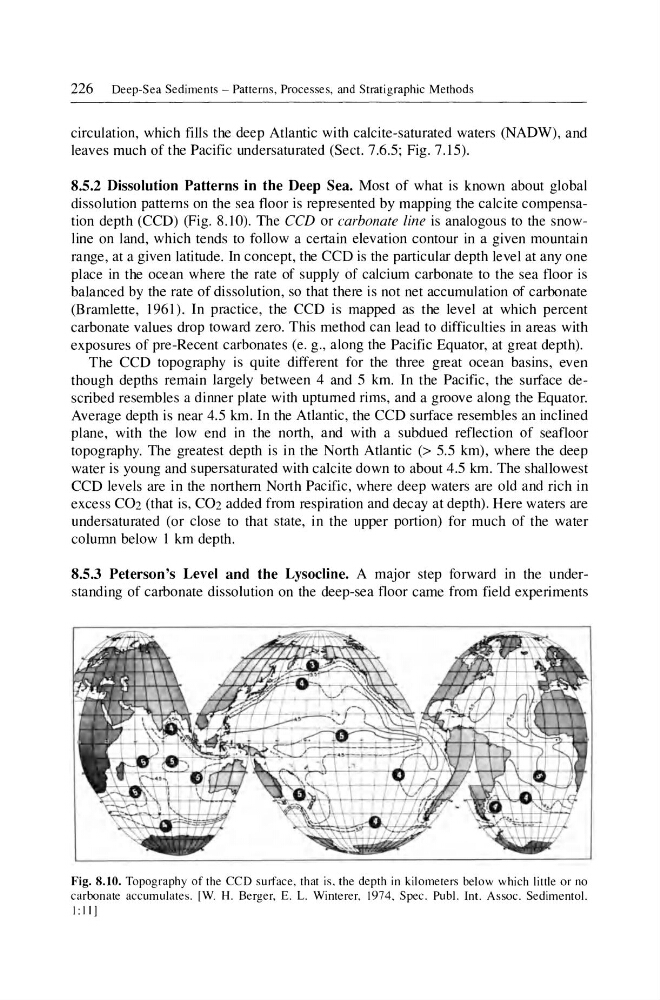
dissolution patterns on the sea floor is represented by mapping the calcite compensation depth (CCD) (Fig. 8.10). The CCD or carbonate line is analogous to the snowline on land, which tends to follow a certain elevation contour in a given mountain
range, at a given latitude. In concept, the CCD is the particular depth level at anyone
place in the ocean where the rate of supply of calcium carbonate to the sea floor is
balanced by the rate of dissolution, so that there is not net accumulation of carbonate
(Bramlette, 1961). In practice, the CCD is mapped as the level at which percent
carbonate values drop toward zero. This method can lead to difficulties in areas with
exposures of pre-Recent carbonates (e. g., along the Pacific Equator, at great depth).
The CCD topography is quite different for the three great ocean basins, even
though depths remain largely between 4 and 5 km. In the Pacific, the surface described resembles a dinner plate with upturned rims, and a groove along the Equator.
Average depth is near 4.5 km. In the Atlantic, the CCD surface resembles an inclined
plane, with the low end in the north, and with a subdued reflection of seafloor
topography. The greatest depth is in the North Atlantic (> 5.5 km), where the deep
water is young and supersaturated with calcite down to about 4.5 km. The shallowest
CCD levels are in the northern North Pacific, where deep waters are old and rich in
excess C02 (that is, C02 added from respiration and decay at depth). Here waters are
undersaturated (or close to that state, in the upper portion) for much of the water
column below I km depth.
8.5.3 Peterson's Level and the Lysocline. A major step forward in the understanding of carbonate dissolution on the deep-sea floor came from field experiments
Fig. 8.10. Topography of the CCD surface, that is . the depth in kilometers below which little or no
carbonate accumulates. [W. H. Berger, E. L. Winterer, 1974, Spec. Publ. In!. Assoc . Sedimentol.
1: 11]
circulation, which fills the deep Atlantic with calcite-saturated waters (NADW), and
leaves much of the Pacific undersaturated (Sect. 7.6.5; Fig. 7.15).
8.5.2 Dissolution Patterns in the Deep Sea. Most of what is known about global
dissolution patterns on the sea floor is represented by mapping the calcite compensation depth (CCD) (Fig. 8.10). The CCD or carbonate line is analogous to the snowline on land, which tends to follow a certain elevation contour in a given mountain
range, at a given latitude. In concept, the CCD is the particular depth level at anyone
place in the ocean where the rate of supply of calcium carbonate to the sea floor is
balanced by the rate of dissolution, so that there is not net accumulation of carbonate
(Bramlette, 1961). In practice, the CCD is mapped as the level at which percent
carbonate values drop toward zero. This method can lead to difficulties in areas with
exposures of pre-Recent carbonates (e. g., along the Pacific Equator, at great depth).
The CCD topography is quite different for the three great ocean basins, even
though depths remain largely between 4 and 5 km. In the Pacific, the surface described resembles a dinner plate with upturned rims, and a groove along the Equator.
Average depth is near 4.5 km. In the Atlantic, the CCD surface resembles an inclined
plane, with the low end in the north, and with a subdued reflection of seafloor
topography. The greatest depth is in the North Atlantic (> 5.5 km), where the deep
water is young and supersaturated with calcite down to about 4.5 km. The shallowest
CCD levels are in the northern North Pacific, where deep waters are old and rich in
excess C02 (that is, C02 added from respiration and decay at depth). Here waters are
undersaturated (or close to that state, in the upper portion) for much of the water
column below I km depth.
8.5.3 Peterson's Level and the Lysocline. A major step forward in the understanding of carbonate dissolution on the deep-sea floor came from field experiments
Fig. 8.10. Topography of the CCD surface, that is . the depth in kilometers below which little or no
carbonate accumulates. [W. H. Berger, E. L. Winterer, 1974, Spec. Publ. In!. Assoc . Sedimentol.
1: 11]