

Calcareous Ooze
225
kaolinite actually becomes dominant. Chlorite generally is abundant off continents in
high latitudes and is dominant in the Alaska Bight.
From the evidence reviewed, we may conclude that the case for continental
sources of most clay minerals is very strong, and it remains only to ask what proportion of the smectite is continent-derived. For the Atlantic, P. E. Biscaye (1965) argued
that montmorillonite crystallinity patterns run parallel with detrital patterns, and that
this indicates a predominance of continental montmorillonite supply. In the Pacific,
oceanic sources and "the ring of fire" supply the volcanic materials which decay to
montmorillonite.
8.S Calcareous Ooze
8.S.1 Depth Distribution. The ocean receives calcium from both rivers and the
hydrothermal alteration of basalt on the young sea floor. The input is such that the
amount of calcium in the oceans can be delivered within somewhat less than one
million years. To balance this input, the ocean precipitates calcium carbonate. The
precipitation takes place near the surface, within shell- and skeleton-building organisms (coccolithophores, foraminifers, mollusks, corals, algae). Some of these hard
parts (in the main planktonic) find their way to the sea floor, where they are preserved
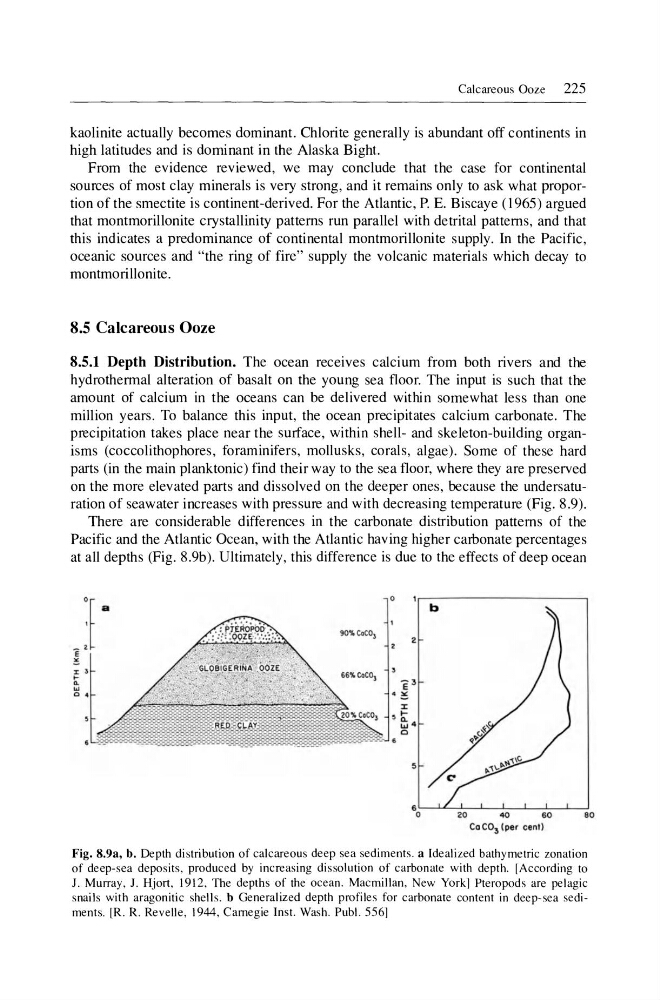
on the more elevated parts and dissolved on the deeper ones, because the undersaturation of seawater increases with pressure and with decreasing temperature (Fig. 8.9).
There are considerable differences in the carbonate distribution patterns of the
Pacific and the Atlantic Ocean, with the Atlantic having higher carbonate percentages
at all depths (Fig. 8.9b). Ultimately, this difference is due to the effects of deep ocean
BO
Fig. 8.9a, b. Depth distribution of calcareous deep sea sediments. a Idealized bathymetric zonation
of deep-sea deposits, produced by increasing dissolution of carbonate with depth. [According to
J. Murray, J. Hjort. 1912. The depths of the ocean. Macmillan, New York] Pteropods are pelagic
snails with aragonitic shells. b Generalized depth profiles for carbonate content in deep-sea sediments. [R. R. Revelle, 1944, Carnegie Inst. Wash. Pub!. 556]
225
kaolinite actually becomes dominant. Chlorite generally is abundant off continents in
high latitudes and is dominant in the Alaska Bight.
From the evidence reviewed, we may conclude that the case for continental
sources of most clay minerals is very strong, and it remains only to ask what proportion of the smectite is continent-derived. For the Atlantic, P. E. Biscaye (1965) argued
that montmorillonite crystallinity patterns run parallel with detrital patterns, and that
this indicates a predominance of continental montmorillonite supply. In the Pacific,
oceanic sources and "the ring of fire" supply the volcanic materials which decay to
montmorillonite.
8.S Calcareous Ooze
8.S.1 Depth Distribution. The ocean receives calcium from both rivers and the
hydrothermal alteration of basalt on the young sea floor. The input is such that the
amount of calcium in the oceans can be delivered within somewhat less than one
million years. To balance this input, the ocean precipitates calcium carbonate. The
precipitation takes place near the surface, within shell- and skeleton-building organisms (coccolithophores, foraminifers, mollusks, corals, algae). Some of these hard
parts (in the main planktonic) find their way to the sea floor, where they are preserved
on the more elevated parts and dissolved on the deeper ones, because the undersaturation of seawater increases with pressure and with decreasing temperature (Fig. 8.9).
There are considerable differences in the carbonate distribution patterns of the
Pacific and the Atlantic Ocean, with the Atlantic having higher carbonate percentages
at all depths (Fig. 8.9b). Ultimately, this difference is due to the effects of deep ocean
BO
Fig. 8.9a, b. Depth distribution of calcareous deep sea sediments. a Idealized bathymetric zonation
of deep-sea deposits, produced by increasing dissolution of carbonate with depth. [According to
J. Murray, J. Hjort. 1912. The depths of the ocean. Macmillan, New York] Pteropods are pelagic
snails with aragonitic shells. b Generalized depth profiles for carbonate content in deep-sea sediments. [R. R. Revelle, 1944, Carnegie Inst. Wash. Pub!. 556]