

224 Deep-Sea Sediments - Patterns, Processes, and Stratigraphic Methods
Illite is a general tenn for clay components belonging to the mica group and their
derivatives; for present purposes it may be considered a fine-grained degraded muscovite. The muscovite structure again shows an octahedral layer, and the ratio of Si to
Al in the tetrahedral layer is exactly 3 to 1. The net negative charge of the "sandwich"
is balanced by nonhydrated, firmly bound K+ ions fitting in the holes left by the
hexagonal arrangement of the comers of the silica tetrahedrons.
Chlorite also consists of "sandwiches", but now bound by an additional octahedral
layer, the so-called brucite layer. Net charges of tetrahedral layers and of octahedral
layers balance each other, and therefore there are no inter-layer ions. Chlorite is a
common constituent of low-grade metamorphic rocks which are widely exposed on
glacially eroded shield areas and provide much of the material for glacial deposits.
Kaolinite consists of alternating tetrahedral and octahedral layers. It is a product of
intense chemical weathering, and represents an insoluble alumino-silicate residue
remaining after cations are stripped from feldspars and other minerals by extensive
leaching.
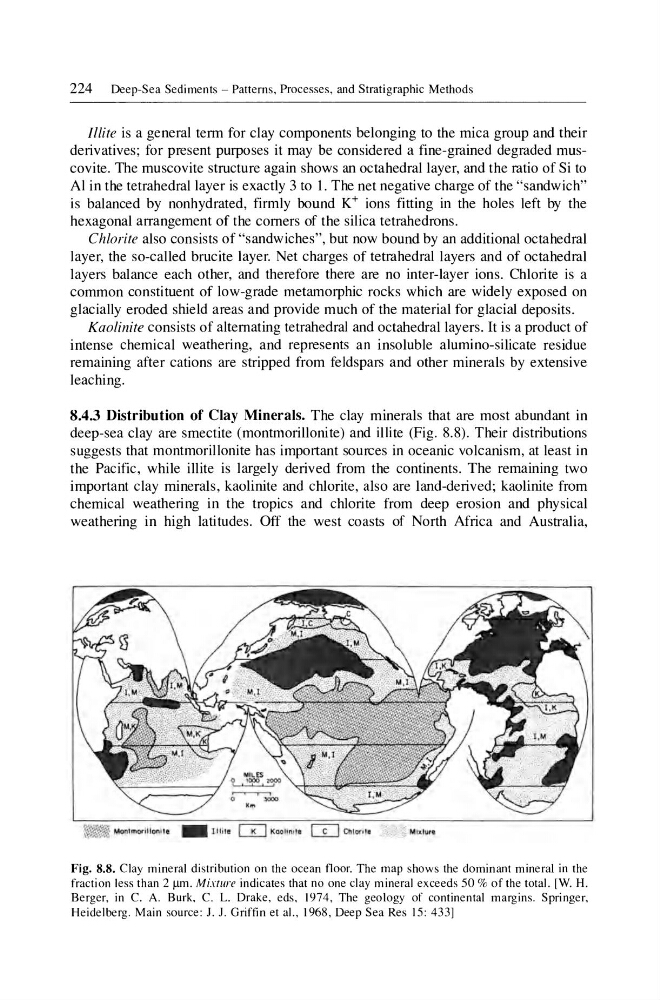
8.4.3 Distribution of Clay Minerals. The clay minerals that are most abundant in
deep-sea clay are smectite (montmorillonite) and illite (Fig. 8.8). Their distributions
suggests that montmorillonite has important sources in oceanic volcanism, at least in
the Pacific, while illite is largely derived from the continents. The remaining two
important clay minerals, kaolinite and chlorite, also are land-derived; kaolinite from
chemical weathering in the tropics and chlorite from deep erosion and physical
weathering in high latitudes. Off the west coasts of North Africa and Australia,
~~ Mont moril lonite
Fig. 8.8. Clay mineral distribution on the ocean floor. The map shows the dominant mineral in the
fraction less than 211m. Mixfure indicates that no one clay mineral exceeds 50 % of the total. [W. H.
Berger, in C. A. Burk, C. L. Drake, eds , 1974, The geology of continental margins. Springer,
Heidelberg. Main source: J. J. Griffin et aI., 1968, Deep Sea Res 15: 433]
Illite is a general tenn for clay components belonging to the mica group and their
derivatives; for present purposes it may be considered a fine-grained degraded muscovite. The muscovite structure again shows an octahedral layer, and the ratio of Si to
Al in the tetrahedral layer is exactly 3 to 1. The net negative charge of the "sandwich"
is balanced by nonhydrated, firmly bound K+ ions fitting in the holes left by the
hexagonal arrangement of the comers of the silica tetrahedrons.
Chlorite also consists of "sandwiches", but now bound by an additional octahedral
layer, the so-called brucite layer. Net charges of tetrahedral layers and of octahedral
layers balance each other, and therefore there are no inter-layer ions. Chlorite is a
common constituent of low-grade metamorphic rocks which are widely exposed on
glacially eroded shield areas and provide much of the material for glacial deposits.
Kaolinite consists of alternating tetrahedral and octahedral layers. It is a product of
intense chemical weathering, and represents an insoluble alumino-silicate residue
remaining after cations are stripped from feldspars and other minerals by extensive
leaching.
8.4.3 Distribution of Clay Minerals. The clay minerals that are most abundant in
deep-sea clay are smectite (montmorillonite) and illite (Fig. 8.8). Their distributions
suggests that montmorillonite has important sources in oceanic volcanism, at least in
the Pacific, while illite is largely derived from the continents. The remaining two
important clay minerals, kaolinite and chlorite, also are land-derived; kaolinite from
chemical weathering in the tropics and chlorite from deep erosion and physical
weathering in high latitudes. Off the west coasts of North Africa and Australia,
~~ Mont moril lonite
Fig. 8.8. Clay mineral distribution on the ocean floor. The map shows the dominant mineral in the
fraction less than 211m. Mixfure indicates that no one clay mineral exceeds 50 % of the total. [W. H.
Berger, in C. A. Burk, C. L. Drake, eds , 1974, The geology of continental margins. Springer,
Heidelberg. Main source: J. J. Griffin et aI., 1968, Deep Sea Res 15: 433]