

" Red Clay" and "Clay Minerals
223
Concerning the lithogenous and hydrogenous minerals, they can be identified also
in the coarser fractions and compared to their parent rocks (e. g., basic or acidic
volcanics, granitic rocks), so that their origin can be readily deduced. The distribution
of quartz in the North Pacific suggests eolian transport from desert belts which agrees
with evidence on size distribution and chemical composition of the quartz. The Asian
highlands are the nearest source of dust.
The clay minerals warrant our special attention, since they make up the bulk of the
finest size class of nonbiogenous deep-sea sediments (ca. two thirds of the clay size
fraction; median diameters around 0 .001 mm, that is I /Jill) . The clay size fraction in
tum provides some 90 % of "pure" "red clay". The main groups may be briefly
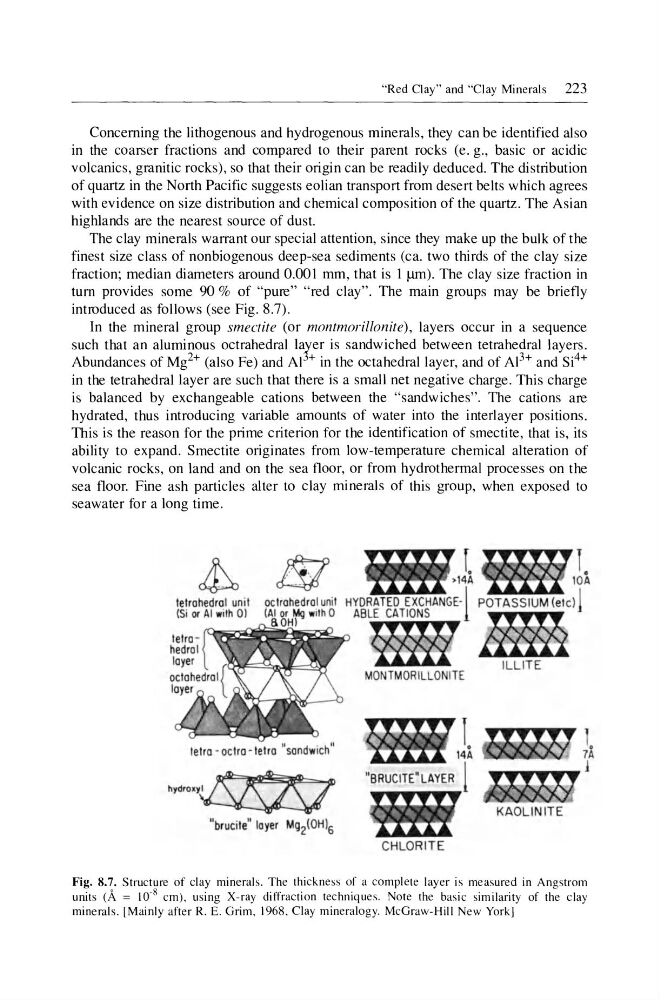
introduced as follows (see Fig. 8.7).
In the mineral group smectite (or montmorillonite), layers occur in a sequence
such that an aluminous octrahedral la?er is sandwiched between tetrahedral layers.
Abundances of Mg2+ (also Fe) and AI + in the octahedral layer, and of A1 3 + and Si4+
in the tetrahedral layer are such that there is a small net negative charge. This charge
is balanced by exchangeable cations between the "sandwiches". The cations are
hydrated, thus introducing variable amounts of water into the interlayer positions.
This is the reason for the prime criterion for the identification of smectite, that is, its
ability to expand. Smectite originates from low-temperature chemical alteration of
volcanic rocks, on land and on the sea floor, or from hydrothermal processes on the
sea floor. Fine ash particles alter to clay minerals of this group, when exposed to
seawater for a long time .
letra - actra - tetra "sandwich"
hYdro.y~
"brucite" layer M9 2 (OH)6
MONTMORILLONITE
l .
14A
CHLORITE
1.
1.
7A
.......... J
KAOLINITE
Fig. 8.7. Structure of clay mineral s. The thickness of a complete layer is measured in Angstrom
unit s (A = 10. 8 em). using X-ray diffraction technique s. Note the basic similarity of the clay
mineral s. [Mainly after R. E. Grim. 1968. Clay mineralogy. McGraw-Hili New York]
223
Concerning the lithogenous and hydrogenous minerals, they can be identified also
in the coarser fractions and compared to their parent rocks (e. g., basic or acidic
volcanics, granitic rocks), so that their origin can be readily deduced. The distribution
of quartz in the North Pacific suggests eolian transport from desert belts which agrees
with evidence on size distribution and chemical composition of the quartz. The Asian
highlands are the nearest source of dust.
The clay minerals warrant our special attention, since they make up the bulk of the
finest size class of nonbiogenous deep-sea sediments (ca. two thirds of the clay size
fraction; median diameters around 0 .001 mm, that is I /Jill) . The clay size fraction in
tum provides some 90 % of "pure" "red clay". The main groups may be briefly
introduced as follows (see Fig. 8.7).
In the mineral group smectite (or montmorillonite), layers occur in a sequence
such that an aluminous octrahedral la?er is sandwiched between tetrahedral layers.
Abundances of Mg2+ (also Fe) and AI + in the octahedral layer, and of A1 3 + and Si4+
in the tetrahedral layer are such that there is a small net negative charge. This charge
is balanced by exchangeable cations between the "sandwiches". The cations are
hydrated, thus introducing variable amounts of water into the interlayer positions.
This is the reason for the prime criterion for the identification of smectite, that is, its
ability to expand. Smectite originates from low-temperature chemical alteration of
volcanic rocks, on land and on the sea floor, or from hydrothermal processes on the
sea floor. Fine ash particles alter to clay minerals of this group, when exposed to
seawater for a long time .
letra - actra - tetra "sandwich"
hYdro.y~
"brucite" layer M9 2 (OH)6
MONTMORILLONITE
l .
14A
CHLORITE
1.
1.
7A
.......... J
KAOLINITE
Fig. 8.7. Structure of clay mineral s. The thickness of a complete layer is measured in Angstrom
unit s (A = 10. 8 em). using X-ray diffraction technique s. Note the basic similarity of the clay
mineral s. [Mainly after R. E. Grim. 1968. Clay mineralogy. McGraw-Hili New York]