

Seafloor Spreading and Plate Tectonics: the New Paradigm
9
Temperoture lower,
froctures heoled, veioci t y
nor mol
8.1 km/sec
Seismic velocity
decreosed by higher temperoture
ond frocturing, brecciation,
dilation
kmjm
~
I\~ \
. .-.
/
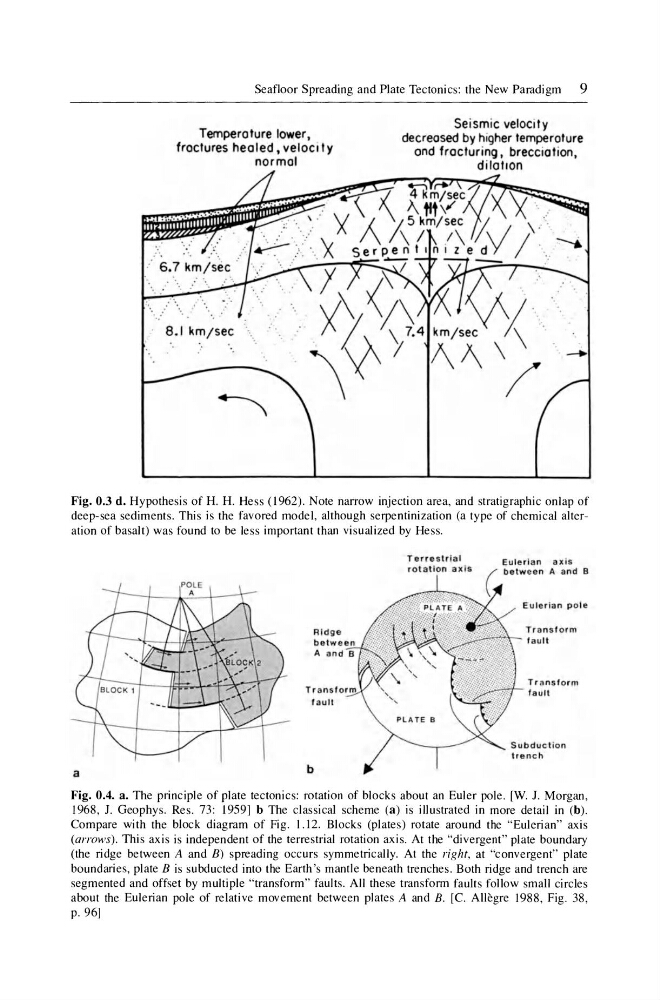
Fig. 0.3 d. Hypothesis of H. H. Hess (1962). Note narrow injection area. and stratigraphic onlap of
deep-sea sediments. This is the favored model, although serpentinization (a type of chemical alteration of basalt) was found to be less important than visualized by Hess.
Terreslrlal
a
b
Eulerian axis
between A and 6
Eu lerian pole
Tr ansform
fault
Trans for m
fault
Fig. 0.4. a. The principle of plate tectonics: rotation of blocks about an Euler pole. [W. 1. Morgan,
1968, J. Geophys. Res. 73: 1959] b The classical scheme (a) is illustrated in more detail in (b).
Compare with the block diagram of Fig. 1.12. Blocks (plates) rotate around the "Eulerian" axis
(arrows). This axis is independent of the terrestrial rotation axis. At the "divergent" plate boundary
(the ridge between A and B) spreading occurs symmetrically. At the right, at "convergent" plate
boundaries, plate B is subducted into the Earth's mantle beneath trenches. Both ridge and trench are
segmented and offset by multiple "transform" faults. All these transform faults follow small circles
about the Eulerian pole of relative movement between plates A and B. [CO Allegre 1988, Fig. 38,
p. 96]
9
Temperoture lower,
froctures heoled, veioci t y
nor mol
8.1 km/sec
Seismic velocity
decreosed by higher temperoture
ond frocturing, brecciation,
dilation
kmjm
~
I\~ \
. .-.
/
Fig. 0.3 d. Hypothesis of H. H. Hess (1962). Note narrow injection area. and stratigraphic onlap of
deep-sea sediments. This is the favored model, although serpentinization (a type of chemical alteration of basalt) was found to be less important than visualized by Hess.
Terreslrlal
a
b
Eulerian axis
between A and 6
Eu lerian pole
Tr ansform
fault
Trans for m
fault
Fig. 0.4. a. The principle of plate tectonics: rotation of blocks about an Euler pole. [W. 1. Morgan,
1968, J. Geophys. Res. 73: 1959] b The classical scheme (a) is illustrated in more detail in (b).
Compare with the block diagram of Fig. 1.12. Blocks (plates) rotate around the "Eulerian" axis
(arrows). This axis is independent of the terrestrial rotation axis. At the "divergent" plate boundary
(the ridge between A and B) spreading occurs symmetrically. At the right, at "convergent" plate
boundaries, plate B is subducted into the Earth's mantle beneath trenches. Both ridge and trench are
segmented and offset by multiple "transform" faults. All these transform faults follow small circles
about the Eulerian pole of relative movement between plates A and B. [CO Allegre 1988, Fig. 38,
p. 96]