

8 Introduction
a
CONTIN EN TAL BLOCK
c 0
INITIAL
'" 10
RIFTING
i 15
20
2.5
0
. . 10
...
"' l 15
25
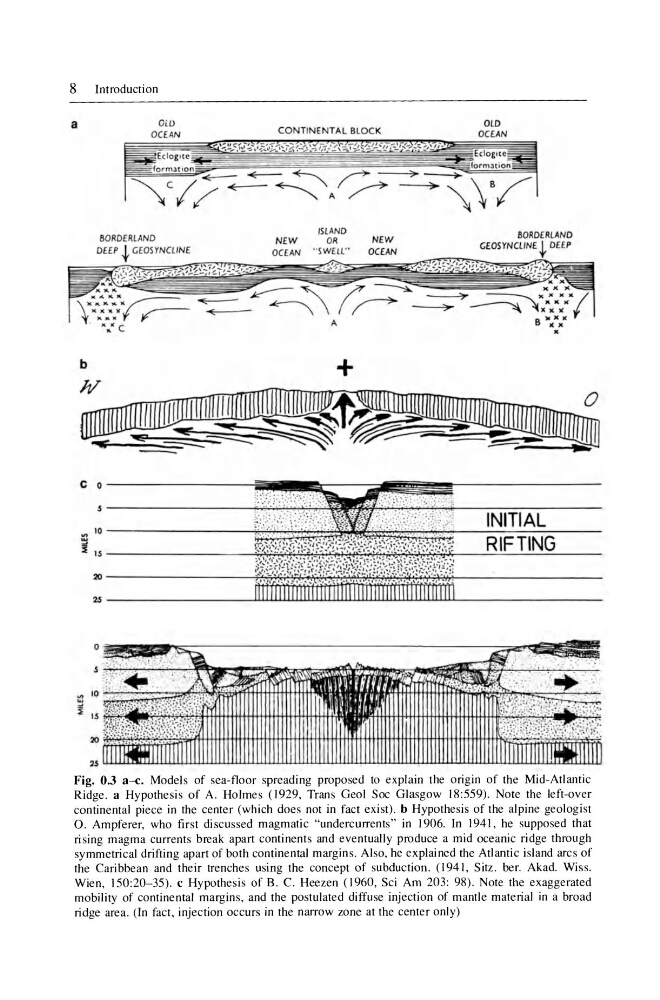
Fig. 0.3 a--c. Models of sea-floor spreading proposed to explain the origin of the Mid-Atlantic
Ridge. a Hypothesis of A. Holmes (1929, Trans Geol Soc Glasgow 18:559). Note the left-over
continental piece in the center (which does not in fact exist). b Hypothesis of the alpine geologist
O. Ampferer, who first discussed magmatic "undercurrents" in 1906. In 1941, he supposed that
rising magma currents break apart continents and eventually produce a mid oceanic ridge through
symmetrical drifting apart of both continental margins. Also, he explained the Atlantic island arcs of
the Caribbean and their trenches using the concept of subduction. (1941, Sitz. ber. Akad. Wiss.
Wien, 150:20- 35). c Hypothesis of B. C. Heezen (1960, Sci Am 203: 98) . Note the exaggerated
mobility of continental margins, and the postulated diffu se injection of mantle material in a broad
ridge area. (In fact , injection occurs in the narrow zone at the center only)
a
CONTIN EN TAL BLOCK
c 0
INITIAL
'" 10
RIFTING
i 15
20
2.5
0
. . 10
...
"' l 15
25
Fig. 0.3 a--c. Models of sea-floor spreading proposed to explain the origin of the Mid-Atlantic
Ridge. a Hypothesis of A. Holmes (1929, Trans Geol Soc Glasgow 18:559). Note the left-over
continental piece in the center (which does not in fact exist). b Hypothesis of the alpine geologist
O. Ampferer, who first discussed magmatic "undercurrents" in 1906. In 1941, he supposed that
rising magma currents break apart continents and eventually produce a mid oceanic ridge through
symmetrical drifting apart of both continental margins. Also, he explained the Atlantic island arcs of
the Caribbean and their trenches using the concept of subduction. (1941, Sitz. ber. Akad. Wiss.
Wien, 150:20- 35). c Hypothesis of B. C. Heezen (1960, Sci Am 203: 98) . Note the exaggerated
mobility of continental margins, and the postulated diffu se injection of mantle material in a broad
ridge area. (In fact , injection occurs in the narrow zone at the center only)