

208 Imprint of Climatic Zonation on Marine Sediments
PAC I FI C
ANTARCT I C
km
•
, I 11 1' 3 -:.:- 3' 50> 5 02 m il l
AT L ANT I C
G'l
:IJ
fTl
fTl
Z
r
1>
Z
o
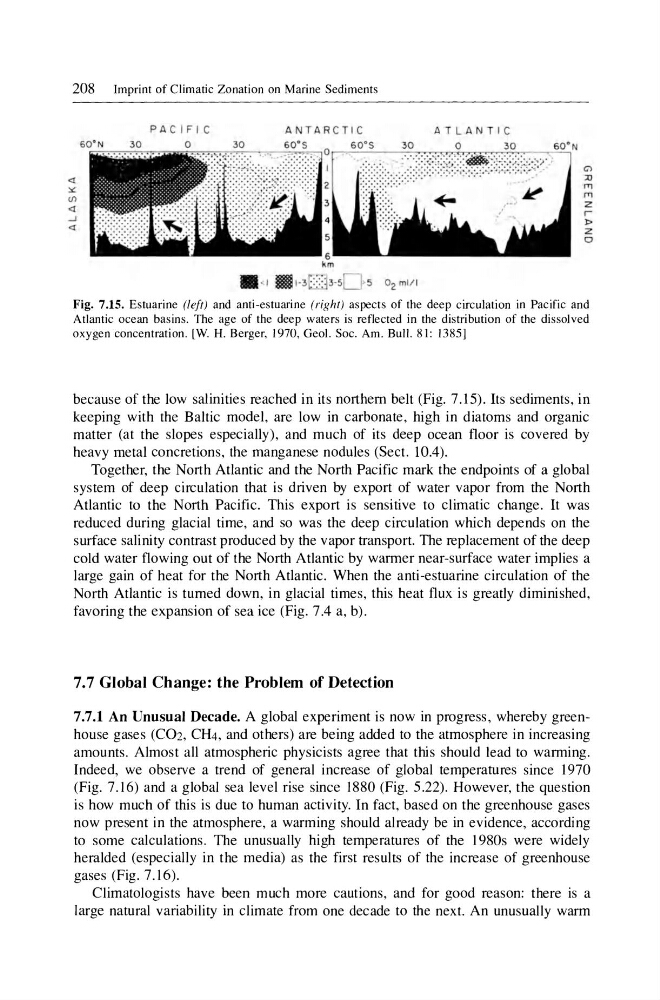
Fig. 7.15. Estuarine (left) and anti·estuarine (right! aspects of the deep circulation in Pacific and
Atlantic ocean basins. The age of the deep waters is reflected in the distribution of the dissolved
oxygen concentration. [w. H. Berger, 1970, Geol. Soc. Am. Bull. 81: 1385]
because of the low salinities reached in its northern belt (Fig. 7.15). Its sediments, in
keeping with the Baltic model, are low in carbonate, high in diatoms and organic
matter (at the slopes especially), and much of its deep ocean floor is covered by
heavy metal concretions, the manganese nodules (Sect. lOA).
Together, the North Atlantic and the North Pacific mark the endpoints of a global
system of deep circulation that is driven by export of water vapor from the North
Atlantic to the North Pacific. This export is sensitive to climatic change. It was
reduced during glacial time, and so was the deep circulation which depends on the
surface salinity contrast produced by the vapor transport. The replacement of the deep
cold water flowing out of the North Atlantic by warmer near-surface water implies a
large gain of heat for the North Atlantic. When the anti-estuarine circulation of the
North Atlantic is turned down, in glacial times, this heat flux is greatly diminished,
favoring the expansion of sea ice (Fig. 704 a, b).
7.7 Global Change: the Problem of Detection
7.7.1 An Unusual Decade. A global experiment is now in progress, whereby greenhouse gases (C02, CH4, and others) are being added to the atmosphere in increasing
amounts. Almost all atmospheric physicists agree that this should lead to wanning.
Indeed, we observe a trend of general increase of global temperatures since 1970
(Fig. 7.16) and a global sea level rise since 1880 (Fig. 5.22). However, the question
is how much of this is due to human activity. In fact, based on the greenhouse gases
now present in the atmosphere, a warming should already be in evidence, according
to some calculations. The unusually high temperatures of the 1980s were widely
heralded (especially in the media) as the first results of the increase of greenhouse
gases (Fig. 7.16).
Climatologists have been much more cautions, and for good reason: there is a
large natural variability in climate from one decade to the next. An unusually warm
PAC I FI C
ANTARCT I C
km
•
, I 11 1' 3 -:.:- 3' 50> 5 02 m il l
AT L ANT I C
G'l
:IJ
fTl
fTl
Z
r
1>
Z
o
Fig. 7.15. Estuarine (left) and anti·estuarine (right! aspects of the deep circulation in Pacific and
Atlantic ocean basins. The age of the deep waters is reflected in the distribution of the dissolved
oxygen concentration. [w. H. Berger, 1970, Geol. Soc. Am. Bull. 81: 1385]
because of the low salinities reached in its northern belt (Fig. 7.15). Its sediments, in
keeping with the Baltic model, are low in carbonate, high in diatoms and organic
matter (at the slopes especially), and much of its deep ocean floor is covered by
heavy metal concretions, the manganese nodules (Sect. lOA).
Together, the North Atlantic and the North Pacific mark the endpoints of a global
system of deep circulation that is driven by export of water vapor from the North
Atlantic to the North Pacific. This export is sensitive to climatic change. It was
reduced during glacial time, and so was the deep circulation which depends on the
surface salinity contrast produced by the vapor transport. The replacement of the deep
cold water flowing out of the North Atlantic by warmer near-surface water implies a
large gain of heat for the North Atlantic. When the anti-estuarine circulation of the
North Atlantic is turned down, in glacial times, this heat flux is greatly diminished,
favoring the expansion of sea ice (Fig. 704 a, b).
7.7 Global Change: the Problem of Detection
7.7.1 An Unusual Decade. A global experiment is now in progress, whereby greenhouse gases (C02, CH4, and others) are being added to the atmosphere in increasing
amounts. Almost all atmospheric physicists agree that this should lead to wanning.
Indeed, we observe a trend of general increase of global temperatures since 1970
(Fig. 7.16) and a global sea level rise since 1880 (Fig. 5.22). However, the question
is how much of this is due to human activity. In fact, based on the greenhouse gases
now present in the atmosphere, a warming should already be in evidence, according
to some calculations. The unusually high temperatures of the 1980s were widely
heralded (especially in the media) as the first results of the increase of greenhouse
gases (Fig. 7.16).
Climatologists have been much more cautions, and for good reason: there is a
large natural variability in climate from one decade to the next. An unusually warm