

Climatic Clues from Restricted Seas
207
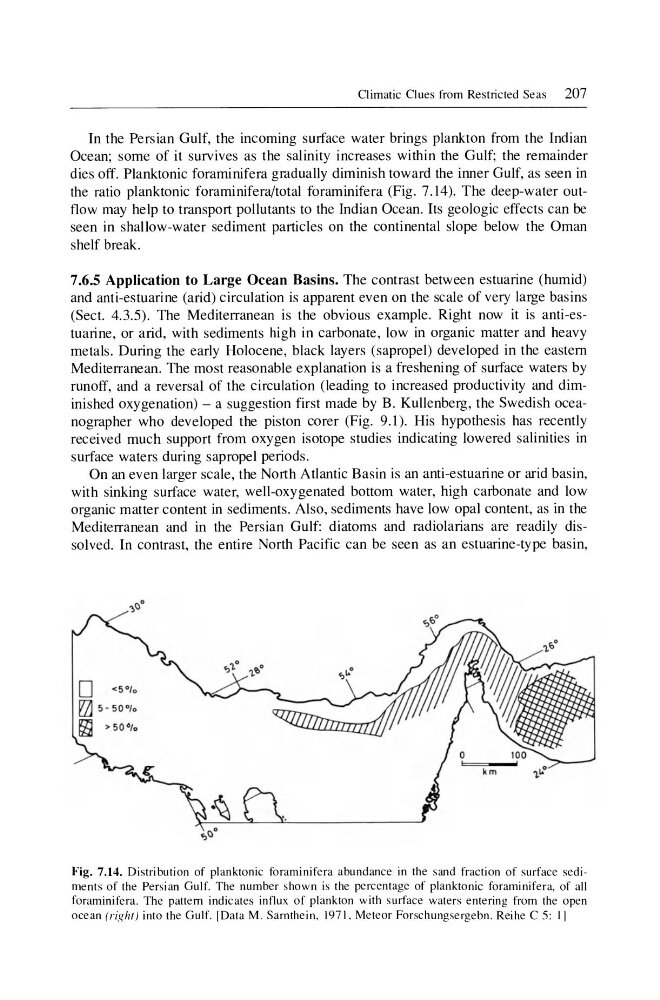
In the Persian Gulf, the incoming surface water brings plankton from the Indian
Ocean; some of it survives as the salinity increases within the Gulf; the remainder
dies off. Planktonic foraminifera gradually diminish toward the inner Gulf, as seen in
the ratio planktonic foraminifera/total foraminifera (Fig. 7.14). The deep-water outnow may help to transport pollutants to the Indian Ocean. Its geologic effects can be
seen in shallow-water sediment particles on the continental slope below the Oman
shelf break.
7.6.5 Application to Large Ocean Basins. The contrast between estuarine (humid)
and anti-estuarine (arid) circulation is apparent even on the scale of very large basins
(Sect. 4.3.5). The Mediterranean is the obvious example. Right now it is anti-estuarine, or arid, with sediments high in carbonate, low in organic matter and heavy
metals. During the early Holocene, black layers (sapropel) developed in the eastern
Mediterranean. The most reasonable explanation is a freshening of surface waters by
runoff, and a reversal of the circulation (leading to increased productivity and diminished oxygenation) - a suggestion first made by B. Kullenberg, the Swedish oceanographer who developed the piston corer (Fig. 9.1). His hypothesis has recently
received much support from oxygen isotope studies indicating lowered salinities in
surface waters during sapropel periods.
On an even larger scale, the North Atlantic Basin is an anti-estuarine or arid basin,
with sinking surface water, well-oxygenated bottom water, high carbonate and low
organic matter content in sediments. Also, sediments have low opal content, as in the
Mediterranean and in the Persian Gulf: diatoms and radiolarians are readily dissolved. In contrast, the entire North Pacific can be seen as an estuarine-type basin,
o <5 %
~ 5 -50 %
~ >50"'0
k m
Fig. 7.14. Distribution of planktonic foraminifera abundance in the sand fraction of surface sedi·
ments of the Persian Gulf. The number shown is the percentage of planktonic foraminifera, of all
foraminifera. The pattern indicates influx of plankton with surface waters entering from the open
ocean (right) into the Gulf. [Data M. Sarnthein, 1971, Meteor Forschungsergebn. Reihe C 5: 11
207
In the Persian Gulf, the incoming surface water brings plankton from the Indian
Ocean; some of it survives as the salinity increases within the Gulf; the remainder
dies off. Planktonic foraminifera gradually diminish toward the inner Gulf, as seen in
the ratio planktonic foraminifera/total foraminifera (Fig. 7.14). The deep-water outnow may help to transport pollutants to the Indian Ocean. Its geologic effects can be
seen in shallow-water sediment particles on the continental slope below the Oman
shelf break.
7.6.5 Application to Large Ocean Basins. The contrast between estuarine (humid)
and anti-estuarine (arid) circulation is apparent even on the scale of very large basins
(Sect. 4.3.5). The Mediterranean is the obvious example. Right now it is anti-estuarine, or arid, with sediments high in carbonate, low in organic matter and heavy
metals. During the early Holocene, black layers (sapropel) developed in the eastern
Mediterranean. The most reasonable explanation is a freshening of surface waters by
runoff, and a reversal of the circulation (leading to increased productivity and diminished oxygenation) - a suggestion first made by B. Kullenberg, the Swedish oceanographer who developed the piston corer (Fig. 9.1). His hypothesis has recently
received much support from oxygen isotope studies indicating lowered salinities in
surface waters during sapropel periods.
On an even larger scale, the North Atlantic Basin is an anti-estuarine or arid basin,
with sinking surface water, well-oxygenated bottom water, high carbonate and low
organic matter content in sediments. Also, sediments have low opal content, as in the
Mediterranean and in the Persian Gulf: diatoms and radiolarians are readily dissolved. In contrast, the entire North Pacific can be seen as an estuarine-type basin,
o <5 %
~ 5 -50 %
~ >50"'0
k m
Fig. 7.14. Distribution of planktonic foraminifera abundance in the sand fraction of surface sedi·
ments of the Persian Gulf. The number shown is the percentage of planktonic foraminifera, of all
foraminifera. The pattern indicates influx of plankton with surface waters entering from the open
ocean (right) into the Gulf. [Data M. Sarnthein, 1971, Meteor Forschungsergebn. Reihe C 5: 11