

Atlantic - Gibraltar- Medlterr.
Indlc - Bab el Mandeb - Red Sea
Indic - Hormus - Pers. Arab Gulf
- ESTUARINE CIRCULATION
Climatic Clues from Restricted Seas
203
Atlantic-Sill-Norwegian and Greenland FiOrds
Medlterr. - Bosporus - Black Sea
North Sea - Belts - Baltic
ESTUARINE CIRCULATION
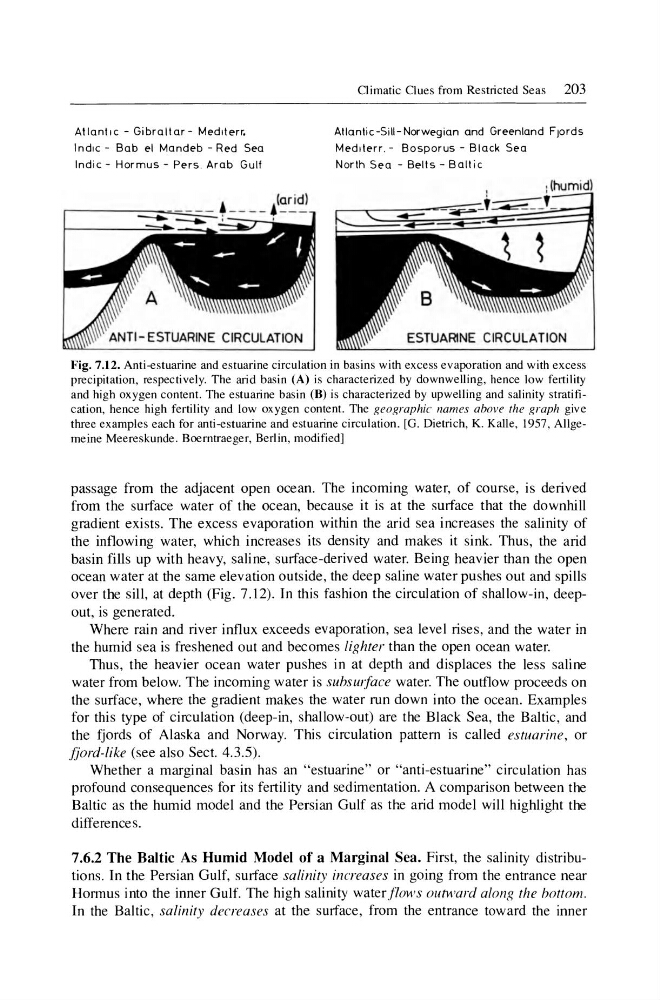
Fig. 7.12. Anti-estuarine and estuarine circulation in basins with excess evaporation and with excess
precipitation, respectively. The arid basin (A) is characterized by downwelling, hence low fertility
and high oxygen content. The estuarine basin (8) is characterized by upwelling and salinity stratification, hence high fertility and low oxygen content. The geographic names above the graph give
three examples each for anti-estuarine and estuarine circulation. [G . Dietrich, K. Kalle, 1957, Allgemeine Meereskunde. Boerntraeger, Berlin, modified]
passage from the adjacent open ocean. The incoming water, of course, is derived
from the surface water of the ocean, because it is at the surface that the downhill
gradient exists. The excess evaporation within the arid sea increases the salinity of
the inflowing water, which increases its density and makes it sink. Thus, the arid
basin fills up with heavy, saline, surface-derived water. Being heavier than the open
ocean water at the same elevation outside, the deep saline water pushes out and spills
over the sill, at depth (Fig. 7.12). In this fashion the circulation of shallow-in, deepout, is generated.
Where rain and river influx exceeds evaporation, sea level rises, and the water in
the humid sea is freshened out and becomes Ii/?hter than the open ocean water.
Thus, the heavier ocean water pushes in at depth and displaces the less saline
water from below. The incoming water is subsUiface water. The outflow proceeds on
the surface, where the gradient makes the water run down into the ocean. Examples
for this type of circulation (deep-in, shallow-out) are the Black Sea, the Baltic, and
the fjords of Alaska and Norway. This circulation pattern is called estuarine, or
fjord-like (see also Sect. 4.3.5).
Whether a marginal basin has an "estuarine" or "anti-estuarine" circulation has
profound consequences for its fertility and sedimentation. A comparison between the
Baltic as the humid model and the Persian Gulf as the arid model will highlight the
differences.
7.6.2 The Baltic As Humid Model of a Marginal Sea. First, the salinity distributions. In the Persian Gulf, surface salinity increases in going from the entrance near
Honnus into the inner Gulf. The high salinity water f70ws outward alon/? the bOl/om .
In the Baltic, salinity decreases at the surface, from the entrance toward the inner
Indlc - Bab el Mandeb - Red Sea
Indic - Hormus - Pers. Arab Gulf
- ESTUARINE CIRCULATION
Climatic Clues from Restricted Seas
203
Atlantic-Sill-Norwegian and Greenland FiOrds
Medlterr. - Bosporus - Black Sea
North Sea - Belts - Baltic
ESTUARINE CIRCULATION
Fig. 7.12. Anti-estuarine and estuarine circulation in basins with excess evaporation and with excess
precipitation, respectively. The arid basin (A) is characterized by downwelling, hence low fertility
and high oxygen content. The estuarine basin (8) is characterized by upwelling and salinity stratification, hence high fertility and low oxygen content. The geographic names above the graph give
three examples each for anti-estuarine and estuarine circulation. [G . Dietrich, K. Kalle, 1957, Allgemeine Meereskunde. Boerntraeger, Berlin, modified]
passage from the adjacent open ocean. The incoming water, of course, is derived
from the surface water of the ocean, because it is at the surface that the downhill
gradient exists. The excess evaporation within the arid sea increases the salinity of
the inflowing water, which increases its density and makes it sink. Thus, the arid
basin fills up with heavy, saline, surface-derived water. Being heavier than the open
ocean water at the same elevation outside, the deep saline water pushes out and spills
over the sill, at depth (Fig. 7.12). In this fashion the circulation of shallow-in, deepout, is generated.
Where rain and river influx exceeds evaporation, sea level rises, and the water in
the humid sea is freshened out and becomes Ii/?hter than the open ocean water.
Thus, the heavier ocean water pushes in at depth and displaces the less saline
water from below. The incoming water is subsUiface water. The outflow proceeds on
the surface, where the gradient makes the water run down into the ocean. Examples
for this type of circulation (deep-in, shallow-out) are the Black Sea, the Baltic, and
the fjords of Alaska and Norway. This circulation pattern is called estuarine, or
fjord-like (see also Sect. 4.3.5).
Whether a marginal basin has an "estuarine" or "anti-estuarine" circulation has
profound consequences for its fertility and sedimentation. A comparison between the
Baltic as the humid model and the Persian Gulf as the arid model will highlight the
differences.
7.6.2 The Baltic As Humid Model of a Marginal Sea. First, the salinity distributions. In the Persian Gulf, surface salinity increases in going from the entrance near
Honnus into the inner Gulf. The high salinity water f70ws outward alon/? the bOl/om .
In the Baltic, salinity decreases at the surface, from the entrance toward the inner