

204 Imprint of Climatic Zonation on Marine Sediments
bight. The heavy marine water comes in at the bottom, spilling from one depression
to the next. In the Baltic, low salinities are prevalent, generally less than 18 %0, due
to dilution from rain and rivers. In the Persian Gulf, salinities reach 40 %0.
Both excessively low and excessively high salinities are unfavorable for normal
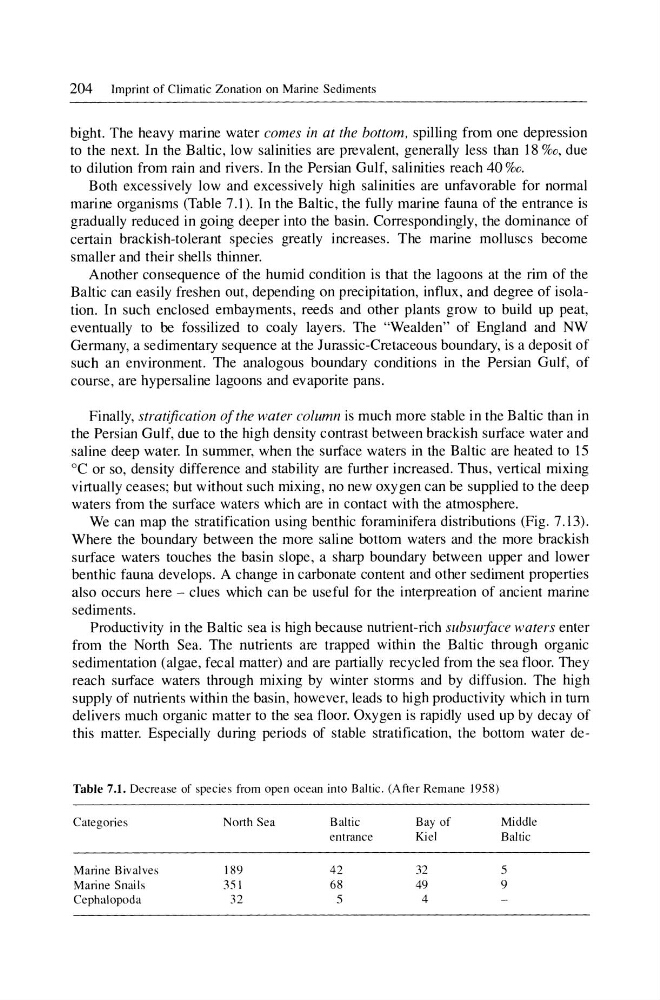
marine organisms (Table 7.l). In the Baltic, the fully marine fauna of the entrance is
gradually reduced in going deeper into the basin. Correspondingly, the dominance of
certain brackish-tolerant species greatly increases. The marine molluscs become
smaller and their shells thinner.
Another consequence of the humid condition is that the lagoons at the rim of the
Baltic can easily freshen out, depending on precipitation, influx, and degree of isolation. In such enclosed embayments, reeds and other plants grow to build up peat,
eventually to be fossilized to coaly layers. The "Wealden" of England and NW
Germany, a sedimentary sequence at the Jurassic-Cretaceous boundary, is a deposit of
such an environment. The analogous boundary conditions in the Persian Gulf, of
course, are hypersaline lagoons and evaporite pans.
Finally, stratification of the water column is much more stable in the Baltic than in
the Persian Gulf, due to the high density contrast between brackish surface water and
saline deep water. In summer, when the surface waters in the Baltic are heated to 15
°C or so, density difference and stability are further increased. Thus, vertical mixing
virtually ceases; but without such mixing, no new oxygen can be supplied to the deep
waters from the surface waters which are in contact with the atmosphere.
We can map the stratification using benthic foraminifera distributions (Fig. 7.13).
Where the boundary between the more saline bottom waters and the more brackish
surface waters touches the basin slope, a sharp boundary between upper and lower
benthic fauna develops. A change in carbonate content and other sediment properties
also occurs here - clues which can be useful for the interpreation of ancient marine
sediments.
Productivity in the Baltic sea is high because nutrient-rich subsUiface waters enter
from the North Sea. The nutrients are trapped within the Baltic through organic
sedimentation (algae, fecal matter) and are partially recycled from the sea floor. They
reach surface waters through mixing by winter storms and by diffusion. The high
supply of nutrients within the basin, however, leads to high productivity which in tum
delivers much organic matter to the sea floor. Oxygen is rapidly used up by decay of
this matter. Especially during periods of stable stratification, the bottom water deTable 7.1. Decrease of species from open ocean into Baltic. (After Remane 1958)
Categories
North Sea
Baltic
Bay of
Middle
entrance
Kiel
Baltic
Marine Bivalves
189
42
32
5
Marine Snails
351
68
49
9
Cephalopoda
32
5
4
bight. The heavy marine water comes in at the bottom, spilling from one depression
to the next. In the Baltic, low salinities are prevalent, generally less than 18 %0, due
to dilution from rain and rivers. In the Persian Gulf, salinities reach 40 %0.
Both excessively low and excessively high salinities are unfavorable for normal
marine organisms (Table 7.l). In the Baltic, the fully marine fauna of the entrance is
gradually reduced in going deeper into the basin. Correspondingly, the dominance of
certain brackish-tolerant species greatly increases. The marine molluscs become
smaller and their shells thinner.
Another consequence of the humid condition is that the lagoons at the rim of the
Baltic can easily freshen out, depending on precipitation, influx, and degree of isolation. In such enclosed embayments, reeds and other plants grow to build up peat,
eventually to be fossilized to coaly layers. The "Wealden" of England and NW
Germany, a sedimentary sequence at the Jurassic-Cretaceous boundary, is a deposit of
such an environment. The analogous boundary conditions in the Persian Gulf, of
course, are hypersaline lagoons and evaporite pans.
Finally, stratification of the water column is much more stable in the Baltic than in
the Persian Gulf, due to the high density contrast between brackish surface water and
saline deep water. In summer, when the surface waters in the Baltic are heated to 15
°C or so, density difference and stability are further increased. Thus, vertical mixing
virtually ceases; but without such mixing, no new oxygen can be supplied to the deep
waters from the surface waters which are in contact with the atmosphere.
We can map the stratification using benthic foraminifera distributions (Fig. 7.13).
Where the boundary between the more saline bottom waters and the more brackish
surface waters touches the basin slope, a sharp boundary between upper and lower
benthic fauna develops. A change in carbonate content and other sediment properties
also occurs here - clues which can be useful for the interpreation of ancient marine
sediments.
Productivity in the Baltic sea is high because nutrient-rich subsUiface waters enter
from the North Sea. The nutrients are trapped within the Baltic through organic
sedimentation (algae, fecal matter) and are partially recycled from the sea floor. They
reach surface waters through mixing by winter storms and by diffusion. The high
supply of nutrients within the basin, however, leads to high productivity which in tum
delivers much organic matter to the sea floor. Oxygen is rapidly used up by decay of
this matter. Especially during periods of stable stratification, the bottom water deTable 7.1. Decrease of species from open ocean into Baltic. (After Remane 1958)
Categories
North Sea
Baltic
Bay of
Middle
entrance
Kiel
Baltic
Marine Bivalves
189
42
32
5
Marine Snails
351
68
49
9
Cephalopoda
32
5
4