

Reconstruction of Sea Level Changes
149
L
9
• _.l·~ £ ~
m
o 9
~ ~
::0: C
;=
o
3: Z
~
m
:g
en
oJ---------------------------------------------~-O
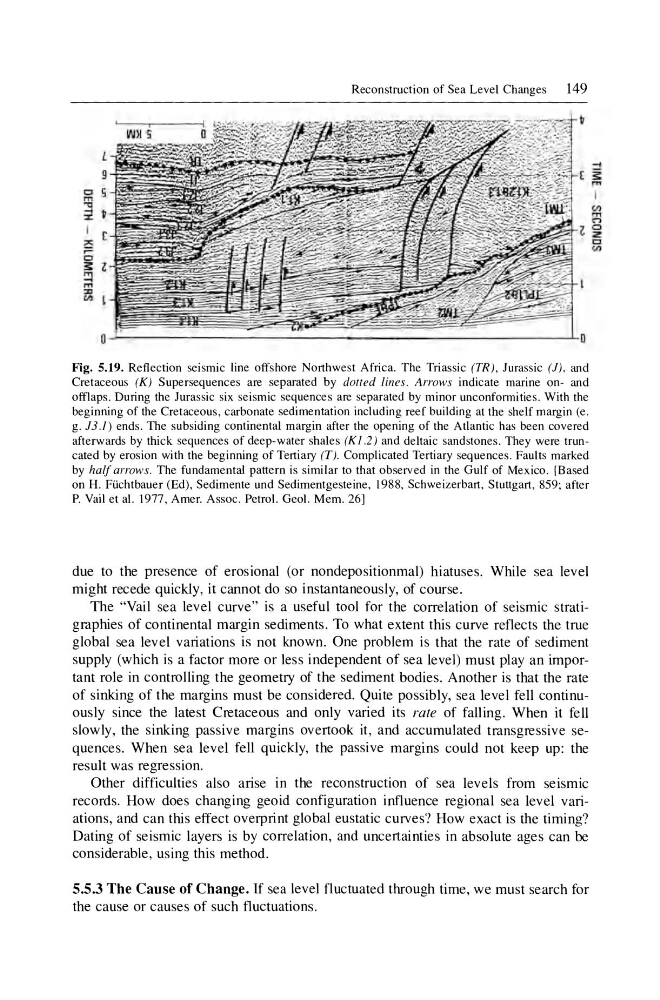
Fig. 5.19. Reflection seismic line offshore Northwest Africa. The Triassic (TR), Jurassic (1) . and
Cretaceous (K) Supersequences are separated by dotted lines. Arrows indicate marine on- and
offlaps. During the Jurassic six seismic sequences are separated by minor unconfonnities. With the
beginning of the Cretaceous, carbonate sedimentation including reef building at the shelf margin (e.
g. 13.1) ends. The subsiding continental margin after the opening of the Atlantic has been covered
afterwards by thick sequences of deep-water shales (K 1.2) and deltaic sandstones. They were truncated by erosion with the beginning of Tertiary (T). Complicated Tertiary sequences. Faults marked
by half arrows. The fundamental pattern is similar to that observed in the Gulf of Mexico. [Based
on H. Ftichtbauer (Ed), Sedimente und Sedimentgesteine , 1988, Schweizerbart, Stuttgart, 859; after
P. Vail et al. 1977, Amer. Assoc. Petrol. Geol. Mem. 26]
due to the presence of erosional (or nondepositionmal) hiatuses. While sea level
might recede quickly, it cannot do so instantaneously, of course.
The "Vail sea level curve" is a useful tool for the correlation of seismic stratigraphies of continental margin sediments. To what extent this curve reflects the true
global sea level variations is not known. One problem is that the rate of sediment
supply (which is a factor more or less independent of sea level) must play an important role in controlling the geometry of the sediment bodies. Another is that the rate
of sinking of the margins must be considered. Quite possibly, sea level fell continuously since the latest Cretaceous and only varied its rate of falling. When it fell
slowly, the sinking passive margins overtook it, and accumulated transgressive sequences. When sea level fell quickly, the passive margins could not keep up: the
result was regression.
Other difficulties also arise in the reconstruction of sea levels from seismic
records. How does changing geoid configuration influence regional sea level variations, and can this effect overprint global eustatic curves? How exact is the timing?
Dating of seismic layers is by correlation, and uncertainties in absolute ages can be
considerable, using this method.
5.5.3 The Cause of Change. If sea level fluctuated through time , we must search for
the cause or causes of such fluctuations .
149
L
9
• _.l·~ £ ~
m
o 9
~ ~
::0: C
;=
o
3: Z
~
m
:g
en
oJ---------------------------------------------~-O
Fig. 5.19. Reflection seismic line offshore Northwest Africa. The Triassic (TR), Jurassic (1) . and
Cretaceous (K) Supersequences are separated by dotted lines. Arrows indicate marine on- and
offlaps. During the Jurassic six seismic sequences are separated by minor unconfonnities. With the
beginning of the Cretaceous, carbonate sedimentation including reef building at the shelf margin (e.
g. 13.1) ends. The subsiding continental margin after the opening of the Atlantic has been covered
afterwards by thick sequences of deep-water shales (K 1.2) and deltaic sandstones. They were truncated by erosion with the beginning of Tertiary (T). Complicated Tertiary sequences. Faults marked
by half arrows. The fundamental pattern is similar to that observed in the Gulf of Mexico. [Based
on H. Ftichtbauer (Ed), Sedimente und Sedimentgesteine , 1988, Schweizerbart, Stuttgart, 859; after
P. Vail et al. 1977, Amer. Assoc. Petrol. Geol. Mem. 26]
due to the presence of erosional (or nondepositionmal) hiatuses. While sea level
might recede quickly, it cannot do so instantaneously, of course.
The "Vail sea level curve" is a useful tool for the correlation of seismic stratigraphies of continental margin sediments. To what extent this curve reflects the true
global sea level variations is not known. One problem is that the rate of sediment
supply (which is a factor more or less independent of sea level) must play an important role in controlling the geometry of the sediment bodies. Another is that the rate
of sinking of the margins must be considered. Quite possibly, sea level fell continuously since the latest Cretaceous and only varied its rate of falling. When it fell
slowly, the sinking passive margins overtook it, and accumulated transgressive sequences. When sea level fell quickly, the passive margins could not keep up: the
result was regression.
Other difficulties also arise in the reconstruction of sea levels from seismic
records. How does changing geoid configuration influence regional sea level variations, and can this effect overprint global eustatic curves? How exact is the timing?
Dating of seismic layers is by correlation, and uncertainties in absolute ages can be
considerable, using this method.
5.5.3 The Cause of Change. If sea level fluctuated through time , we must search for
the cause or causes of such fluctuations .