

150 Sea Level Processes and Effects of Sea Level Change
TME
o my
AIle< 40 my
11K 4000
2000
o
2000
4000 4000
2000
o
2000
4000
20 MY ISC&\TH
4() MY ISOBATH
60MY ISCSATH
20 MY ISCeATH
4() MY I!alATH
60 MY I!alATH
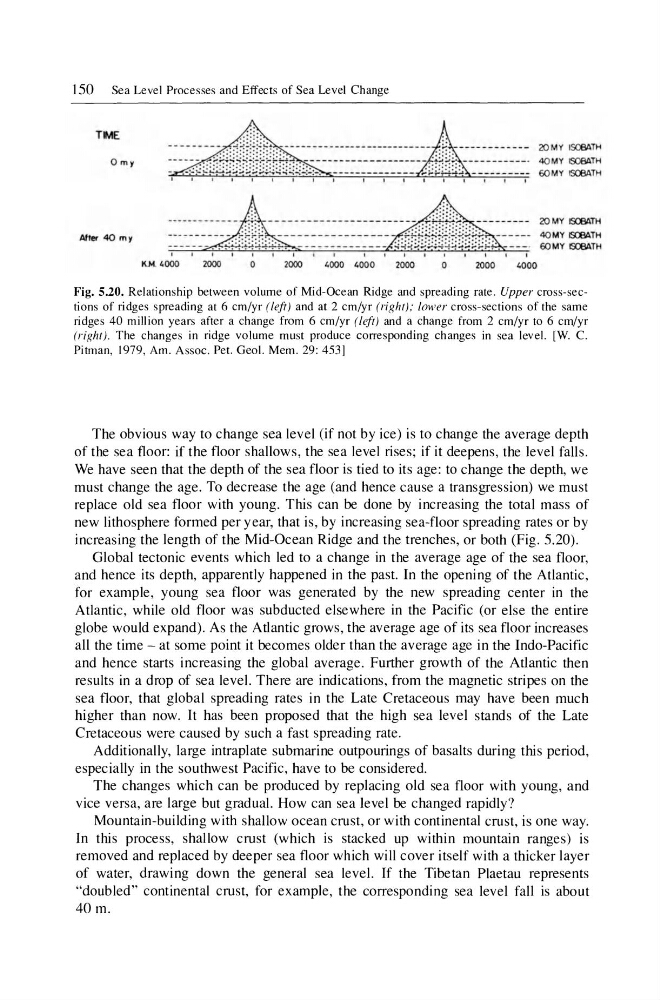
Fig. 5.20. Relationship between volume of Mid-Ocean Ridge and spreading rate. Upper cross-sections of ridges spreading at 6 cm/yr (left! and at 2 cm/yr (right) ; lower cross-sections of the same
ridges 40 million years after a change from 6 cm/yr (left) and a change from 2 cm/yr to 6 cm/yr
(right). The changes in ridge volume must produce corresponding changes in sea level. [W. C.
Pitman, 1979, Am . Assoc. Pet. Geol. Mem. 29: 453]
The obvious way to change sea level (if not by ice) is to change the average depth
of the sea floor: if the floor shallows, the sea level rises; if it deepens, the level falls.
We have seen that the depth of the sea floor is tied to its age: to change the depth, we
must change the age. To decrease the age (and hence cause a transgression) we must
replace old sea floor with young. This can be done by increasing the total mass of
new lithosphere formed per year, that is, by increasing sea-floor spreading rates or by
increasing the length of the Mid-Ocean Ridge and the trenches, or both (Fig. 5.20).
Global tectonic events which led to a change in the average age of the sea floor,
and hence its depth, apparently happened in the past. In the opening of the Atlantic,
for example, young sea floor was generated by the new spreading center in the
Atlantic, while old floor was subducted elsewhere in the Pacific (or else the entire
globe would expand). As the Atlantic grows, the average age of its sea floor increases
all the time - at some point it becomes older than the average age in the Indo-Pacific
and hence starts increasing the global average. Further growth of the Atlantic then
results in a drop of sea level. There are indications, from the magnetic stripes on the
sea floor, that global spreading rates in the Late Cretaceous may have been much
higher than now. It has been proposed that the high sea level stands of the Late
Cretaceous were caused by such a fast spreading rate.
Additionally, large intraplate submarine outpourings of basalts during this period,
especially in the southwest Pacific, have to be considered.
The changes which can be produced by replacing old sea floor with young, and
vice versa, are large but gradual. How can sea level be changed rapidly?
Mountain-building with shallow ocean crust, or with continental crust, is one way.
In this process, shallow crust (which is stacked up within mountain ranges) is
removed and replaced by deeper sea floor which will cover itself with a thicker layer
of water, drawing down the general sea level. If the Tibetan Plaetau represents
"doubled" continental crust, for example, the corresponding sea level fall is about
40m.
TME
o my
AIle< 40 my
11K 4000
2000
o
2000
4000 4000
2000
o
2000
4000
20 MY ISC&\TH
4() MY ISOBATH
60MY ISCSATH
20 MY ISCeATH
4() MY I!alATH
60 MY I!alATH
Fig. 5.20. Relationship between volume of Mid-Ocean Ridge and spreading rate. Upper cross-sections of ridges spreading at 6 cm/yr (left! and at 2 cm/yr (right) ; lower cross-sections of the same
ridges 40 million years after a change from 6 cm/yr (left) and a change from 2 cm/yr to 6 cm/yr
(right). The changes in ridge volume must produce corresponding changes in sea level. [W. C.
Pitman, 1979, Am . Assoc. Pet. Geol. Mem. 29: 453]
The obvious way to change sea level (if not by ice) is to change the average depth
of the sea floor: if the floor shallows, the sea level rises; if it deepens, the level falls.
We have seen that the depth of the sea floor is tied to its age: to change the depth, we
must change the age. To decrease the age (and hence cause a transgression) we must
replace old sea floor with young. This can be done by increasing the total mass of
new lithosphere formed per year, that is, by increasing sea-floor spreading rates or by
increasing the length of the Mid-Ocean Ridge and the trenches, or both (Fig. 5.20).
Global tectonic events which led to a change in the average age of the sea floor,
and hence its depth, apparently happened in the past. In the opening of the Atlantic,
for example, young sea floor was generated by the new spreading center in the
Atlantic, while old floor was subducted elsewhere in the Pacific (or else the entire
globe would expand). As the Atlantic grows, the average age of its sea floor increases
all the time - at some point it becomes older than the average age in the Indo-Pacific
and hence starts increasing the global average. Further growth of the Atlantic then
results in a drop of sea level. There are indications, from the magnetic stripes on the
sea floor, that global spreading rates in the Late Cretaceous may have been much
higher than now. It has been proposed that the high sea level stands of the Late
Cretaceous were caused by such a fast spreading rate.
Additionally, large intraplate submarine outpourings of basalts during this period,
especially in the southwest Pacific, have to be considered.
The changes which can be produced by replacing old sea floor with young, and
vice versa, are large but gradual. How can sea level be changed rapidly?
Mountain-building with shallow ocean crust, or with continental crust, is one way.
In this process, shallow crust (which is stacked up within mountain ranges) is
removed and replaced by deeper sea floor which will cover itself with a thicker layer
of water, drawing down the general sea level. If the Tibetan Plaetau represents
"doubled" continental crust, for example, the corresponding sea level fall is about
40m.