

140 Sea Level Processes and Effects of Sea Level Change
...... . ' . .. .. . . ........................... ... ............................. .. .
"::::;:::;::' ::;:::;' ::::;:::::;';.::;:::::::::::,:::;:;:;:;:;:::::::::::::::::;::::.::;.:
o
100km
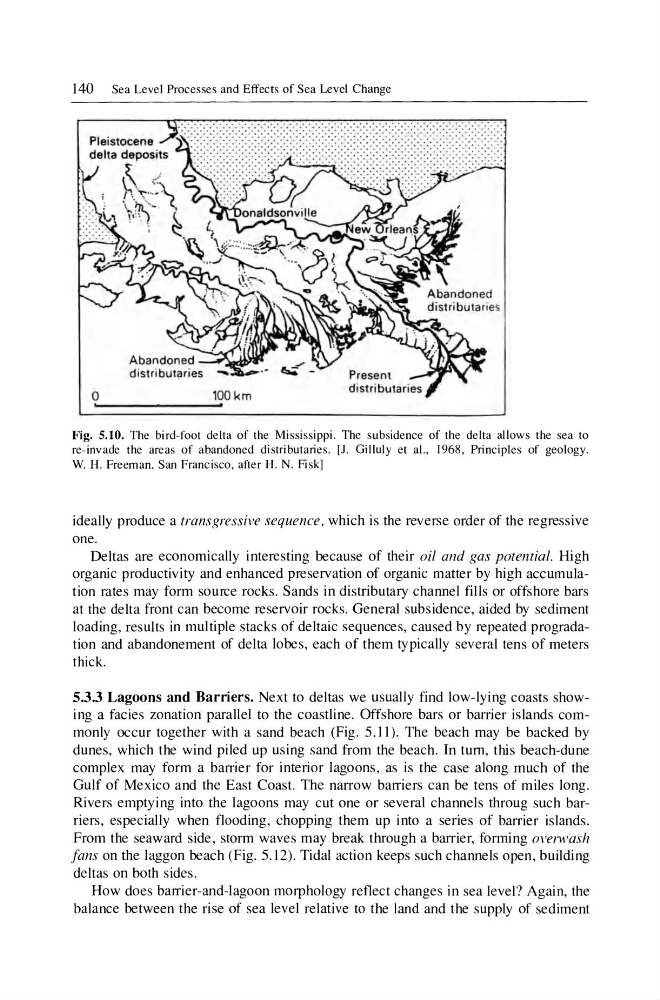
Fig. 5.10. The bird-foot delta of the Mississippi. The subsidence of the delta allows the sea to
re-invade the areas of abandoned distributaries. [J. Gilluly et aI., 1968, Principles of geology.
W. H. Freeman. San Francisco, after H. N. Fisk]
ideally produce a transgressive sequence , which is the reverse order of the regressive
one.
Deltas are economically interesting because of their oil and gas potential. High
organic productivity and enhanced preservation of organic matter by high accumulation rates may form source rocks. Sands in distributary channel fills or offshore bars
at the delta front can become reservoir rocks. General subsidence, aided by sediment
loading, results in multiple stacks of deltaic sequences, caused by repeated progradation and abandonement of delta lobes, each of them typically several tens of meters
thick.
5.3.3 Lagoons and Barriers. Next to deltas we usually find low-lying coasts showing a facies zonation parallel to the coastline. Offshore bars or barrier islands commonly occur together with a sand beach (Fig. 5.11). The beach may be backed by
dunes, which the wind piled up using sand from the beach. In tum, this beach-dune
complex may form a barrier for interior lagoons, as is the case along much of the
Gulf of Mexico and the East Coast. The narrow barriers can be tens of miles long.
Rivers emptying into the lagoons may cut one or several channels throug such barriers, especially when flooding, chopping them up into a series of barrier islands.
From the seaward side, storm waves may break through a barrier, forming overwash
fans on the laggon beach (Fig. 5.12). Tidal action keeps such channels open, building
deltas on both sides.
How does barrier-and-lagoon morphology reflect changes in sea level? Again, the
balance between the rise of sea level relative to the land and the supply of sediment
...... . ' . .. .. . . ........................... ... ............................. .. .
"::::;:::;::' ::;:::;' ::::;:::::;';.::;:::::::::::,:::;:;:;:;:;:::::::::::::::::;::::.::;.:
o
100km
Fig. 5.10. The bird-foot delta of the Mississippi. The subsidence of the delta allows the sea to
re-invade the areas of abandoned distributaries. [J. Gilluly et aI., 1968, Principles of geology.
W. H. Freeman. San Francisco, after H. N. Fisk]
ideally produce a transgressive sequence , which is the reverse order of the regressive
one.
Deltas are economically interesting because of their oil and gas potential. High
organic productivity and enhanced preservation of organic matter by high accumulation rates may form source rocks. Sands in distributary channel fills or offshore bars
at the delta front can become reservoir rocks. General subsidence, aided by sediment
loading, results in multiple stacks of deltaic sequences, caused by repeated progradation and abandonement of delta lobes, each of them typically several tens of meters
thick.
5.3.3 Lagoons and Barriers. Next to deltas we usually find low-lying coasts showing a facies zonation parallel to the coastline. Offshore bars or barrier islands commonly occur together with a sand beach (Fig. 5.11). The beach may be backed by
dunes, which the wind piled up using sand from the beach. In tum, this beach-dune
complex may form a barrier for interior lagoons, as is the case along much of the
Gulf of Mexico and the East Coast. The narrow barriers can be tens of miles long.
Rivers emptying into the lagoons may cut one or several channels throug such barriers, especially when flooding, chopping them up into a series of barrier islands.
From the seaward side, storm waves may break through a barrier, forming overwash
fans on the laggon beach (Fig. 5.12). Tidal action keeps such channels open, building
deltas on both sides.
How does barrier-and-lagoon morphology reflect changes in sea level? Again, the
balance between the rise of sea level relative to the land and the supply of sediment