

,-'
' .'
Lagoons and Barriers
141
"
I
I
,
,
,
,
I
I
;
/
I
;
"
"
/
I
I
I
I
/
Marsh L:~~ Lagoonal pond
~
",;;
~ Shore fa~ce;"ir----+---------~
Iv v v I Flood plain I ~ ' " ~ I Marsh
I ~""-, ' " I longshore bars
v
(AllUVium)
'.:.j
,
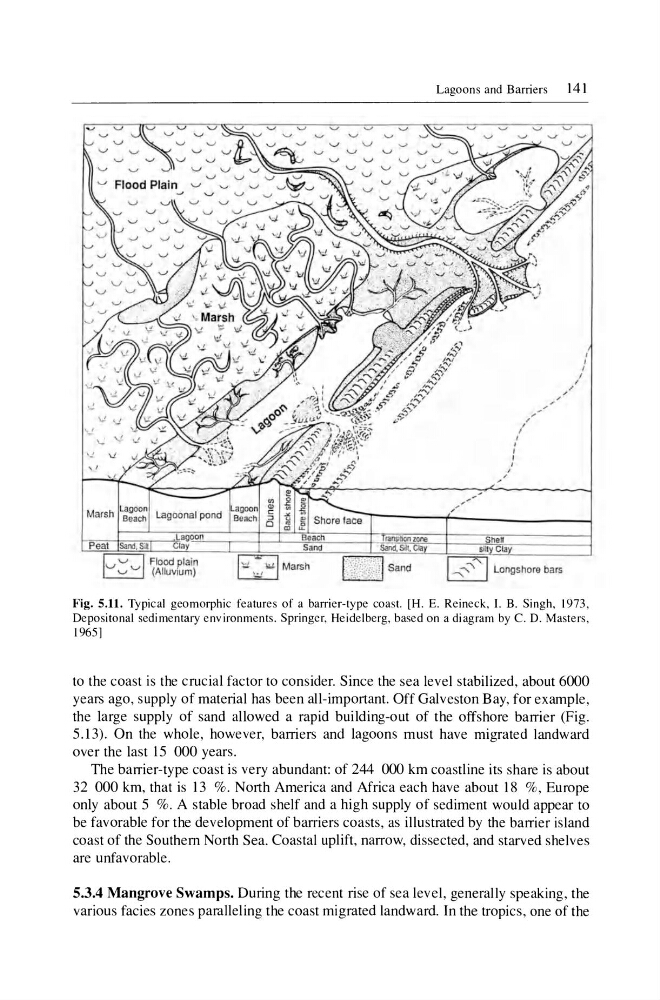
Fig. 5.11. Typical geomorphic features of a barrier-type coast. [H. E. Reineck, I. B. Singh, 1973 ,
Depositonal sedimentary environments. Springer, Heidelberg, based on a diagram by C. D. Masters,
1965]
to the coast is the crucial factor to consider. Since the sea level stabilized, about 6000
years ago, supply of material has been all-important. Off Galveston Bay, for example,
the large supply of sand allowed a rapid building-out of the offshore barrier (Fig.
5.13). On the whole , however, barriers and lagoons must have migrated landward
over the last 15 000 years.
The barrier-type coast is very abundant: of 244 000 km coastline its share is about
32 000 km, that is 13 %. North America and Africa each have about 18 %, Europe
only about 5 %. A stable broad shelf and a high supply of sediment would appear to
be favorable for the development of barriers coasts, as illustrated by the barrier island
coast of the Southern North Sea. Coastal uplift, narrow, dissected, and starved shelves
are unfavorable.
5.3.4 Mangrove Swamps. During the recent rise of sea level, generally speaking, the
various facies zones paralleling the coast migrated landward. In the tropics, one of the
' .'
Lagoons and Barriers
141
"
I
I
,
,
,
,
I
I
;
/
I
;
"
"
/
I
I
I
I
/
Marsh L:~~ Lagoonal pond
~
",;;
~ Shore fa~ce;"ir----+---------~
Iv v v I Flood plain I ~ ' " ~ I Marsh
I ~""-, ' " I longshore bars
v
(AllUVium)
'.:.j
,
Fig. 5.11. Typical geomorphic features of a barrier-type coast. [H. E. Reineck, I. B. Singh, 1973 ,
Depositonal sedimentary environments. Springer, Heidelberg, based on a diagram by C. D. Masters,
1965]
to the coast is the crucial factor to consider. Since the sea level stabilized, about 6000
years ago, supply of material has been all-important. Off Galveston Bay, for example,
the large supply of sand allowed a rapid building-out of the offshore barrier (Fig.
5.13). On the whole , however, barriers and lagoons must have migrated landward
over the last 15 000 years.
The barrier-type coast is very abundant: of 244 000 km coastline its share is about
32 000 km, that is 13 %. North America and Africa each have about 18 %, Europe
only about 5 %. A stable broad shelf and a high supply of sediment would appear to
be favorable for the development of barriers coasts, as illustrated by the barrier island
coast of the Southern North Sea. Coastal uplift, narrow, dissected, and starved shelves
are unfavorable.
5.3.4 Mangrove Swamps. During the recent rise of sea level, generally speaking, the
various facies zones paralleling the coast migrated landward. In the tropics, one of the