

River Mouths
139
.... , ',.'. " " .. . ~ : .. .
. : : ~ .
.: .... :
. " "
-.. .... : .;;;. , . . -: . .:,' ..
B
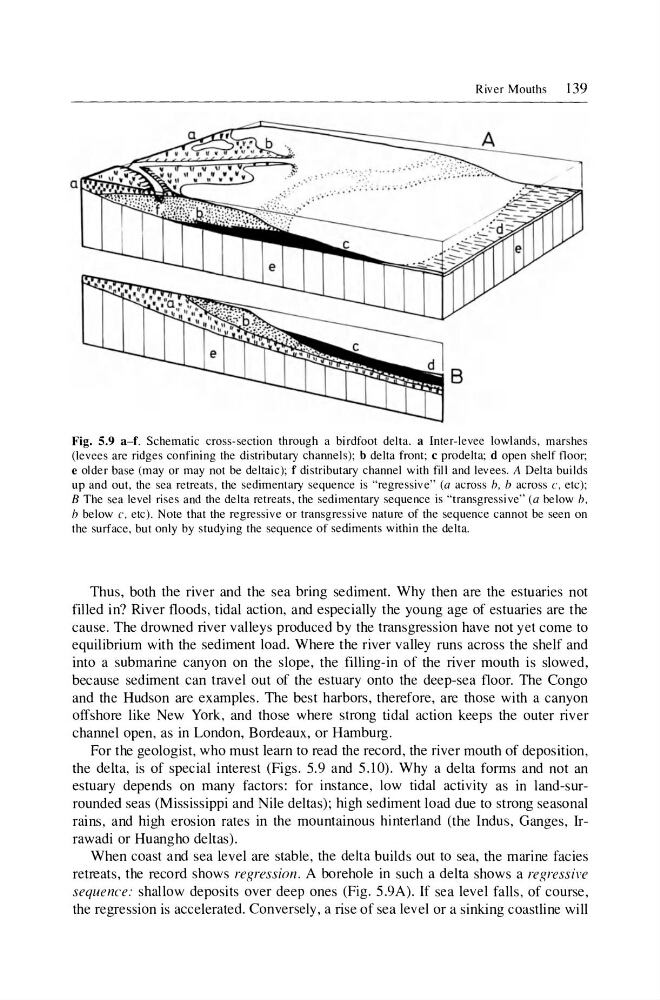
Fig. 5.9 a-f. Schematic cross-section through a birdfoot delta. a Inter-levee lowlands, marshes
(levees are ridges confining the distributary channels); b delta front; c prodelta; d open shelf floor;
e older base (mayor may not be deltaic); f distributary channel with fill and levees. A Delta builds
up and out, the sea retreats, the sedimentary sequence is "regressive" (a across h, b across c, etc);
B The sea level rises and the delta retreats, the sedimentary sequence is "transgressive" (a below h,
b below c. etc). Note that the regressive or transgressive nature of the sequence cannot be seen on
the surface, but only by studying the sequence of sediments within the delta.
Thus, both the river and the sea bring sediment. Why then are the estuaries not
filled in? River floods, tidal action, and especially the young age of estuaries are the
cause, The drowned river valleys produced by the transgression have not yet come to
equilibrium with the sediment load. Where the river valley runs across the shelf and
into a submarine canyon on the slope, the filling-in of the river mouth is slowed,
because sediment can travel out of the estuary onto the deep-sea floor. The Congo
and the Hudson are examples. The best harbors, therefore, are those with a canyon
offshore like New York, and those where strong tidal action keeps the outer river
channel open, as in London, Bordeaux, or Hamburg.
For the geologist, who must learn to read the record, the river mouth of deposition,
the delta, is of special interest (Figs. 5.9 and 5.10). Why a delta forms and not an
estuary depends on many factors: for instance, low tidal activity as in land-surrounded seas (Mississippi and Nile deltas); high sediment load due to strong seasonal
rains, and high erosion rates in the mountainous hinterland (the Indus, Ganges, Irrawadi or Huangho deltas).
When coast and sea level are stable, the delta builds out to sea, the marine facies
retreats, the record shows regression . A borehole in such a delta shows a regressive
sequence: shallow deposits over deep ones (Fig. 5.9A). If sea level falls, of course,
the regression is accelerated. Conversely, a rise of sea level or a sinking coastline wi II
139
.... , ',.'. " " .. . ~ : .. .
. : : ~ .
.: .... :
. " "
-.. .... : .;;;. , . . -: . .:,' ..
B
Fig. 5.9 a-f. Schematic cross-section through a birdfoot delta. a Inter-levee lowlands, marshes
(levees are ridges confining the distributary channels); b delta front; c prodelta; d open shelf floor;
e older base (mayor may not be deltaic); f distributary channel with fill and levees. A Delta builds
up and out, the sea retreats, the sedimentary sequence is "regressive" (a across h, b across c, etc);
B The sea level rises and the delta retreats, the sedimentary sequence is "transgressive" (a below h,
b below c. etc). Note that the regressive or transgressive nature of the sequence cannot be seen on
the surface, but only by studying the sequence of sediments within the delta.
Thus, both the river and the sea bring sediment. Why then are the estuaries not
filled in? River floods, tidal action, and especially the young age of estuaries are the
cause, The drowned river valleys produced by the transgression have not yet come to
equilibrium with the sediment load. Where the river valley runs across the shelf and
into a submarine canyon on the slope, the filling-in of the river mouth is slowed,
because sediment can travel out of the estuary onto the deep-sea floor. The Congo
and the Hudson are examples. The best harbors, therefore, are those with a canyon
offshore like New York, and those where strong tidal action keeps the outer river
channel open, as in London, Bordeaux, or Hamburg.
For the geologist, who must learn to read the record, the river mouth of deposition,
the delta, is of special interest (Figs. 5.9 and 5.10). Why a delta forms and not an
estuary depends on many factors: for instance, low tidal activity as in land-surrounded seas (Mississippi and Nile deltas); high sediment load due to strong seasonal
rains, and high erosion rates in the mountainous hinterland (the Indus, Ganges, Irrawadi or Huangho deltas).
When coast and sea level are stable, the delta builds out to sea, the marine facies
retreats, the record shows regression . A borehole in such a delta shows a regressive
sequence: shallow deposits over deep ones (Fig. 5.9A). If sea level falls, of course,
the regression is accelerated. Conversely, a rise of sea level or a sinking coastline wi II