

138 Sea Level Processes and Effects of Sea Level Change
Longshore sand transport (Sect. 4.22) tends to close off the estuaries which fill with
sediment to make marshlands (Fig. 5.7b).
Drowned rivers can make good harbors: the East Coast is dotted by ports with
excellent deep-water access. Drowned rivers are sediment traps; they tend to catch in
their estuaries whatever material is brought from the continent. On the whole, therefore, the shelf off the East Coast is starved of sediment. What we find on the sea floor
there is largely relict material from the last ice age. The distribution of such relict
sediments , naturally, is not very indicative of the present-day processes active on the
shelf, except through the evidence for reworking .
With this general background, let us now consider the geologic-morphologic processes at sea level in more detail, first at river mouths, then at lowland coasts between
the rivers.
5.3.2 River. Mouths. A glance at a world map shows that river mouths can be
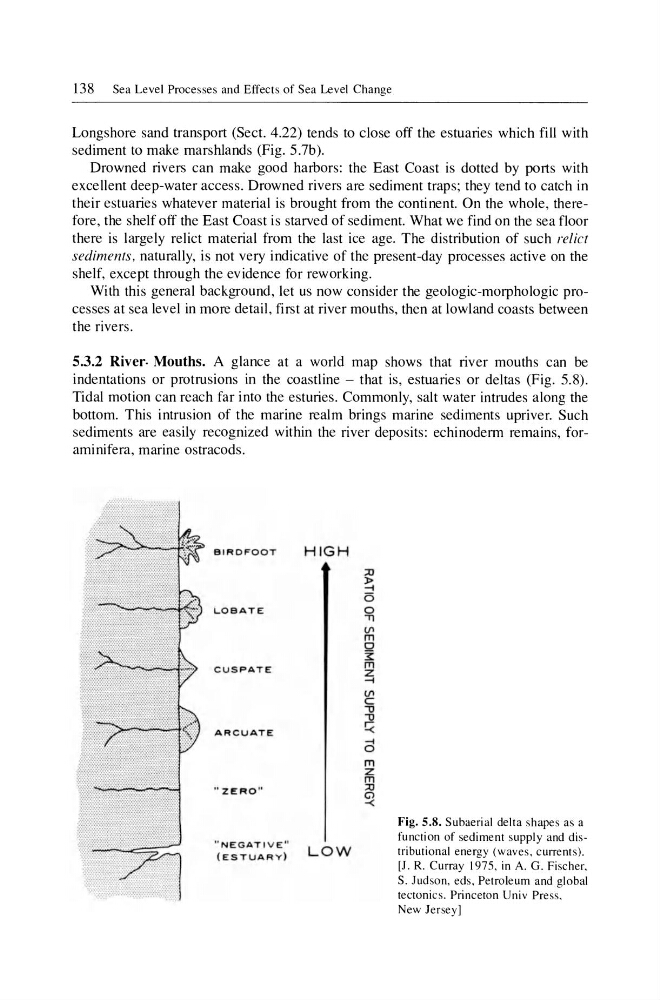
indentations or protrusions in the coastline - that is, estuaries or deltas (Fig. 5.8) .
Tidal motion can reach far into the esturies. Commonly, salt water intrudes along the
bottom. This intrusion of the marine realm brings marine sediments upriver. Such
sediments are easily recognized within the river deposits: echinoderm remains, foraminifera, marine ostracods.
B I RO F OO T
L OBA TE
C U SPA T E
ARC U ATE
" ZII!:RO "
" N E G A TIVE "
(E S T UAR Y)
H IGH
LOW
Fig. 5.8. Subaerial delta shapes as a
function of sedimenl supply and di stribution al energy (waves. currenls).
[1. R. Curray 1975. in A. G. Fischer.
S. Jud son. eds. Petroleum and global
tectonics. Princeton Univ Press.
New Jersey]
Longshore sand transport (Sect. 4.22) tends to close off the estuaries which fill with
sediment to make marshlands (Fig. 5.7b).
Drowned rivers can make good harbors: the East Coast is dotted by ports with
excellent deep-water access. Drowned rivers are sediment traps; they tend to catch in
their estuaries whatever material is brought from the continent. On the whole, therefore, the shelf off the East Coast is starved of sediment. What we find on the sea floor
there is largely relict material from the last ice age. The distribution of such relict
sediments , naturally, is not very indicative of the present-day processes active on the
shelf, except through the evidence for reworking .
With this general background, let us now consider the geologic-morphologic processes at sea level in more detail, first at river mouths, then at lowland coasts between
the rivers.
5.3.2 River. Mouths. A glance at a world map shows that river mouths can be
indentations or protrusions in the coastline - that is, estuaries or deltas (Fig. 5.8) .
Tidal motion can reach far into the esturies. Commonly, salt water intrudes along the
bottom. This intrusion of the marine realm brings marine sediments upriver. Such
sediments are easily recognized within the river deposits: echinoderm remains, foraminifera, marine ostracods.
B I RO F OO T
L OBA TE
C U SPA T E
ARC U ATE
" ZII!:RO "
" N E G A TIVE "
(E S T UAR Y)
H IGH
LOW
Fig. 5.8. Subaerial delta shapes as a
function of sedimenl supply and di stribution al energy (waves. currenls).
[1. R. Curray 1975. in A. G. Fischer.
S. Jud son. eds. Petroleum and global
tectonics. Princeton Univ Press.
New Jersey]