

120
Effects of Waves and Currents
Upwelling is not restricted to coastal areas. The divergence of surface waters
anywhere in the open ocean causes replacement from below. The great equatorial
divergences in the Pacific and Atlantic Oceans cause the well -known equatorial
upwelling which we shall encounter when studying carbonate distributions (Chap. 8).
The high productivity along these belts not only raises the sedimentation rates of
calcareous and siliceous ooze, but also may be ultimately responsible - through
concentration of trace metals in organisms and transport to the sea floor in organic
debris - for the high values of copper, nickel, zinc, and other metals in Pacific
manganese nodules (Sect. 10.4).
4.3.4 Deep Ocean Currents and Benthic Storms. There was a time, not so long
ago, when the deep ocean was thought to be a quiet, calm environment whose
currents are weak and relatively unimportant as far as shaping the sea floor. The first
indication that this is not necessarily so came from the calculations of Georg Wiist
(1890-1977) and Albert Defant (1884--1974) in the 1930s. They showed that the
temperature-salinity distributions seen in the closely spaced profiles of the Meteor
Expedition in the central Atlantic implied strong bottom-near flows driven by density
differences. Such currents hug the slopes of ocean margins and the flanks of midocean ridges, and they follow density surfaces which are practically horizontal.
Hence, the currents are parallel to bottom contours, and marine geologists refer to
them as contour currents. For physical oceanographers they are deep geostrophic
currents. Their effects are clearly visible on deep-sea photographs (Fig. 4.22). Such
currents can erode, especially where confined to passages. Erosion occurs, for
o·
WSBW
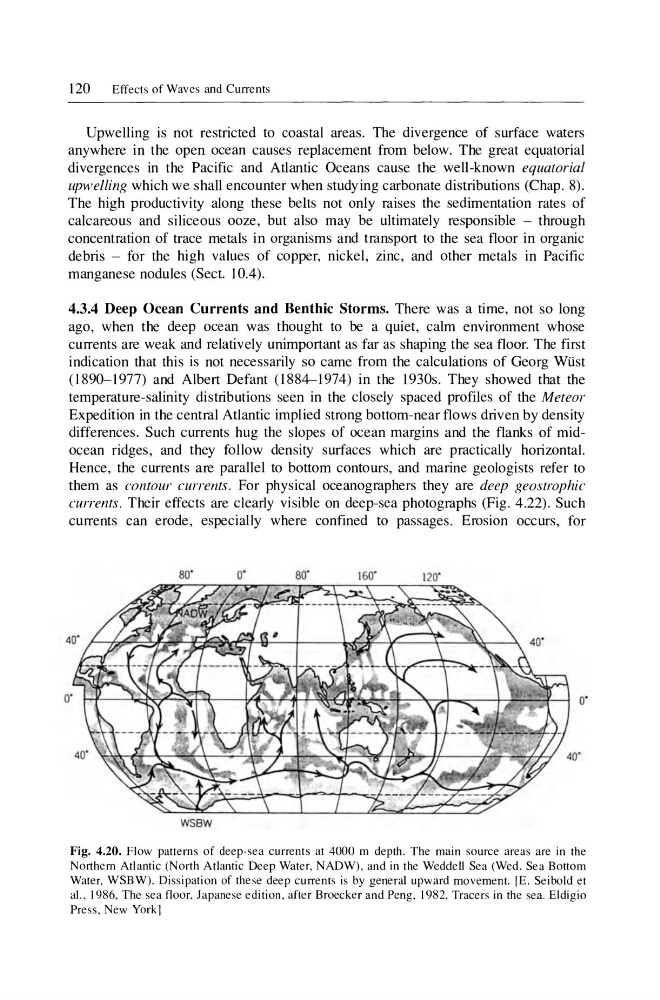
Fig. 4.20. Flow patte rns of deep-sea currents at 4000 m de pth. The main source areas are in the
Northe rn Atlantic (North Atlantic Deep Water, NADW), and in the Weddell Sea (Wed. Sea Bottom
Water, WSBW). Dissipation of these dee p currents is by gene ral upward movement. [E. Seibold et
aI. , 1986, The sea floor. Japanese edition, after Broecker and Peng, 1982, Tracers in the sea. Eldigio
Press. New York]
Effects of Waves and Currents
Upwelling is not restricted to coastal areas. The divergence of surface waters
anywhere in the open ocean causes replacement from below. The great equatorial
divergences in the Pacific and Atlantic Oceans cause the well -known equatorial
upwelling which we shall encounter when studying carbonate distributions (Chap. 8).
The high productivity along these belts not only raises the sedimentation rates of
calcareous and siliceous ooze, but also may be ultimately responsible - through
concentration of trace metals in organisms and transport to the sea floor in organic
debris - for the high values of copper, nickel, zinc, and other metals in Pacific
manganese nodules (Sect. 10.4).
4.3.4 Deep Ocean Currents and Benthic Storms. There was a time, not so long
ago, when the deep ocean was thought to be a quiet, calm environment whose
currents are weak and relatively unimportant as far as shaping the sea floor. The first
indication that this is not necessarily so came from the calculations of Georg Wiist
(1890-1977) and Albert Defant (1884--1974) in the 1930s. They showed that the
temperature-salinity distributions seen in the closely spaced profiles of the Meteor
Expedition in the central Atlantic implied strong bottom-near flows driven by density
differences. Such currents hug the slopes of ocean margins and the flanks of midocean ridges, and they follow density surfaces which are practically horizontal.
Hence, the currents are parallel to bottom contours, and marine geologists refer to
them as contour currents. For physical oceanographers they are deep geostrophic
currents. Their effects are clearly visible on deep-sea photographs (Fig. 4.22). Such
currents can erode, especially where confined to passages. Erosion occurs, for
o·
WSBW
Fig. 4.20. Flow patte rns of deep-sea currents at 4000 m de pth. The main source areas are in the
Northe rn Atlantic (North Atlantic Deep Water, NADW), and in the Weddell Sea (Wed. Sea Bottom
Water, WSBW). Dissipation of these dee p currents is by gene ral upward movement. [E. Seibold et
aI. , 1986, The sea floor. Japanese edition, after Broecker and Peng, 1982, Tracers in the sea. Eldigio
Press. New York]