

km
a
Deep Ocean Currents
121
ATLANTIC
ANT.
so" 70 60 SO 40 30 20 10 0 10
S
ARCTIC
30 40 SO 60 70"
N
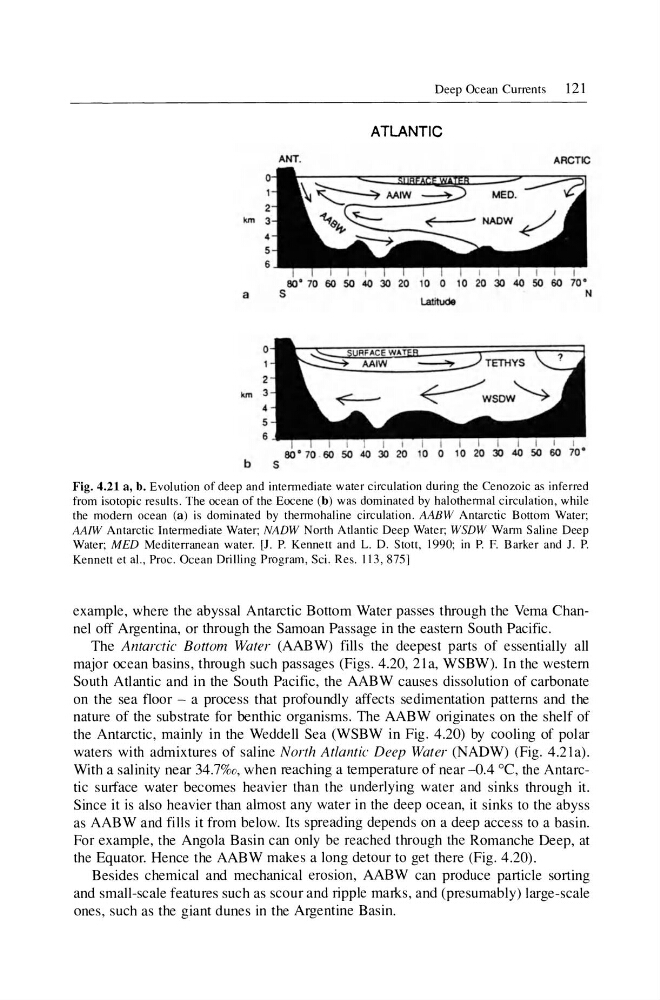
Fig. 4.21 a, b. Evolution of deep and intennediate water circulation during the Cenozoic as inferred
from isotopic results. The ocean of the Eocene (b) was dominated by halothennal circulation, while
the modern ocean (a) is dominated by thennohaline circulation. AABW Antarctic Bottom Water;
AAIW Antarctic Intennediate Water; NADW North Atlantic Deep Water; WSDW Wann Saline Deep
Water; MED Mediterranean water. [J. P. Kennett and L. D. Stott, 1990; in P. F. Barker and J. P.
Kennett et aI., Proc. Ocean Drilling Program, Sci . Res. 113, 875]
example, where the abyssal Antarctic Bottom Water passes through the Vema Channel off Argentina, or through the Samoan Passage in the eastern South Pacific.
The Antarctic Bottom Water (AABW) fills the deepest parts of essentially all
major ocean basins, through such passages (Figs. 4.20, 21 a, WSBW). In the western
South Atlantic and in the South Pacific, the AABW causes dissolution of carbonate
on the sea floor - a process that profoundly affects sedimentation patterns and the
nature of the substrate for benthic organisms. The AABW originates on the shelf of
the Antarctic, mainly in the Weddell Sea (WSBW in Fig. 4.20) by cooling of polar
waters with admixtures of saline North Atlantic Deep Water (NADW) (Fig. 4.21 a).
With a salinity near 34.7%0, when reaching a temperature of near -0.4 °C, the Antarctic surface water becomes heavier than the underlying water and sinks through it.
Since it is also heavier than almost any water in the deep ocean, it sinks to the abyss
as AABW and fills it from below. Its spreading depends on a deep access to a basin.
For example, the Angola Basin can only be reached through the Romanche Deep, at
the Equator. Hence the AABW makes a long detour to get there (Fig. 4.20).
Besides chemical and mechanical erosion, AABW can produce particle sorting
and small-scale features such as scour and ripple marks, and (presumably) large-scale
ones, such as the giant dunes in the Argentine Basin.
a
Deep Ocean Currents
121
ATLANTIC
ANT.
so" 70 60 SO 40 30 20 10 0 10
S
ARCTIC
30 40 SO 60 70"
N
Fig. 4.21 a, b. Evolution of deep and intennediate water circulation during the Cenozoic as inferred
from isotopic results. The ocean of the Eocene (b) was dominated by halothennal circulation, while
the modern ocean (a) is dominated by thennohaline circulation. AABW Antarctic Bottom Water;
AAIW Antarctic Intennediate Water; NADW North Atlantic Deep Water; WSDW Wann Saline Deep
Water; MED Mediterranean water. [J. P. Kennett and L. D. Stott, 1990; in P. F. Barker and J. P.
Kennett et aI., Proc. Ocean Drilling Program, Sci . Res. 113, 875]
example, where the abyssal Antarctic Bottom Water passes through the Vema Channel off Argentina, or through the Samoan Passage in the eastern South Pacific.
The Antarctic Bottom Water (AABW) fills the deepest parts of essentially all
major ocean basins, through such passages (Figs. 4.20, 21 a, WSBW). In the western
South Atlantic and in the South Pacific, the AABW causes dissolution of carbonate
on the sea floor - a process that profoundly affects sedimentation patterns and the
nature of the substrate for benthic organisms. The AABW originates on the shelf of
the Antarctic, mainly in the Weddell Sea (WSBW in Fig. 4.20) by cooling of polar
waters with admixtures of saline North Atlantic Deep Water (NADW) (Fig. 4.21 a).
With a salinity near 34.7%0, when reaching a temperature of near -0.4 °C, the Antarctic surface water becomes heavier than the underlying water and sinks through it.
Since it is also heavier than almost any water in the deep ocean, it sinks to the abyss
as AABW and fills it from below. Its spreading depends on a deep access to a basin.
For example, the Angola Basin can only be reached through the Romanche Deep, at
the Equator. Hence the AABW makes a long detour to get there (Fig. 4.20).
Besides chemical and mechanical erosion, AABW can produce particle sorting
and small-scale features such as scour and ripple marks, and (presumably) large-scale
ones, such as the giant dunes in the Argentine Basin.