

b
Upwelling
119
a
T (C · )
~----------~r---------~~---,O m
11
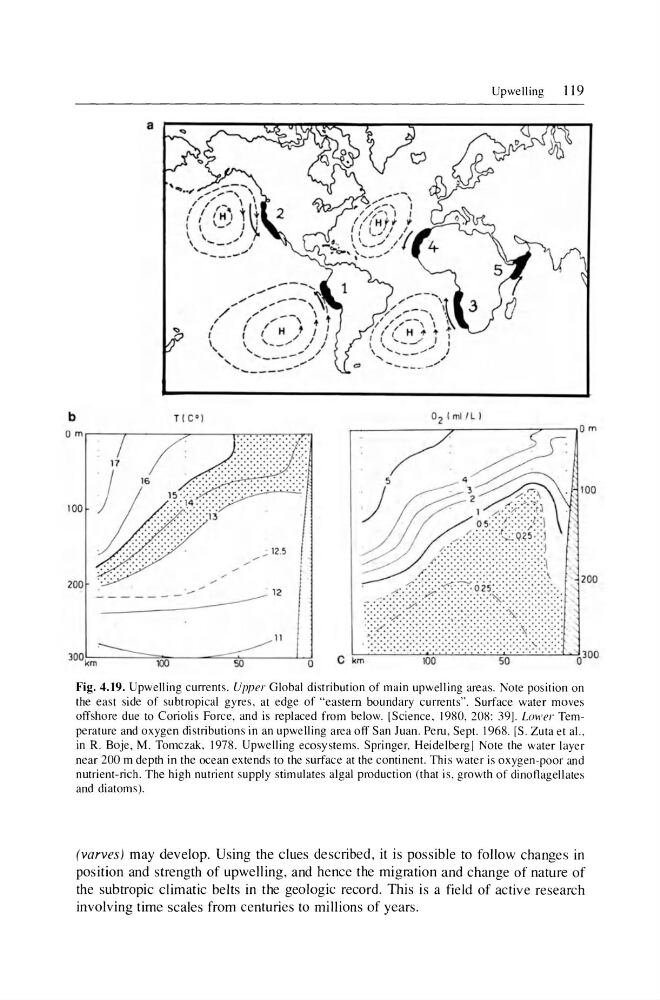
Fig. 4.19. Upwelling currents. Upper Global distribution of main upwelling areas. Note position on
the east side of subtropical gyres, at edge of "eastern boundary currents". Surface water moves
offshore due to Coriolis Force, and is replaced from below. [Science . 1980,208: 39]. Lower Temperature and oxygen distributions in an upwelling area off San Juan. Peru , Sept. 1968. [S o Zuta et aI. ,
in R. Boje, M. Tomczak. 1978. Upwelling ecosystems. Springer, Heidelberg] Note the water layer
near 200 m depth in the ocean extends to the surface at the continent. This water is oxygen-poor and
nutrient-rich. The high nutrient supply stimulates algal production (that is, growth of dinoflagellates
and diatoms).
(varves) may develop. Using the clues described, it is possible to follow changes in
position and strength of upwelling , and hence the migration and change of nature of
the subtropic climatic belts in the geologic record. This is a field of active research
involving time scales from centuries to millions of years.
Upwelling
119
a
T (C · )
~----------~r---------~~---,O m
11
Fig. 4.19. Upwelling currents. Upper Global distribution of main upwelling areas. Note position on
the east side of subtropical gyres, at edge of "eastern boundary currents". Surface water moves
offshore due to Coriolis Force, and is replaced from below. [Science . 1980,208: 39]. Lower Temperature and oxygen distributions in an upwelling area off San Juan. Peru , Sept. 1968. [S o Zuta et aI. ,
in R. Boje, M. Tomczak. 1978. Upwelling ecosystems. Springer, Heidelberg] Note the water layer
near 200 m depth in the ocean extends to the surface at the continent. This water is oxygen-poor and
nutrient-rich. The high nutrient supply stimulates algal production (that is, growth of dinoflagellates
and diatoms).
(varves) may develop. Using the clues described, it is possible to follow changes in
position and strength of upwelling , and hence the migration and change of nature of
the subtropic climatic belts in the geologic record. This is a field of active research
involving time scales from centuries to millions of years.