

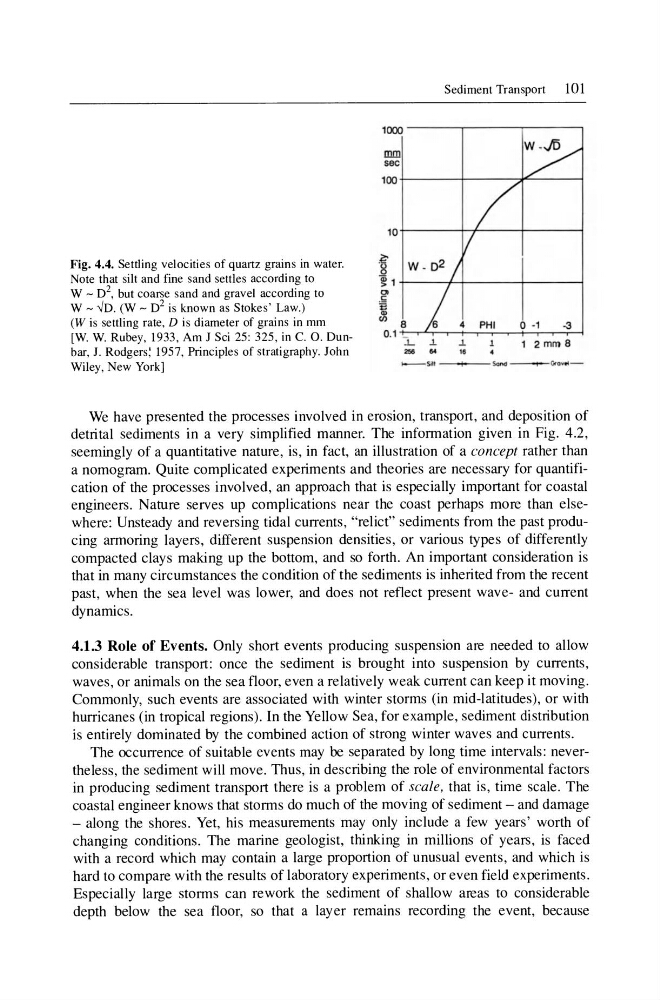
Fig. 4.4. Settling velocities of quartz grains in water.
Note that silt and fine sand settles according to
W - 0 2 , but coarse sand and gravel according to
W - ..JO. (W - 0 2 is known as Stokes' Law.)
(W is settling rate, D is diameter of grains in mm
[w. W. Rubey, 1933, Am J Sci 25 : 325, in C. O. Dunbar, J. Rodgers: 1957, Principles of stratigraphy. John
Wiley, New York]
Sediment Transport
101
1000 - - -- , - - - - r - -----,
mm
sec
l00 +---~r_--~~--~
10 +-----~~--r---~
§
~1+----~+----r---~
go
E
Jl 8
0.1 ": _:--o-LT---.-+-....,.:.....:;....~-t--..;-r-rl
.L.l.
.1.
1 2mrn8
25S
14
18
t--SlIt - _ --SoNI -----t--Gta.,.. -
We have presented the processes involved in erosion, transport, and deposition of
detrital sediments in a very simplified manner. The information given in Fig. 4.2,
seemingly of a quantitative nature, is, in fact, an illustration of a concept rather than
a nomogram. Quite complicated experiments and theories are necessary for quantification of the processes involved, an approach that is especially important for coastal
engineers. Nature serves up complications near the coast perhaps more than elsewhere: Unsteady and reversing tidal currents, "relict" sediments from the past producing armoring layers, different suspension densities, or various types of differently
compacted clays making up the bottom, and so forth. An important consideration is
that in many circumstances the condition of the sediments is inherited from the recent
past, when the sea level was lower, and does not reflect present wave- and current
dynamics.
4.1.3 Role of Events. Only short events producing suspension are needed to allow
considerable transport: once the sediment is brought into suspension by currents,
waves, or animals on the sea floor, even a relatively weak current can keep it moving.
Commonly, such events are associated with winter storms (in mid-latitudes), or with
hurricanes (in tropical regions). In the Yellow Sea, for example, sediment distribution
is entirely dominated by the combined action of strong winter waves and currents.
The occurrence of suitable events may be separated by long time intervals: nevertheless, the sediment will move. Thus, in describing the role of environmental factors
in producing sediment transport there is a problem of scale, that is, time scale. The
coastal engineer knows that storms do much of the moving of sediment - and damage
- along the shores. Yet, his measurements may only include a few years' worth of
changing conditions. The marine geologist, thinking in millions of years, is faced
with a record which may contain a large proportion of unusual events. and which is
hard to compare with the results of laboratory experiments, or even field experiments.
Especially large storms can rework the sediment of shallow areas to considerable
depth below the sea floor. so that a layer remains recording the event. because
Note that silt and fine sand settles according to
W - 0 2 , but coarse sand and gravel according to
W - ..JO. (W - 0 2 is known as Stokes' Law.)
(W is settling rate, D is diameter of grains in mm
[w. W. Rubey, 1933, Am J Sci 25 : 325, in C. O. Dunbar, J. Rodgers: 1957, Principles of stratigraphy. John
Wiley, New York]
Sediment Transport
101
1000 - - -- , - - - - r - -----,
mm
sec
l00 +---~r_--~~--~
10 +-----~~--r---~
§
~1+----~+----r---~
go
E
Jl 8
0.1 ": _:--o-LT---.-+-....,.:.....:;....~-t--..;-r-rl
.L.l.
.1.
1 2mrn8
25S
14
18
t--SlIt - _ --SoNI -----t--Gta.,.. -
We have presented the processes involved in erosion, transport, and deposition of
detrital sediments in a very simplified manner. The information given in Fig. 4.2,
seemingly of a quantitative nature, is, in fact, an illustration of a concept rather than
a nomogram. Quite complicated experiments and theories are necessary for quantification of the processes involved, an approach that is especially important for coastal
engineers. Nature serves up complications near the coast perhaps more than elsewhere: Unsteady and reversing tidal currents, "relict" sediments from the past producing armoring layers, different suspension densities, or various types of differently
compacted clays making up the bottom, and so forth. An important consideration is
that in many circumstances the condition of the sediments is inherited from the recent
past, when the sea level was lower, and does not reflect present wave- and current
dynamics.
4.1.3 Role of Events. Only short events producing suspension are needed to allow
considerable transport: once the sediment is brought into suspension by currents,
waves, or animals on the sea floor, even a relatively weak current can keep it moving.
Commonly, such events are associated with winter storms (in mid-latitudes), or with
hurricanes (in tropical regions). In the Yellow Sea, for example, sediment distribution
is entirely dominated by the combined action of strong winter waves and currents.
The occurrence of suitable events may be separated by long time intervals: nevertheless, the sediment will move. Thus, in describing the role of environmental factors
in producing sediment transport there is a problem of scale, that is, time scale. The
coastal engineer knows that storms do much of the moving of sediment - and damage
- along the shores. Yet, his measurements may only include a few years' worth of
changing conditions. The marine geologist, thinking in millions of years, is faced
with a record which may contain a large proportion of unusual events. and which is
hard to compare with the results of laboratory experiments, or even field experiments.
Especially large storms can rework the sediment of shallow areas to considerable
depth below the sea floor. so that a layer remains recording the event. because