

100 Effects of Waves and Currents
Fluid discharge rate
and bed form
low discharge
-High discharge
..
Very high discharge ..
. . . .
' .. .
, ' . .
;:8;~~tf~~W~1~~~?~;~~t~!~0f: ?:~f~\ :r~'
Groin and bed
motion
Threshold of groin
movement on flat bed
I incipient motion I
Vortex plume over
ripple crest
Ripple bed, ripple form
- - - - moves down
I dunes I
stream
Suspension
Sheet flow on smooth bed
Standing wove in fluid
Suspension
Sand waves, form moves
up-stream
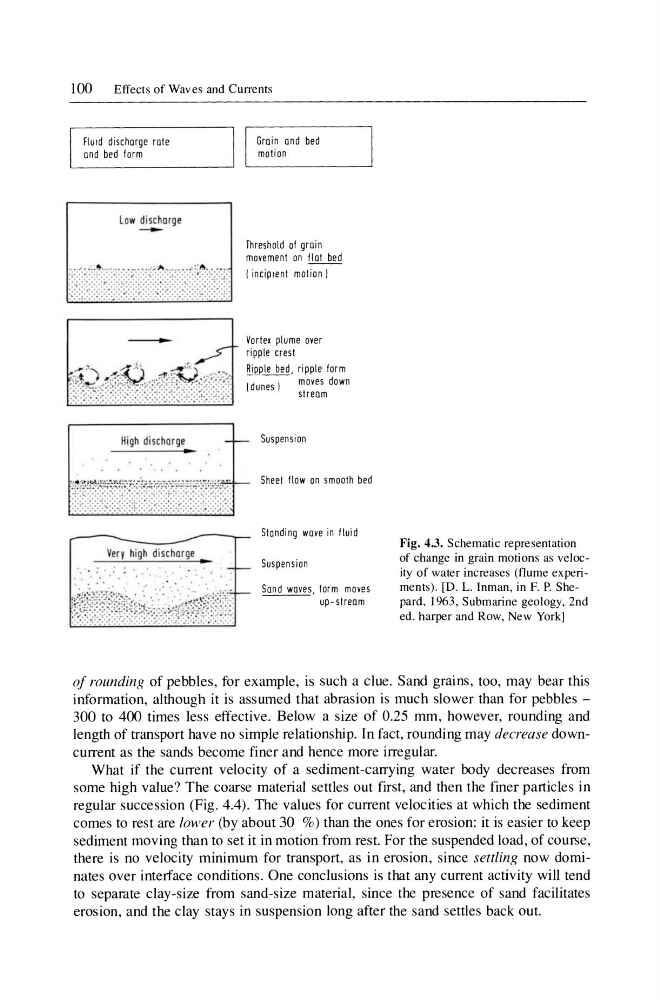
Fig. 4.3. Schematic representation
of change in grain motions as velocity of water increases (flume experiments). [D. L. Inman, in F. P. Shepard, 1963, Submarine geology, 2nd
ed. harper and Row, New York)
of rounding of pebbles, for example, is such a clue. Sand grains, too, may bear this
information, although it is assumed that abrasion is much slower than for pebbles -
300 to 400 times less effective. Below a size of 0.25 mm, however, rounding and
length of transport have no simple relationship. In fact, rounding may decrease downcurrent as the sands become finer and hence more irregular.
What if the current velocity of a sediment-carrying water body decreases from
some high value? The coarse material settles out first, and then the finer particles in
regular succession (Fig. 4.4). The values for current velocities at which the sediment
comes to rest are lower (by about 30 %) than the ones for erosion: it is easier to keep
sediment moving than to set it in motion from rest. For the suspended load, of course,
there is no velocity minimum for transport, as in erosion, since settling now dominates over interface conditions. One conclusions is that any current activity will tend
to sepamte clay-size from sand-size material, since the presence of sand facilitates
erosion, and the clay stays in suspension long after the sand settles back out.
Fluid discharge rate
and bed form
low discharge
-High discharge
..
Very high discharge ..
. . . .
' .. .
, ' . .
;:8;~~tf~~W~1~~~?~;~~t~!~0f: ?:~f~\ :r~'
Groin and bed
motion
Threshold of groin
movement on flat bed
I incipient motion I
Vortex plume over
ripple crest
Ripple bed, ripple form
- - - - moves down
I dunes I
stream
Suspension
Sheet flow on smooth bed
Standing wove in fluid
Suspension
Sand waves, form moves
up-stream
Fig. 4.3. Schematic representation
of change in grain motions as velocity of water increases (flume experiments). [D. L. Inman, in F. P. Shepard, 1963, Submarine geology, 2nd
ed. harper and Row, New York)
of rounding of pebbles, for example, is such a clue. Sand grains, too, may bear this
information, although it is assumed that abrasion is much slower than for pebbles -
300 to 400 times less effective. Below a size of 0.25 mm, however, rounding and
length of transport have no simple relationship. In fact, rounding may decrease downcurrent as the sands become finer and hence more irregular.
What if the current velocity of a sediment-carrying water body decreases from
some high value? The coarse material settles out first, and then the finer particles in
regular succession (Fig. 4.4). The values for current velocities at which the sediment
comes to rest are lower (by about 30 %) than the ones for erosion: it is easier to keep
sediment moving than to set it in motion from rest. For the suspended load, of course,
there is no velocity minimum for transport, as in erosion, since settling now dominates over interface conditions. One conclusions is that any current activity will tend
to sepamte clay-size from sand-size material, since the presence of sand facilitates
erosion, and the clay stays in suspension long after the sand settles back out.