

N
'lilt
o 0 0000
o 0 0 00
~ ~:g~ N
~ ~CI:!C> C>
o 0 00 0 0 OO~ N
Grain size. in millimeters
Sediment Transport
99
~ COCDO
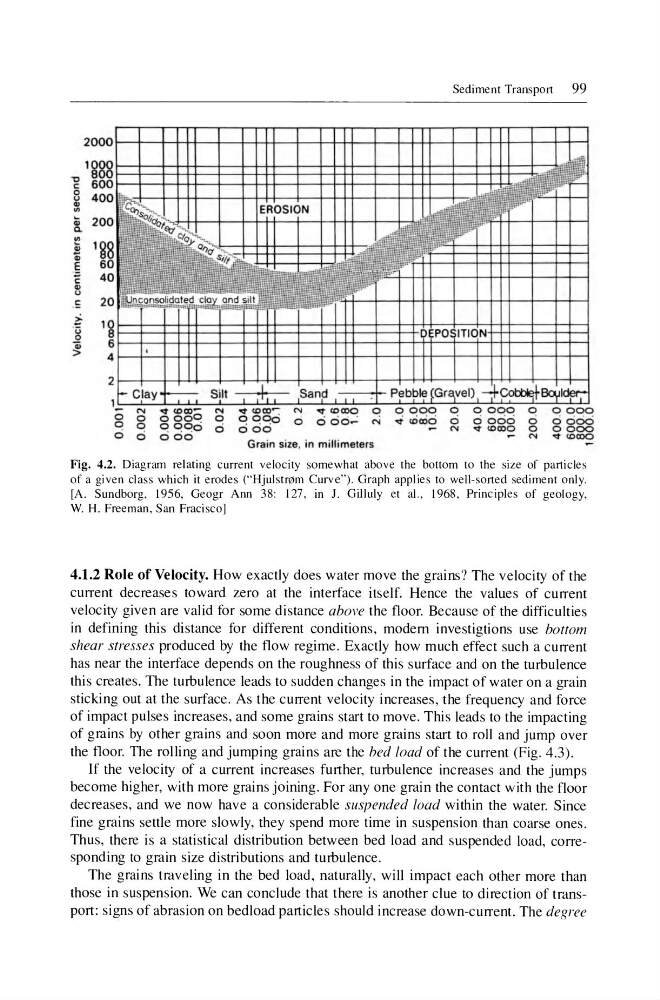
Fig. 4.2. Diagram relating current velocity somewhat above the bottom to the size of particles
of a given class which it erodes ("'Hjulstr0m Curve"). Graph applies to well-sorted sediment only.
[A. Sundborg, 1956, Geogr Ann 38: 127, in J. Gilluly et aI. , 1968, Principles of geology,
W. H. Freeman, San Fraciscol
4.1.2 Role of Velocity. How exactly does water move the grains? The velocity of the
current decreases toward zero at the interface itself. Hence the values of current
velocity given are valid for some distance above the floor. Because of the difficulties
in defining this distance for different conditions, modem investigtions use bottom
shear stresses produced by the flow regime. Exactly how much effect such a current
has near the interface depends on the roughness of this surface and on the turbulence
this creates. The turbulence leads to sudden changes in the impact of water on a grain
sticking out at the surface. As the current velocity increases, the frequency and force
of impact pulses increases, and some grains start to move. This leads to the impacting
of grains by other grains and soon more and more grains start to roll and jump over
the floor. The rolling and jumping grains are the hed load of the current (Fig. 4.3).
If the velocity of a current increases further, turbulence increases and the jumps
become higher, with more grains joining. For anyone grain the contact with the floor
decreases, and we now have a considerable suspended load within the water. Since
fine grains settle more slowly, they spend more time in suspension than coarse ones.
Thus, there is a statistical distribution between bed load and suspended load, corresponding to grain size distributions and turbulence.
The grains traveling in the bed load, naturally, will impact each other more than
those in suspension. We can conclude that there is another clue to direction of transport: signs of abrasion on bedload particles should increase down-current. The degree
'lilt
o 0 0000
o 0 0 00
~ ~:g~ N
~ ~CI:!C> C>
o 0 00 0 0 OO~ N
Grain size. in millimeters
Sediment Transport
99
~ COCDO
Fig. 4.2. Diagram relating current velocity somewhat above the bottom to the size of particles
of a given class which it erodes ("'Hjulstr0m Curve"). Graph applies to well-sorted sediment only.
[A. Sundborg, 1956, Geogr Ann 38: 127, in J. Gilluly et aI. , 1968, Principles of geology,
W. H. Freeman, San Fraciscol
4.1.2 Role of Velocity. How exactly does water move the grains? The velocity of the
current decreases toward zero at the interface itself. Hence the values of current
velocity given are valid for some distance above the floor. Because of the difficulties
in defining this distance for different conditions, modem investigtions use bottom
shear stresses produced by the flow regime. Exactly how much effect such a current
has near the interface depends on the roughness of this surface and on the turbulence
this creates. The turbulence leads to sudden changes in the impact of water on a grain
sticking out at the surface. As the current velocity increases, the frequency and force
of impact pulses increases, and some grains start to move. This leads to the impacting
of grains by other grains and soon more and more grains start to roll and jump over
the floor. The rolling and jumping grains are the hed load of the current (Fig. 4.3).
If the velocity of a current increases further, turbulence increases and the jumps
become higher, with more grains joining. For anyone grain the contact with the floor
decreases, and we now have a considerable suspended load within the water. Since
fine grains settle more slowly, they spend more time in suspension than coarse ones.
Thus, there is a statistical distribution between bed load and suspended load, corresponding to grain size distributions and turbulence.
The grains traveling in the bed load, naturally, will impact each other more than
those in suspension. We can conclude that there is another clue to direction of transport: signs of abrasion on bedload particles should increase down-current. The degree