

102
Effects of Waves and Currents
subsequent reworking does not reach as deep again. Such layers are known as "tempestites". They are commonly characterized by coarse material overlying an erosive
base, followed by intercalations of coarser and finer sediment. In the intertidal "wadden" the coarse material consists of shell.
The existence of tempestites is a reminder that experiments on sediment transport,
for example in artificial waterways (flumes), have a scale problem with regard to
both size and time. Small-scale experiments do not necessarily reproduce the largescale phenomena observed in nature.
4.2 Effects of Waves
4.2.1 Waves and Offshore Sediment. Sooner or later, every marine geologist
becomes familiar with some of the less pleasant effects of waves, when at sea. Here
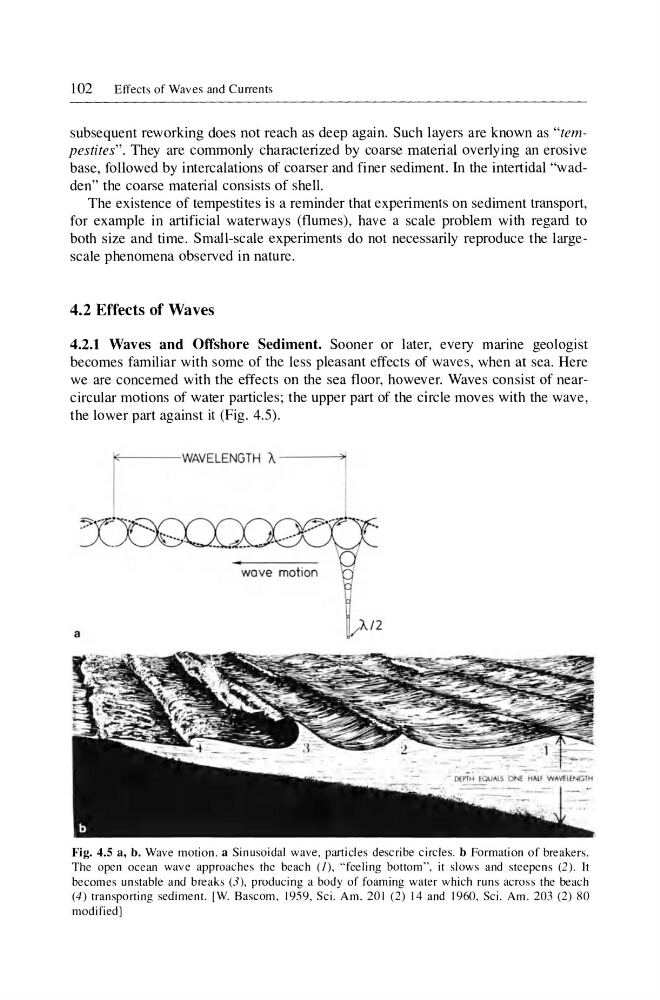
we are concerned with the effects on the sea floor, however. Waves consist of nearcircular motions of water particles; the upper part of the circle moves with the wave,
the lower part against it (Fig. 4.5).
wove motion
a
/12
Fig. 4.5 a, b. Wave motion. a Sinusoidal wave, particles describe circles. b Formation of breakers.
The open ocean wave approaches the beach (/), "'feeling bottom", it slows and steepens (2). It
becomes unstable and breaks (3), producing a body of foaming water which runs across the beach
(4) transporting sediment. rw. Bascom, 1959, Sci. Am. 201 (2) 14 and 1960, Sci . Am. 203 (2) 80
modified)
Effects of Waves and Currents
subsequent reworking does not reach as deep again. Such layers are known as "tempestites". They are commonly characterized by coarse material overlying an erosive
base, followed by intercalations of coarser and finer sediment. In the intertidal "wadden" the coarse material consists of shell.
The existence of tempestites is a reminder that experiments on sediment transport,
for example in artificial waterways (flumes), have a scale problem with regard to
both size and time. Small-scale experiments do not necessarily reproduce the largescale phenomena observed in nature.
4.2 Effects of Waves
4.2.1 Waves and Offshore Sediment. Sooner or later, every marine geologist
becomes familiar with some of the less pleasant effects of waves, when at sea. Here
we are concerned with the effects on the sea floor, however. Waves consist of nearcircular motions of water particles; the upper part of the circle moves with the wave,
the lower part against it (Fig. 4.5).
wove motion
a
/12
Fig. 4.5 a, b. Wave motion. a Sinusoidal wave, particles describe circles. b Formation of breakers.
The open ocean wave approaches the beach (/), "'feeling bottom", it slows and steepens (2). It
becomes unstable and breaks (3), producing a body of foaming water which runs across the beach
(4) transporting sediment. rw. Bascom, 1959, Sci. Am. 201 (2) 14 and 1960, Sci . Am. 203 (2) 80
modified)