

7 Sm-Nd Isotope Geochemistry of Argillaceous Sediments 207
authigenic, accessory minerals, which grew in the remaining pore spaces (cementmineral phases). Diagenetic fluid phases were pumped through associated primary
and secondary pore spaces for some distance as a result of compaction and
excessive overburden, which must have led to large-scale isotopic homogenization
in the migrating fluids and thus also with the crystallizing authigenic cement
mineral phases. The Sm-Nd isotopic system would appear to be suitable for dating
the process of diagenetic compaction and cement formation in this case.
The Sm-Nd isotopic system seems to have behaved rather differently than the
Rb-Sr isotopic system in the case of Morocco, too. The only lightly
metamorphically overprinted, untreated clay fractions define a straight reference
line on the Sr isochron diagram, yielding an age of 309 +_ 43 Ma (Fig. 7.17A). The
linear relationship between 87Sr/a6Sr and l/St ratios (Fig. 7.17B) shows clearly
that this reference line in Fig. 7.17A originates from the mixing of two
isotopically different components. This age cannot be geologically relevant.
The Rb-Sr isotopic data for the finest <0.2 tam clay fractions, which contain to
a large extent newly formed illite and little detritus, define an isochron age of 342
+ 21 Ma in Fig. 7. t 7C. Is this age geologically relevant? Could this be a reflection
of Hercynian overprinting? Which mechanism allowed the reopening and
subsequent rehomogenization of the Rb-Sr isotopic system? Schaltegger et al.
discussed possible physico-chemical conditions that would have permitted a
decoupling of the two isotopic systems.
"0
z
" o
z
;t
0.512~,
0.5122
0.5120
0.5118
Age: 523 "" 72Ma
s Nd: -7.6 • l.I
MSWD:
4.99
/ f
9
2988
9 2990
2991
I Error
o
2995
C] 3014
0.5116
i
,
,
,
,
,
,
,
,
I
I
,
,
0.10
0.12
0.1&
0.16
0.18
0.20
0.22
V'TSm I v'"Nd
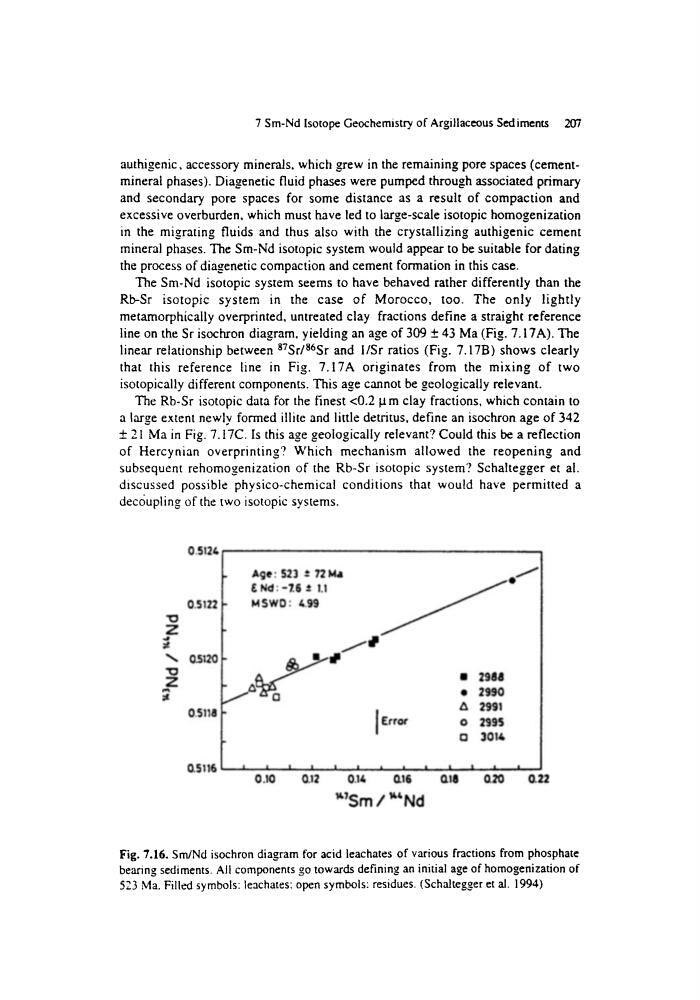
Fig. 7.16. SrrdNd isochron diagram for acid leachates of various fractions from phosphate
bearing sediments. All components go towards defining an initial age of homogenization of
523 Ma. Filled symbols: leachates: open symbols: residues. (Schaltegger et al. 1994)
authigenic, accessory minerals, which grew in the remaining pore spaces (cementmineral phases). Diagenetic fluid phases were pumped through associated primary
and secondary pore spaces for some distance as a result of compaction and
excessive overburden, which must have led to large-scale isotopic homogenization
in the migrating fluids and thus also with the crystallizing authigenic cement
mineral phases. The Sm-Nd isotopic system would appear to be suitable for dating
the process of diagenetic compaction and cement formation in this case.
The Sm-Nd isotopic system seems to have behaved rather differently than the
Rb-Sr isotopic system in the case of Morocco, too. The only lightly
metamorphically overprinted, untreated clay fractions define a straight reference
line on the Sr isochron diagram, yielding an age of 309 +_ 43 Ma (Fig. 7.17A). The
linear relationship between 87Sr/a6Sr and l/St ratios (Fig. 7.17B) shows clearly
that this reference line in Fig. 7.17A originates from the mixing of two
isotopically different components. This age cannot be geologically relevant.
The Rb-Sr isotopic data for the finest <0.2 tam clay fractions, which contain to
a large extent newly formed illite and little detritus, define an isochron age of 342
+ 21 Ma in Fig. 7. t 7C. Is this age geologically relevant? Could this be a reflection
of Hercynian overprinting? Which mechanism allowed the reopening and
subsequent rehomogenization of the Rb-Sr isotopic system? Schaltegger et al.
discussed possible physico-chemical conditions that would have permitted a
decoupling of the two isotopic systems.
"0
z
" o
z
;t
0.512~,
0.5122
0.5120
0.5118
Age: 523 "" 72Ma
s Nd: -7.6 • l.I
MSWD:
4.99
/ f
9
2988
9 2990
2991
I Error
o
2995
C] 3014
0.5116
i
,
,
,
,
,
,
,
,
I
I
,
,
0.10
0.12
0.1&
0.16
0.18
0.20
0.22
V'TSm I v'"Nd
Fig. 7.16. SrrdNd isochron diagram for acid leachates of various fractions from phosphate
bearing sediments. All components go towards defining an initial age of homogenization of
523 Ma. Filled symbols: leachates: open symbols: residues. (Schaltegger et al. 1994)