

208 Peter Stille and Graham Shields
1,1
1.0
~. 0.9
O3
0.8
0.7
0
1.1
IJO
0.9
9 2988"l Untrtatea
~3 2990.1
9 ,9881..i~ j
o 29901
o ~ ~ "
II Untreated Sampte$
309 • /.3 Ma
~i~II~
.~w:0.718 -* O.t2; MSWD - ~ 2 0
.j~'Q
Rt, s~ue~,348 .* 23Ma
~:~
$ri: 0.720_ 0009; MSWO,,,409
I
I
iO
J
__. i
|
20
60
80
"R b / "Sr
0.8
2988 "~ Untreated
2990 J
9
2988 ]
o 2990J Residues
9 |
ii @
o
!
i
0.02
0.7
I
i
i
t
=
0.0~
0.06
0.08
1.1
1 / S r
9 2988 "] _ _
o 2990 J < ~ m
R m /
, 0
O3
.
U
~
)
Age : 31.2 ~ 2t M.~
0.8
U R . O "
Sri : 0.'/15 * 0.010
O
~ll J :
Leacl~a te
s
~
HSWO -3220
0_7 |
~
~
J
~
j
J
i
0
20
~0
60
I~Rb / "St
80
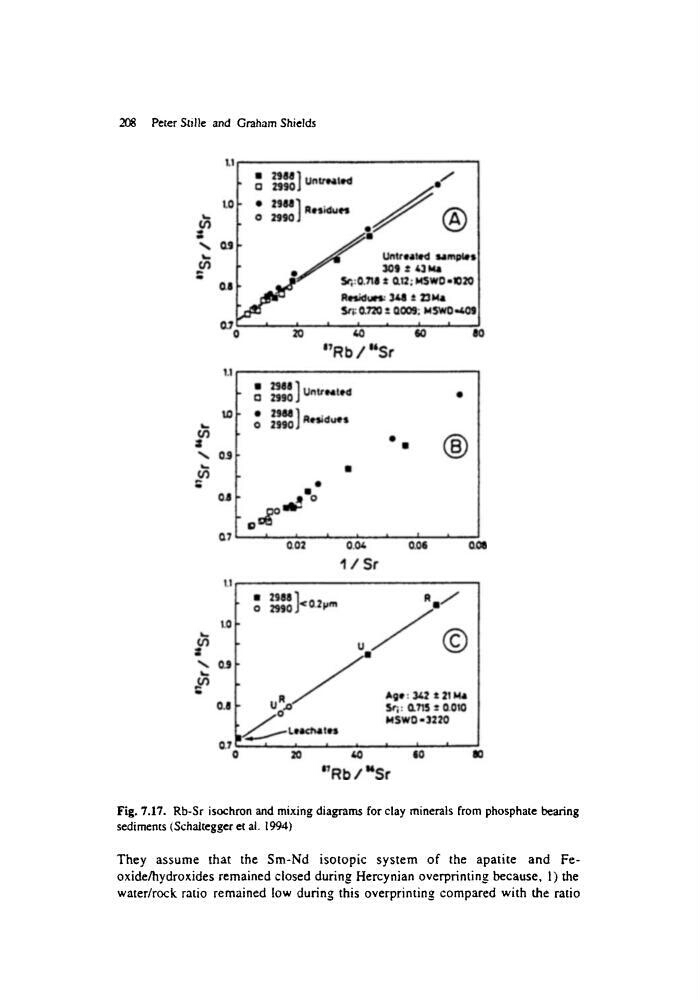
Fig. 7.17. Rb-Sr isochron and mixing diagrams for clay minerals from phosphate bearing
sediments (Schakegger et al. 1994)
They assume that the Sm-Nd isotopic system of the apatite and Feoxide/hydroxides remained closed during Hercynian overprinting because, 1) the
water/rock ratio remained low during this overprinting compared with the ratio
1,1
1.0
~. 0.9
O3
0.8
0.7
0
1.1
IJO
0.9
9 2988"l Untrtatea
~3 2990.1
9 ,9881..i~ j
o 29901
o ~ ~ "
II Untreated Sampte$
309 • /.3 Ma
~i~II~
.~w:0.718 -* O.t2; MSWD - ~ 2 0
.j~'Q
Rt, s~ue~,348 .* 23Ma
~:~
$ri: 0.720_ 0009; MSWO,,,409
I
I
iO
J
__. i
|
20
60
80
"R b / "Sr
0.8
2988 "~ Untreated
2990 J
9
2988 ]
o 2990J Residues
9 |
ii @
o
!
i
0.02
0.7
I
i
i
t
=
0.0~
0.06
0.08
1.1
1 / S r
9 2988 "] _ _
o 2990 J < ~ m
R m /
, 0
O3
.
U
~
)
Age : 31.2 ~ 2t M.~
0.8
U R . O "
Sri : 0.'/15 * 0.010
O
~ll J :
Leacl~a te
s
~
HSWO -3220
0_7 |
~
~
J
~
j
J
i
0
20
~0
60
I~Rb / "St
80
Fig. 7.17. Rb-Sr isochron and mixing diagrams for clay minerals from phosphate bearing
sediments (Schakegger et al. 1994)
They assume that the Sm-Nd isotopic system of the apatite and Feoxide/hydroxides remained closed during Hercynian overprinting because, 1) the
water/rock ratio remained low during this overprinting compared with the ratio