

206 Peter Stille and Graham Shields
(s
Z
0
tu
0
._I
t000
100
10
1000
100
10
0 <0.2 pm 2988
e. 02- 06 IJm 2988
0 0.4-tvm 2988
9 2-Tpm 2990
I
I
I
I
I
I
I
I
C] 6-20vm 2995
~
9 <04pro 301/
~ -
1
I
I
I
I
!
I
t
ka
Ce
Nd Sm
Eu
Tb
Yb
Lu
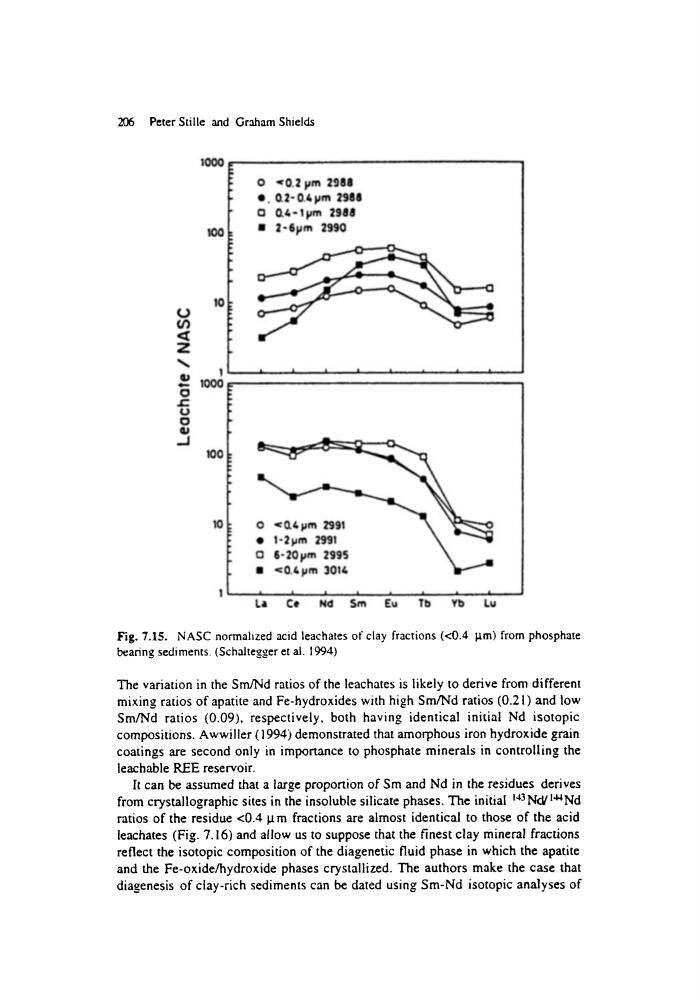
Fig. 7.15. NASC normalized acid leachates of clay fractions (<0.4 lain) from phosphate
bearing sediments. (Schahegger et al. 1994)
The variation in the Sm/Nd ratios of the leachates is likely to derive from different
mixing ratios of apatite and Fe-hydroxides with high Sm/Nd ratios (0.2 l) and low
Sm/Nd ratios (0.09), respectively, both having identical initial Nd isotopic
compositions. Awwiller (1994) demonstrated that amorphous iron hydroxide grain
coatings are second only in importance to phosphate minerals in controlling the
leachable REE reservoir.
It can be assumed that a large proportion of Sm and Nd in the residues derives
from crystallographic sites in the insoluble silicate phases. The initial 14a Nd/Za4Nd
ratios of the residue <0.4 I.tm fractions are almost identical to those of the acid
leachates (Fig. 7.16) and allow us to suppose that the finest clay mineral fractions
reflect the isotopic composition of the diagenetic fluid phase in which the apatite
and the Fe-oxide/hydroxide phases crystallized. The authors make the case that
diagenesis of clay-rich sediments can be dated using Sm-Nd isotopic analyses of
(s
Z
0
tu
0
._I
t000
100
10
1000
100
10
0 <0.2 pm 2988
e. 02- 06 IJm 2988
0 0.4-tvm 2988
9 2-Tpm 2990
I
I
I
I
I
I
I
I
C] 6-20vm 2995
~
9 <04pro 301/
~ -
1
I
I
I
I
!
I
t
ka
Ce
Nd Sm
Eu
Tb
Yb
Lu
Fig. 7.15. NASC normalized acid leachates of clay fractions (<0.4 lain) from phosphate
bearing sediments. (Schahegger et al. 1994)
The variation in the Sm/Nd ratios of the leachates is likely to derive from different
mixing ratios of apatite and Fe-hydroxides with high Sm/Nd ratios (0.2 l) and low
Sm/Nd ratios (0.09), respectively, both having identical initial Nd isotopic
compositions. Awwiller (1994) demonstrated that amorphous iron hydroxide grain
coatings are second only in importance to phosphate minerals in controlling the
leachable REE reservoir.
It can be assumed that a large proportion of Sm and Nd in the residues derives
from crystallographic sites in the insoluble silicate phases. The initial 14a Nd/Za4Nd
ratios of the residue <0.4 I.tm fractions are almost identical to those of the acid
leachates (Fig. 7.16) and allow us to suppose that the finest clay mineral fractions
reflect the isotopic composition of the diagenetic fluid phase in which the apatite
and the Fe-oxide/hydroxide phases crystallized. The authors make the case that
diagenesis of clay-rich sediments can be dated using Sm-Nd isotopic analyses of