

7 Sm-Nd Isotope Geochemistry of Argillaceous Sediments 205
reduction of hydrolized Mn and Fe oxides, and by the dissolution of phosphaterich fish bone fragments (Elderfield et al. 1981; Elderfield und Sholkovitz 1987;
Sholkovitz et al. 1989). For early diagenetic apatite to form, it is particularly
important that a sediment be rich in organic matter as almost all the dissolved
phosphorus in porewaters is likely to come from this source. Experimental data of
Van Cappellen and Berner (1991) show that authigenic phosphate has grain-sizes
between 0.I to 10 )am.
Schaltegger et al. (1994) investigated greywackes from a metamorphic profile
southwest of Casablanca (Morocco). The sample material was derived from a nonmetamorposed, diagenetic zone of anchi- and epi-zonal metamorphic facies. The
acid leachates of the clay fractions were generally rich in Ca, Mg and Fe, which
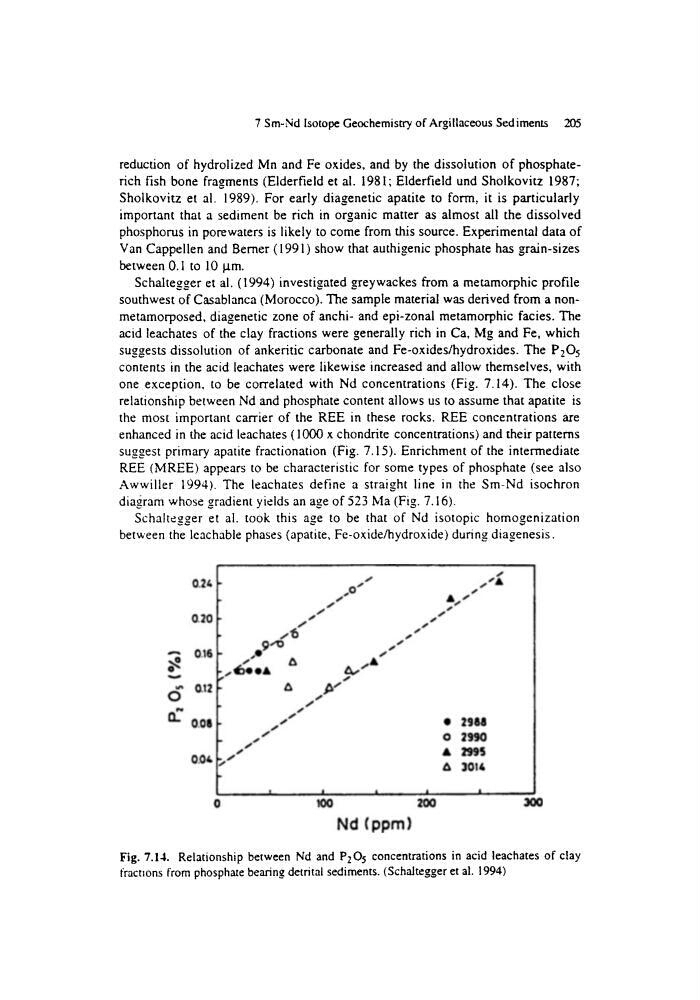
suggests dissolution of ankeritic carbonate and Fe-oxides/hydroxides. The P205
contents in the acid leachates were likewise increased and allow themselves, with
one exception, to be correlated with Nd concentrations (Fig. 7.14). The close
relationship between Nd and phosphate content allows us to assume that apatite is
the most important carrier of the REE in these rocks. REE concentrations are
enhanced in the acid leachates (1000 x chondrite concentrations) and their patterns
suggest primary apatite fractionation (Fig. 7.15). Enrichment of the intermediate
REE (MREE) appears to be characteristic for some types of phosphate (see also
Awwiller 1994). The leachates define a straight line in the Sm-Nd isochron
diag~ram whose gradient yields an age of 523 Ma (Fig. 7.16).
Schaltegger et al. took this age to be that of Nd isotopic homogenization
between the leachable phases (apatite, Fe-oxide/hydroxide) during diagenesis.
v
,ff
0.7
0.24
0.20
0.16
0.12
0.08
0.04
J
s O I
J
J
J
/
f
jJ
.o 9 ~
t
. . . . ~ o o o 9
.- d.. . / / 9
f
J
J
/
J
7
f
J
f
J
J
f
J
J
J
f
/ / , L
, I
A..-"
9 2988
O 2990
9 2995
A 301/*
;
I
I
I
o
lOO
200
300
Nd (ppm)
Fig. 7.14. Relationship between Nd and P205 concentrations in acid leachates of clay
tractzons from phosphate bearing detrital sediments. (Schaltegger et al. 1994)
reduction of hydrolized Mn and Fe oxides, and by the dissolution of phosphaterich fish bone fragments (Elderfield et al. 1981; Elderfield und Sholkovitz 1987;
Sholkovitz et al. 1989). For early diagenetic apatite to form, it is particularly
important that a sediment be rich in organic matter as almost all the dissolved
phosphorus in porewaters is likely to come from this source. Experimental data of
Van Cappellen and Berner (1991) show that authigenic phosphate has grain-sizes
between 0.I to 10 )am.
Schaltegger et al. (1994) investigated greywackes from a metamorphic profile
southwest of Casablanca (Morocco). The sample material was derived from a nonmetamorposed, diagenetic zone of anchi- and epi-zonal metamorphic facies. The
acid leachates of the clay fractions were generally rich in Ca, Mg and Fe, which
suggests dissolution of ankeritic carbonate and Fe-oxides/hydroxides. The P205
contents in the acid leachates were likewise increased and allow themselves, with
one exception, to be correlated with Nd concentrations (Fig. 7.14). The close
relationship between Nd and phosphate content allows us to assume that apatite is
the most important carrier of the REE in these rocks. REE concentrations are
enhanced in the acid leachates (1000 x chondrite concentrations) and their patterns
suggest primary apatite fractionation (Fig. 7.15). Enrichment of the intermediate
REE (MREE) appears to be characteristic for some types of phosphate (see also
Awwiller 1994). The leachates define a straight line in the Sm-Nd isochron
diag~ram whose gradient yields an age of 523 Ma (Fig. 7.16).
Schaltegger et al. took this age to be that of Nd isotopic homogenization
between the leachable phases (apatite, Fe-oxide/hydroxide) during diagenesis.
v
,ff
0.7
0.24
0.20
0.16
0.12
0.08
0.04
J
s O I
J
J
J
/
f
jJ
.o 9 ~
t
. . . . ~ o o o 9
.- d.. . / / 9
f
J
J
/
J
7
f
J
f
J
J
f
J
J
J
f
/ / , L
, I
A..-"
9 2988
O 2990
9 2995
A 301/*
;
I
I
I
o
lOO
200
300
Nd (ppm)
Fig. 7.14. Relationship between Nd and P205 concentrations in acid leachates of clay
tractzons from phosphate bearing detrital sediments. (Schaltegger et al. 1994)