

202 Peter Stille and Graham Shields
z
"0
Z
~t
0.51238
0.51234
0.51230
0.51226
R
R
0.51222
I
I
I
I
I
t
I
I
|
t
t
0.08
0.10
0.17
0.14
0.16
0.1@
0.20
'~Sm / '~Nd
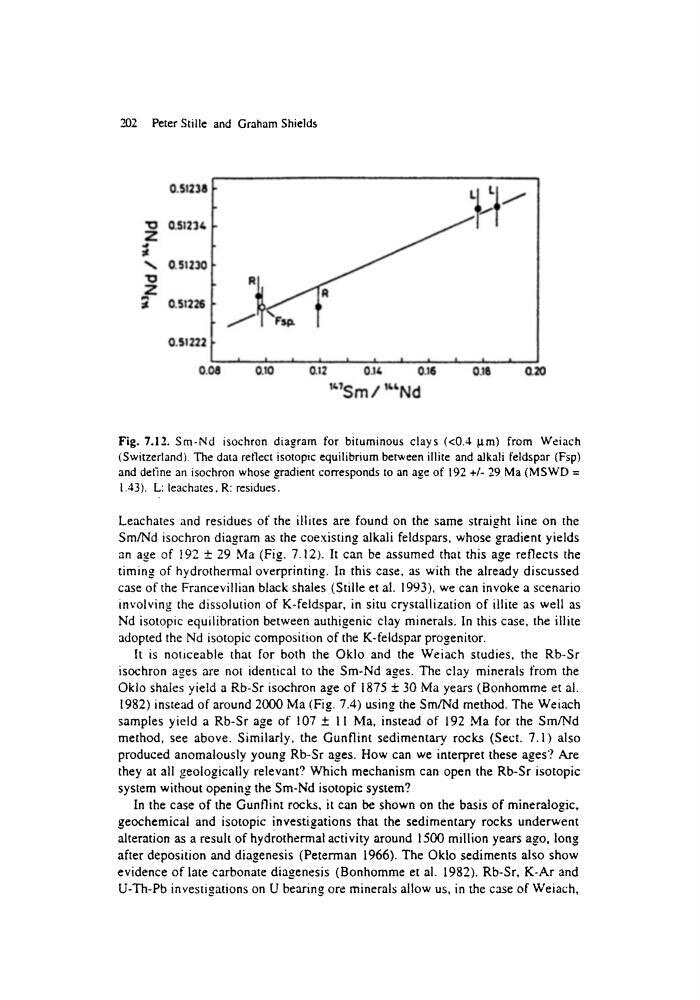
Fig. 7.12. Sm-Nd isochron diagram for bituminous clays (<0.4 pro) from Weiach
(Switzerland) The data reflect isotopic equilibrium between illite and alkali feldspar (Fsp)
and define an isochron whose gradient corresponds to an age of 192 +/- 29 Ma (MSWD =
1.43). L: leachates. R: residues.
Leachates and residues of the illites are found on the same straight line on the
Sm/Nd isochron diagram as the coexisting alkali feldspars, whose gradient yields
an age of t92 + 29 Ma (Fig. 7.12). It can be assumed that this age reflects the
timing of hydrothermal overprinting. In this case, as with the already discussed
case of the Francevillian black shales (Stille et al. 1993), we can invoke a scenario
involving the dissolution of K-feldspar, in situ crystallization of illite as well as
Nd isotopic equilibration between authigenic clay minerals. In this case, the illite
adopted the Nd isotopic composition of the K-feldspar progenitor.
It is noticeable that for both the Oklo and the Weiach studies, the Rb-Sr
isochron ages are not identical to the Sm-Nd ages. The clay minerals from the
Oklo shales yield a Rb-Sr isochron age of 1875 _+ 30 Ma years (Bonhomme et al.
1982) instead of around 2000 Ma (Fig. 7.4) using the Sm/Nd method. The Weiach
samples yield a Rb-Sr age of 107 + 11 Ma, instead of 192 Ma for the Sm/Nd
method, see above. Similarly, the Gunflint sedimentary, rocks (Sect. 7.1) also
produced anomalously young Rb-Sr ages. How can we interpret these ages? Are
they at all geologically relevant? Which mechanism can open the Rb-Sr isotopic
system without opening the Sm-Nd isotopic system?
In the case of the Gunflint rocks, it can be shown on the basis of mineralogic,
geochemical and isotopic investigations that the sedimentary rocks underwent
alteration as a result of hydrothermal activity around 1500 million years ago, long
after deposition and diagenesis (Peterman 1966). The Oklo sediments also show
evidence of late carbonate diagenesis (Bonhomme et al. 1982). Rb-Sr, K-Ar and
U-Th-Pb investigations on U bearing ore minerals allow us, in the case of Weiach,
z
"0
Z
~t
0.51238
0.51234
0.51230
0.51226
R
R
0.51222
I
I
I
I
I
t
I
I
|
t
t
0.08
0.10
0.17
0.14
0.16
0.1@
0.20
'~Sm / '~Nd
Fig. 7.12. Sm-Nd isochron diagram for bituminous clays (<0.4 pro) from Weiach
(Switzerland) The data reflect isotopic equilibrium between illite and alkali feldspar (Fsp)
and define an isochron whose gradient corresponds to an age of 192 +/- 29 Ma (MSWD =
1.43). L: leachates. R: residues.
Leachates and residues of the illites are found on the same straight line on the
Sm/Nd isochron diagram as the coexisting alkali feldspars, whose gradient yields
an age of t92 + 29 Ma (Fig. 7.12). It can be assumed that this age reflects the
timing of hydrothermal overprinting. In this case, as with the already discussed
case of the Francevillian black shales (Stille et al. 1993), we can invoke a scenario
involving the dissolution of K-feldspar, in situ crystallization of illite as well as
Nd isotopic equilibration between authigenic clay minerals. In this case, the illite
adopted the Nd isotopic composition of the K-feldspar progenitor.
It is noticeable that for both the Oklo and the Weiach studies, the Rb-Sr
isochron ages are not identical to the Sm-Nd ages. The clay minerals from the
Oklo shales yield a Rb-Sr isochron age of 1875 _+ 30 Ma years (Bonhomme et al.
1982) instead of around 2000 Ma (Fig. 7.4) using the Sm/Nd method. The Weiach
samples yield a Rb-Sr age of 107 + 11 Ma, instead of 192 Ma for the Sm/Nd
method, see above. Similarly, the Gunflint sedimentary, rocks (Sect. 7.1) also
produced anomalously young Rb-Sr ages. How can we interpret these ages? Are
they at all geologically relevant? Which mechanism can open the Rb-Sr isotopic
system without opening the Sm-Nd isotopic system?
In the case of the Gunflint rocks, it can be shown on the basis of mineralogic,
geochemical and isotopic investigations that the sedimentary rocks underwent
alteration as a result of hydrothermal activity around 1500 million years ago, long
after deposition and diagenesis (Peterman 1966). The Oklo sediments also show
evidence of late carbonate diagenesis (Bonhomme et al. 1982). Rb-Sr, K-Ar and
U-Th-Pb investigations on U bearing ore minerals allow us, in the case of Weiach,